Chapter 18, The Mysterious Letters Present a Puzzle to Mankind, argues that, under a methodology that counts the letters of the Uthmanic archetype as the tradition identifies them — the best approximation to the source that the history of the text affords — five of the seventeen pre-registered muqaṭṭaʿāt cases of the Code 19 system reproduce as multiples of 19 — four on every witness and one as recited — and three are pending, two on the spelling of the yāʾ, where they hold on the treatises and wait on the manuscripts, and one on a spelling of nūn no witness shows; six of the eight coming to the same total under every counting convention anyone has proposed, and that the nine remaining cases all turn on the alif, the one letter whose inventory in the archetype is not yet established. The chapter’s prose was kept brief on technical detail to preserve the argumentative arc. This appendix supplies the apparatus the chapter abbreviates: the historical chronology of the textual layers with sources, the per-letter counting rules in full, the definition of the primary convention and the full sensitivity grid, the variant-readings adjudication with manuscript references, the per-case pipeline and Khalifa-historical totals side by side, the binomial-null probability calculation at three scopes, and the source literature consulted.
The appendix is written for the reader who wants to verify the chapter’s claims independently. None of what follows is required to follow the chapter’s argument. All of it is required to test the chapter’s argument.
Preface — The Method as the Chapter Argues It
This preface holds the chapter’s own statement of its method, in full and in the order the chapter made it: the five layers between the recitation and the printed page; why the recitation must be treated as the source and the skeleton as its nearest approximation; the standing of that ranking in current scholarship, with the dissenting views named; the primary convention and the sensitivity grid; the status of the rules, written after the first counts and admitted as such; and the chapter’s standing in the peer-reviewed literature. The chapter carries a summary of each and points here. The sections that follow this preface document the same material as data.
The Five Layers
The Qur’anic text we have today is a stack of five distinct historical artifacts laid down over six centuries. Naming them in order is not pedantic; it is the methodology. The numbering starts at zero on purpose. Layers 1 through 4 are records — things that survive and can be examined. Layer 0 is what they are records of, and it does not survive.
Layer 0 is the source — what Muhammad recited between 610 and 632 CE. It existed during this period as oral utterance: heard by companions, memorized, transcribed piecemeal on whatever materials were at hand. The transcriptions were aids for memorizers, not substitutes for the recitation. In this chapter Layer 0 is treated as undefined: not unknown in principle, but not directly observable by anyone now living. No recording of it exists, and no single surviving artifact is it. What exists are approximations to it — the bare rasm, the earliest manuscripts, the oral chains, the dotted and vocalised copies — each of which captures part of it and adds something of its own. The chapter counts against those approximations and treats agreement among them as the best available evidence of what Layer 0 contained. The definition is provisional in the right way: further manuscript discoveries, radiocarbon work, and comparative study of the reading traditions can narrow the approximations and make Layer 0 more certain than it is today. Zero marks the point the other layers are measured from, and the point that current evidence can approach but not yet reach. Which approximation comes closest is not a matter of taste. The history of the text ranks them, and the sections that follow say how.
Layer 1 is the bare rasm — the consonantal skeleton of the Uthmanic codex, gathered around 650 CE under the third caliph Uthman by Zayd ibn Thabit. The rasm contained no dots distinguishing letters that share a shape, no vowel marks, no marks for the glottal stop. To read it, one had to already know how to recite it.
Layer 2 is the systematisation of the marking systems, and it needs to be described more carefully than the received account allows, because two different things are usually run together. Consonant-distinguishing dots — iʿjām, the points that separate b from t from th from n — were not invented in the late seventh century. They are attested in Arabic script from the third and fourth centuries CE, in the papyrus of 22 AH and the inscription of 24 AH, and, as Adam Bursi has shown, in Ḥijāzī Qur’anic manuscripts of the first century itself, where they appear sporadically rather than systematically. What belongs to the late seventh and eighth centuries is not the invention of the dots but their regularisation, together with the genuinely later apparatus of vowel marking: Abū al-Aswad al-Duʾalī’s coloured points for the short vowels, and al-Khalīl ibn Aḥmad al-Farāhīdī’s design, in the eighth century, of the marks a modern reader knows, which displaced the points in Qur’an copies only gradually. It is at this layer that ه and ة were separated in writing, that ي and ى were distinguished, and that the hamza was marked.
Layer 3 is the system of vowel marks and recitational aids that accumulated from the late seventh through the eleventh century: the fatha, kasra, damma, shadda, sukūn, wasla, maddah, and small superscript letters including the small yā’ marks (ۦ and ۧ) and the dagger alif (ٰ). These are pronunciation aids added to capture features of the recitation the bare rasm could not represent. The maddah specifically — the mark above muqaṭṭaʿāt letters telling the reciter to pronounce them as full letter names with prolongation — was first explicitly described as a grammatical phenomenon only in the late tenth century, roughly four hundred years after the source.
Layer 4 is the modern standardized editions: the 1924 Cairo edition, the 1985 King Fahd Madinah Mushaf, and the digital corpora descended from them. This is the most recent layer and the layer against which the contemporary critic of Code 19 implicitly insists the count be performed. It is also the layer most heavily mediated by editorial work.
Six centuries of editorial decisions, made by named humans at known dates, layered on top of one another. Every layer was an attempt to capture more of the recitation in writing. None of them changed the recitation by changing the page. The recitation has been transmitted in parallel, through the chain of qirāʾa — but it is not therefore immune to change of its own kind. A variant arising in a minority of transmissions can become dominant when a later editorial selection prunes the alternatives, as the imāla in an-nāsi became standard in al-Dūrī ʿan Abī ʿAmr. Al-Shāṭibī, versifying al-Dānī’s Taysīr, kept only al-Dānī’s recitation (tilāwa) chain, and that chain ran through Abū Ṭāhir (d. 349/960), who, on van Putten’s reading, had taken the imāla over from other students of al-Yazīdī’s circle into al-Dūrī’s transmission, possibly by mistake (van Putten, X thread, 22 July 2024, citing Nasser on al-Shāṭibī’s isnāds). The oral channel has its own mutation and its own selection events, and the chapter’s sensitivity tests on Ṣād and on Qunbul exist because of it. The source is below all of them. Full chronology, named scholars, and source literature for each layer are in Appendix D, Section I.
The principle this chapter operates under can be stated in a single sentence. The goal of the methodology is to remove as much post-hoc editorial accretion as possible and to perform the count against the lowest accessible layer of the text. The lower the layer, the closer to what the Qur’an actually was when it set the puzzle. The higher the layer, the more human editorial work has been imposed between the source and the count.
This principle, once stated, sorts the existing literature on Code 19 with clarity. Much of the rejecting literature — Philips’s rebuttal, the academic-tradition Sunni responses, and the popular polemical material — counts against Layer 4 (the modern standardized printed editions) or against Layer 3 (the fully-pointed text with all the vowel marks and recitational aids in place). They take the most heavily edited form of the text — the form in which the most centuries of human work have been deposited on top of the source — and they perform the count against it, then conclude that the count fails. Where that happens it is a real defect: the claim is tested against the artifact furthest from the source, with the most layers of human editorial mediation between the count and the thing the Qur’an placed in the world. But the charge should be made at its true size. The modern editions are a good approximation to the archetype in most respects and drift from it chiefly in the writing of the alif — which is precisely where the counts fail — so counting at Layer 4 is an imprecision, not an absurdity. Two qualifications are owed to the two names most often listed among the critics. Ziauddin Sardar performed no letter count at all: his objection is to the project of proving scripture by calculation, and it is answered in this chapter’s closing section rather than by any convention. And the Shahid Beheshti review counted the Uthmanic script rather than its pronunciation, and found the arithmetic largely sound; its objection is selection, not layer.
The Man Who Recited: Why Layer 0 Must Be Source
Muhammad was ummī: in this book’s sense, from a people without a scripture, one who had not received, read, or been taught a revealed Book (Chapter 2 gives the definition and its grounds). The argument here does not depend on whether he could read or write. What matters is the mode of delivery, and on that the sources do not divide: what Muhammad produced was recitation. The Qur’an denies that he recited or wrote any scripture before this one (), and it names itself from the root of reciting — al-Qur’ān, the Recitation.
The first revelation, when it came to Muhammad in the cave of Hira around 610 CE, was a command. Iqra’. “Read.” The recorded response is preserved in the sīrah literature with unusual consistency: Mā ana bi-qāriʾ. “I cannot read.” The angel embraced him until he could not bear it and repeated the command. Even on the third pass the command was not “write.” It was “recite”: Iqra’ bismi rabbika alladhī khalaq — “Recite in the name of your Lord who created.”
A book whose first command is Read — delivered to a man who has just confessed I cannot read — and whose first reciter responds by saying he does not know how, is a book that begins, irreducibly, in tension with the written form. The book had to begin as speech.
The transcription of the Qur’an from speech into writing was piecemeal during Muhammad’s lifetime. The full text existed during this period only in memory and in scattered fragments. The first compilation happened after Muhammad’s death; the standardization under Uthman, twenty years later, was the formal codification. But the standardization was always subordinate to the recitation. The reciters of Muhammad’s generation taught the next; that generation taught the generation after; and the Islamic tradition has maintained this chain of recitational transmission — qirā’a — through documented teacher-to-student transmission across fourteen centuries. There are men and women alive today, in thousands of cities across the Muslim world, who have memorized the entire Qur’an in continuity with this chain. The practice is called ḥifẓ; the memorizer is called a ḥāfiẓ; no census of living ḥuffāẓ exists.
This is why the methodology of this chapter is possible. The source is not available as a recording, and the chapter does not claim to hold it; but it is not a vanished artifact to be guessed at from fragments either. It survives as a continuously practiced performance running alongside the written record, and the two together — the rasm and the recitation, checked against each other and against the earliest manuscripts — are the closest approximation to Layer 0 that any ancient text affords.
One objection must be confronted before proceeding. The fact that the recitation came from an unschooled man does not, by itself, foreclose the possibility that the muqaṭṭaʿāt pattern was engineered by literate companions during the decades of compilation that followed his death. Zayd ibn Thabit was literate. Several senior companions were literate. The patterns could in principle have been put into the written text during the compilation period rather than originating in Muhammad’s recitation.
The chapter does not pretend this alternative can be eliminated. What can be said about it is the following. The variant-readings tradition raises a specific difficulty for the engineering hypothesis that is worth stating precisely. The seven canonical qirā’āt preserve dozens of small disagreements among themselves, but the great majority of these are phonetic-vocalic differences — different pronunciations of vowels, different placements of pauses, alternative readings of word-internal phonology. They are not, with rare exceptions, differences in the consonantal skeleton itself.
The two places where the chapter’s count meets a consonantal difference — the sīn recited at where the archetype writes ṣād, and the spelled-out نون asserted at where every codex writes a single ن — are, respectively, a split between the written and the recited consonant and a spelling no witness shows. They are precisely the kind of differences a coordinated engineering committee would have had to suppress in order to produce a single agreed text. A committee engineering a 19-based pattern into the rasm during the compilation period would have needed every contested word to take the form the engineering required; the historical record produces the opposite, with the written and recited traditions preserved side by side through named transmitters and early codices. The pattern in the count survives across these differences only because the underlying recitation carries it; if the pattern had been engineered into a single chosen written form during compilation, the differences would have broken it.
The compilation-engineering hypothesis is therefore not impossible, but it has to contend with this specific pattern in the manuscript record: phonetic-vocalic variants are abundant (as one would expect from oral transmission), while rasm-level variants are rare (as one would expect from a consonantal text transmitted across generations) — and the rasm-level variants that touch a counted letter are few, and are listed in Section II.d with their witnesses. This is what the variant-readings record actually shows. The chapter’s position is that the pattern is unlikely under any plausible seventh-century process — most strongly under direct authorship by an unschooled reciter, but also under literate compilation by his companions, who would have had to produce a single rasm-coordinated text and instead produced a text whose few rasm-level variants happen to be exactly the variants the divisibility pattern picks out.
The Methodology and Its Standing
Before stating the rules, the chapter must make a distinction the audit work has forced into the open: the difference between what Layer 0 is and what our access to Layer 0 is. The first is an ontological commitment about the source. The second is an epistemic claim about our measurement tools.
Layer 0 — what Muhammad uttered — is the source. That is an ontological commitment. The original recitation occurred as a real historical event. It was the source of everything written down later, and it is the layer at which the Qur’an at placed the sign. Nothing about the audit work below changes this.
Our access to Layer 0 is partial. That is an epistemic limit. The recitation is preserved through qirā’a and through the written text that successive scholars aligned with it. Neither is Layer 0 itself; both are approximations. But partial access is not unranked access. The approximations differ in age, in what they add, and in how far each can be traced, and the history of the text is precise about all three: every layer above the Uthmanic rasm was added by named people at known dates. That precision is what allows the chapter to say which approximation is the best one humanly achievable, rather than treating every way of counting as equally entitled to a vote.
The best approximation can be stated from the history of the text rather than from any count, and it rests on findings of recent scholarship that owe nothing to the number nineteen. First, the manuscript evidence shows that every regional codex descends from a single written Uthmanic archetype, copied within roughly two decades of the Prophet’s death: the early codices share orthographic idiosyncrasies that no other account explains as well — the same word spelled the same unpredictable way in the same position across fourteen early manuscripts, a correlation van Putten calls extremely strong and holds cannot be attributable to chance, with its handful of exception sites named and, where the page allows, traced to later hands (van Putten 2019). Second, that archetype predates every canonical reader by a century or more, and the readers read what it permitted — “the rasm is not a reading,” in van Putten’s formulation (laysa r-rasmu bi-qirāʾah, the title of his post of 11 December 2023); the reading traditions are later phonetic realisations constrained by the skeleton, not sources of it. Third, the archetype was written in the Arabic of the Ḥijāz, in which the glottal stop had been lost: where a later Classical reader pronounces a hamza, the scribes wrote — because they said — a glide or nothing, so that the tooth under a modern ئ is a yāʾ that was uttered as well as written, and the hamza sign above it is a mark added generations later to record a different pronunciation (van Putten 2022). Fourth, the consonantal dots that distinguish letters of one shape are contemporary with the skeleton, attested in first-century Qur’anic manuscripts in the scribe’s own ink, while the vowel signs, the hamza sign, the small letters and the madda are the later apparatus (Bursi; Appendix D, Section I).
From those four findings the ranking follows, and it is not a judgment call. Nothing later than the archetype can be the source, because history records who added everything later and when; there is no argument available that the eighth-century vowel points or the tenth-century madda or the hamza sign are what was uttered in 610–632, and no one makes one. The best approximation to Layer 0 that can be humanly achieved is therefore the Uthmanic rasm itself, with its letters identified as the unanimous tradition identifies them — by the dots and by the recitation, two routes that Appendix D shows to agree at every position the chapter counts — and with nothing added after the archetype given authority over what the skeleton writes. That is the chapter’s primary convention, and it is the convention against which every count in this chapter is now reported. It is written out as T8 in Appendix D, Section II.
The other ways of counting are not discarded; they are demoted to what they always were. The chapter still computes every case under ten conventions — every combination of the decisions a counter could make about the waṣla alif, the dagger alif, the doubled consonant and the hamza chair — and reports the full grid. But the grid is a sensitivity analysis, not the test. A result that holds under the primary convention and also under every other convention is a result that no counting choice can touch, and the chapter marks those cases as convention-invariant. A result that holds under the primary convention and fails under a convention that gives a later mark authority over the skeleton is a result about the skeleton, and the convention that breaks it is the one that has left Layer 0. The chapter is explicit about which cases fall where.
The methodology has a single overriding principle that anchors all this. The count should approximate what constitutes source — what was uttered, and what the earliest written record of the utterance preserves — not what successive scribes over multiple generations added to the page. The specific rules — eight in total, enumerated in Appendix D, Section II — apply this principle to the places where the modern editorial text and the archetype diverge. The headline rules: count each letter of the rasm as the tradition identifies it; count the tāʾ marbūṭa (ة) as the hāʾ it is in the rasm, for hāʾ-bearing surahs; count the yāʾ of the rasm — the written chairs ي and ى, including the chair under a later hamza sign — and not the small yāʾ marks added centuries afterward; exclude the dagger alif (ٰ); include the bismillah for every surah; apply every rule uniformly across every occurrence; and escalate to Layer 1 manuscript evidence where the written witnesses disagree.
The Primary Convention, and the Sensitivity Grid
Because access to Layer 0 is through an approximation rather than a recording, the chapter does two things rather than one. It reports every count under the primary convention — the best approximation the history of the text affords — and it reports the same count under nine alternative conventions, so that a reader can see which results depend on a counting decision and which do not. The conventions vary on whether the waṣla alif counts, whether the dagger alif counts as an additional event, whether a shadda-marked consonant counts as one letter or two, whether the chair beneath a hamza sign is counted as the letter the skeleton writes, and whether the diacritics are stripped before counting; Khalifa’s own published rule set and an exploratory pronunciation rule are run alongside them. Every convention was applied to the Tanzil Uthmani XML corpus and cross-checked against the King Fahd text and, for the eight cases below, against the Corpus Coranicum Cairo text. Full convention table and per-case results: Appendix D, Section II.
The discussion that follows in this section — variant-reading adjudication, uniform rule application, protocol-driven execution, peer-review standing, and the probability calculation — remains the chapter’s best available account of its methodology. It applies most cleanly to the cases that hold. For the nine alif cases the discussion still applies, but the chapter does not claim verification for them at this writing, because the letter they turn on cannot yet be counted at the layer the methodology requires.
Acknowledgments about the rules’ status
Clarity about the rules’ status is required, because Appendix D’s full enumeration of rules makes a question visible that the chapter body alone could leave implicit. Were these rules fixed before the counts that confirm them were inspected? In the strictest scientific sense — pre-registered in advance, then applied blindly to the data, with no opportunity for retroactive adjustment — the honest answer is no. Khalifa’s original work was iterative; he found patterns and articulated rules to capture them. The consistency-enforced methodology this chapter articulates was developed later. The chapter is not pre-registered in the form a clinical trial is. But the chapter’s premise changes what that admission means. The text announced a puzzle, and a puzzle is worked the way a jigsaw is worked: a partial pattern is seen, the way the pieces are meant to go is inferred from it, the next piece is tried, and what fits is kept. Every refinement in this chapter was placed that way — the tāʾ marbūṭa counted as the hāʾ it is in the rasm, the chair beneath a later hamza read as the yāʾ it is, the count moved to the archetype, the sign chapters grouped by their letters — and for a pre-registered puzzle that is not a flaw in the method; it is the method the text asked for. What keeps it honest is the same thing that makes a jigsaw a jigsaw: a piece has to fit for a reason visible on the piece, not because the solver wanted it in that hole. The standard every rule had to meet was fixed, even where the rule was not: a justification from the script, the recitation, or the text itself, stated independently of the number it produces. Appendix D gives that justification for each rule, and a reader can check it piece by piece. And the puzzle has to be able to stay unsolved in places — as it does at Ṣād-38, at Ṭā-Hā, and across the alif.
What can be said: the rules, once articulated, have three structural properties that distinguish the methodology from pure iterative fitting. (a) Each rule is derivable from a single underlying principle — counting against the lowest accessible layer — rather than from any specific outcome it produces in any specific case. (b) The rules apply uniformly across the entire 6,236-verse text, not selectively to the pre-registered cases. (c) The methodology is sufficiently specified that an independent investigator can implement the rules and verify the counts against any reasonable Qur’anic corpus. One rule has a history of its own that belongs here: the treatment of the hamza chair as the yāʾ of the rasm was recognised at Yā-Sīn before its principle was drawn from the history of the script, and the chapter records that ordering in the section above rather than leaving it to be discovered. None of this makes the procedure a pre-registration in the methodological sense, and the literature that names these failures names them precisely: Kerr’s HARKing, hypothesising after the results are known (1998, 196); Gelman and Loken’s garden of forking paths (2014, 460); Nosek and colleagues’ observation that “mistaking generation of postdictions with testing of predictions reduces the credibility of research findings” (Nosek et al. 2018, 2600). Section V.E of this chapter is an attempt to measure that exact quantity rather than to plead against it. The truly clean version of pre-registration — fix the rules, hand them to an independent investigator who has never seen the counts, have the investigator perform the calculation blind — has not been performed. It is the cleanest possible next step, and the chapter recommends it.
One further clarification about execution. The rules in their final form were articulated retrospectively, but once articulated they were applied in a single batch — the same eight rules, the same Tanzil corpus, the same Python implementation, computed across all seventeen pre-registered cases at once. There was no per-case adjustment: no rule modified for a single surah after seeing its count, no exception inserted to recover a specific number, no case added to the pre-registered set after the fact. The retrospective articulation and the uniform batch execution are two different stages, and the honesty of the first does not erase the discipline of the second.
Academic standing
A note on the standing of this methodology in academic Qur’anic studies. No peer-reviewed academic paper, to the best of the author’s knowledge, has yet attempted a Layer-0 pronunciation-based count of the muqaṭṭaʿāt with the consistency enforcement this methodology requires and against the multi-convention robustness test described above. The peer-reviewed work that exists has either confirmed Khalifa-style numerical totals without engaging the orthography-versus-pronunciation question (Sayoud 2013, 11, in Quranica, University of Malaya, which replicated K-H-Y-A-S = 798 and Ḥā-Mīm = 2147 — both of which this edition reproduces under its primary convention, the first on the treatise spelling of the yāʾ and pending on the manuscripts) or has evaluated the claims as a set and located their failure in selection rather than in arithmetic. The Shahid Beheshti University Interdisciplinary Qur’anic Studies review tested all fifty-two of Khalifa’s 1982 claims and concluded that “the majority of the claims did not have issues with numerical accuracy” (Moradi and Alizadeh Baygi 2023, 30–31); its objection, in twenty-seven of the fifty-two, is that “those with a total occurrence that is a multiple of 19 are presented, while others that do not have this feature are not mentioned” (27). That is the selection problem — and it is the same defect Section V.E of this chapter measures, on its own historical list, and confirms. The frequently quoted charge that Khalifa “would sometimes treat hamzahs like alifs and sometimes he wouldn’t, depending on the totals he needed” is not from that review but from Bilal Philips (“The Claim of the Numerical Miracle of the Quran,” IslamHouse, 3), and is cited here to him. Three further pieces of peer-reviewed work bear on the subject and are named so that the survey is not read as complete at two: Sidrak (2016, in the same journal as Sayoud) on the dependence of any numerical claim on the historicity of the text; Khan (2010, Anthropological Theory) on Khalifa’s project as an attempt to address the doubt that accompanies written texts; and Daneshgar (2023, Zygon) on the scientific-miracle genre this chapter will be filed under whether it wishes to be or not. Neither camp has tested the methodology this chapter articulates. The chapter welcomes academic engagement on its own terms.
I. The Five Layers — Historical Chronology with Sources
Chapter 18 operates on the premise that the Qur’anic text exists in five distinct historical forms, each laid down at known dates by named scholars. The forms are not equivalent; each adds something the previous did not contain. The chapter’s methodology counts at the lowest layer that contains the information required for each question.
Layer 0 — The Utterance (ca. 610–632 CE)
The recitation of Muhammad during the twenty-three years of revelation. This is the source. It existed during the Prophet’s lifetime as oral utterance heard by companions, memorized by them, and transcribed piecemeal on parchment, palm fronds, the shoulder blades of camels, and smooth stones. The piecemeal transcriptions were aids for memorizers, not substitutes for the recitation. The Qur’an describes Muhammad as ummī and denies that he recited or wrote any scripture before this one (, ); the sīrah literature preserves the cave-of-Hira moment in which the angel commanded Iqra’ (“Read”) and Muhammad responded Mā ana bi-qāriʾ (“I cannot read”).
The recitation tradition continued after the Prophet’s death through the qurrā’ (memorizing reciters) who taught the next generation, who taught the next. The Islamic tradition has maintained this chain — qirā’a — through documented teacher-to-student transmission across fourteen centuries. The science of ḥifẓ (memorizing the entire Qur’an) has been continuously practiced since the seventh century. The seven canonical readings (qirā’āt) are themselves the product of careful preservation of variants that go back to specific named transmitters from the generation of Muhammad’s companions and their immediate students.
Source literature: Nöldeke, Geschichte des Qorāns (3 vols., 1909–1938, English translation Brill 2013); Schoeler, The Genesis of Literature in Islam (Edinburgh, 2009); Sinai, The Qur’an: A Historical-Critical Introduction (Edinburgh, 2017); and the classical ʿulūm al-Qur’ān tradition: al-Zarkashī, al-Burhān fī ʿUlūm al-Qur’ān; al-Suyūṭī, al-Itqān fī ʿUlūm al-Qur’ān.
Layer 1 — The Bare Rasm (ca. 650 CE)
The first standardized written form. Around 650 CE, eighteen years after Muhammad’s death, the third caliph Uthman commissioned the standardization of the written text. Zayd ibn Thabit, who had served as one of Muhammad’s scribes and was himself a memorizer, gathered the existing fragments and produced a single bound codex. Uthman sent copies of this codex to the principal cities of the expanding Muslim world and ordered competing manuscript traditions destroyed.
The Uthmanic codex was the consonantal skeleton — letters written without dots distinguishing letters that share a shape, without vowel marks, without indication of doubled consonants, without signs for the glottal stop, without any of the marks a modern reader would recognize as essential to actually reading Arabic. Words that look different in your modern Mushaf were written with identical letterforms in the rasm. The reader was expected to already know the recitation; the rasm was a mnemonic aid for someone who had memorized.
Surviving Hijazi-script manuscripts from the late seventh and early eighth centuries — including the Ṣanʿāʾ palimpsest, the Tashkent (Samarkand) Codex, the Topkapı Mushaf, and the Birmingham folios — preserve the rasm tradition. Radiocarbon dating places the lower layer of the Ṣanʿāʾ palimpsest in the early-to-mid seventh century, possibly within Muhammad’s own lifetime. The variants among these early manuscripts (notably the spelling of basṭatan in ) are themselves part of what the rasm tradition preserves.
Source literature: Sadeghi & Goudarzi, “Ṣanʿāʾ 1 and the Origins of the Qur’ān,” Der Islam 87 (2012); Déroche, Qur’ans of the Umayyads (Brill, 2014); Brubaker, Corrections in Early Qur’ān Manuscripts (Think & Tell, 2019).
Layer 2 — The Dotting System (late 7th–8th century)
The regularisation of the marking systems, and the introduction of the ones that were genuinely new. A distinction has to be drawn here that the traditional account blurs. Consonant-distinguishing points (iʿjām) are old: they appear in the Raqūsh inscription of 267 CE, in fourth-century material at Jabal Ramm, in the papyrus of 22 AH and in the inscription of Zuhayr of 24 AH, which al-Ghabban and Hoyland report as showing “evidence of a fully-fledged system of diacritical marks”, and in first-century Ḥijāzī Qur’anic manuscripts themselves. Adam Bursi’s study of these manuscripts found the dots present but sporadic — on one folio carrying , eight dotted letters where the modern text has two hundred and forty — and distributed, to a modern eye, oddly: not preferentially at the places where a reader might actually be in doubt. The plate reproduced below shows the situation directly. In an early Ḥijāzī codex the consonantal points are written in the same brown ink and by the same pen as the letters themselves, while the vowel marking sits on the page in a visibly different red ink, added later. The vowel system is the genuinely later development: the grammarian Abū al-Aswad al-Duʾalī (d. 688) is credited with the coloured points marking short vowels, and al-Khalīl ibn Aḥmad al-Farāhīdī (d. 786 or 791; the sources differ) devised the marks in use today, though copyists of the Qur’an went on using the coloured points long after.
Two Ink Systems on One Page
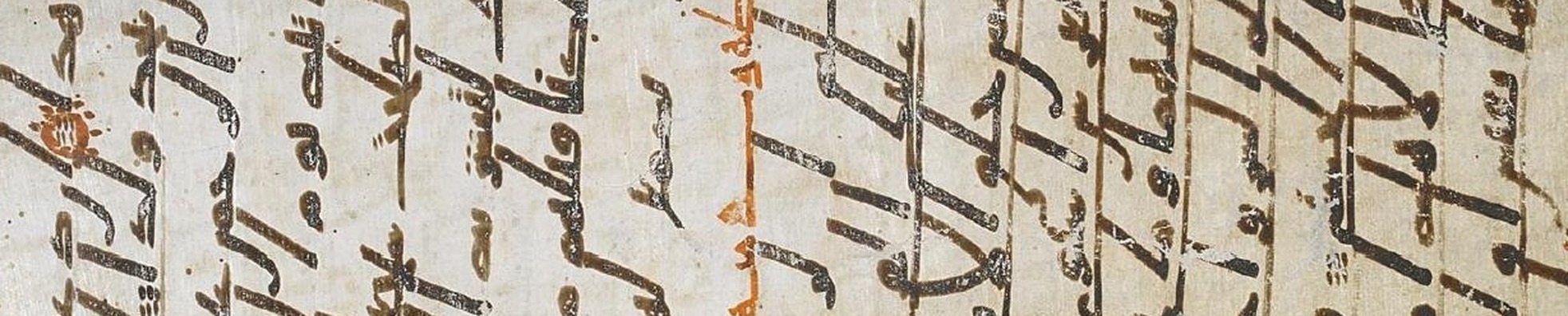
Critically for Chapter 18’s argument, Layer 2 is where the distinctions between several letters that share rasm-period shapes were introduced into writing. Before Layer 2:
ب, ت, and ث were written as the same shape.
ج, ح, and خ were written as the same shape.
د and ذ were written as the same shape.
ر and ز were written as the same shape.
س and ش were written as the same shape.
ص and ض were written as the same shape.
ط and ظ were written as the same shape.
ع and غ were written as the same shape.
ف and ق were written as the same shape.
ن and ي in non-final positions were written as the same shape.
And — most consequentially for the chapter’s count — ه and ة were written as the same shape. The character we now call “tā’ marbūṭa” (ة) was disambiguated from “regular hā’” (ه) only when the Layer-2 dotting system invented the distinction.
The hamza mark (representing the glottal stop) was also introduced at Layer 2. The early Hijazi rasm — written in the dialect of the Quraish — did not mark glottal stops; the glottal stops themselves were uttered from the source, but the consonantal text did not represent them.
Source literature: Versteegh, The Arabic Language (Edinburgh, 2nd ed. 2014); van Putten, Quranic Arabic: From its Hijazi Origins to its Classical Reading Traditions (Brill, 2022).
Layer 3 — Vowel Marks and Recitational Aids (late 7th–11th century)
The system of supra- and subscript marks that encode pronunciation features the bare rasm cannot capture. From the late seventh through the eleventh century, additional marks accumulated:
The fatḥa, kasra, and ḍamma for short vowels.
The shadda for doubled consonants.
The sukūn for the absence of a vowel.
The waṣla for elided alifs.
The maddah for prolongation. The maddah specifically — the small wavy mark placed above muqaṭṭaʿāt letters to signal that the letter is to be recited as its full letter name with the obligatory six-count mudd lāzim prolongation — was first explicitly described as a grammatical phenomenon by Ibn Jinnī (d. 1002) in al-Khaṣā’iṣ. Earlier manuscripts do not show consistent use of the mark; van Putten (2021) traces its emergence as a formal orthoepic device through the late tenth and eleventh centuries.
The small superscript letters: the dagger alif (ٰ, U+0670) marking a long ā vowel not written in the consonantal text; the small yā’ marks (ۦ U+06E6 and ۧ U+06E7) marking yā’ sounds the bare rasm did not write explicitly; the small wāw mark; and several others.
All Layer-3 marks are pronunciation aids — they signal features of the recitation the bare rasm did not capture. Their existence is itself evidence that the recitation contains features the writing system, before Layer 3, could not represent.
Source literature: van Putten, “Madd as Orthoepy Rather Than Orthography,” Journal of Islamic Manuscripts 12 (2021); Sībawayh, al-Kitāb; al-Dānī, al-Muqniʿ fī rasm maṣāḥif al-amṣār (11th century).
Layer 4 — Modern Standardized Editions (1924–present)
The 1924 Cairo edition (often called the “King Fu’ad” edition), produced by a committee at al-Azhar under the editorship of Sheikh Muhammad ʿAlī Khalaf al-Ḥusaynī. The 1985 King Fahd Madinah Mushaf, produced by the King Fahd Glorious Quran Printing Complex (KFGQPC) in Saudi Arabia and now the most widely distributed printed Qur’an in the world. Various digital corpora derived from these editions: the Tanzil project (tanzil.net), the KFGQPC text, the Quran Enc text. The chapter’s computational verification uses the Tanzil Uthmani XML cross-checked against the KFGQPC text.
Layer 4 is the layer where the Qur’an exists as machine-readable Unicode characters with reliable per-letter counts. It is also the layer at which the contemporary critic of Code 19 implicitly insists the count be performed.
Source literature: Reynolds (ed.), The Qur’an in its Historical Context (Routledge, 2008); Albin, “Printing of the Qur’an,” Encyclopaedia of the Qur’an (Brill, 2003).
II. The Counting Rules in Full
The chapter’s pronunciation-based counting methodology can be stated as a small set of operational rules, each justified by what the recitation contains and each applied uniformly across the text. The rules below are stated in the form a programmer or independent investigator would need to reproduce the chapter’s counts.
Rule 1: Body letters
For each letter, count every utterance of the consonant the letter represents in the recitation. In practice, for letters whose orthographic and phonological forms map directly (Kāf ك, ʿAyn ع, Ṣād ص, Qāf ق, Lām ل, Mīm م, Nūn ن, Ḥā ح, Sīn س, Ṭā ط, Rā ر, Bā ب, Tā ت, etc.), the count of utterances equals the count of orthographic glyphs in the standard text. No methodological complication.
Rule 2: Tā’ marbūṭa (ة) counted as Hā’
For surahs where Hā’ (ه) is a pre-registered initial letter, every instance of word-final ة that is uttered as Hā’ in pause counts as a Hā’.
Justification: The distinction between ة and ه as separate characters is a Layer-2 invention. In the pre-Layer-2 rasm, both were the same shape. The Arabic grammatical tradition’s own name for ة — “tā’ marbūṭa,” literally “the tied tā’” — describes its compound phonological function: pronounced as t in continuous recitation, as h when the reciter stops. In careful recitation (tartīl), where the reciter pauses at every verse-end and at every major grammatical break, every word-final ة is uttered as Hā’ at some point. The chapter counts what is uttered.
Edge case: Mid-verse ة that is never reached by a pause is, in principle, never uttered as Hā’. In practice, the recitational tradition of tartīl applies pauses at multiple positions, and the chapter’s count assumes that every ة in the surah is eventually uttered as Hā’ at some pause in correct tartīl. A stricter rule (counting only verse-final ة as Hā’) would change specific counts in ways that can be tested but is not the rule the chapter adopts.
Rule 3: The yāʾ of the rasm
For surahs where Yāʾ (ي) is a pre-registered initial letter, count the yāʾ of the rasm: the written chairs ي and ى, and the chair beneath a hamza sign (ئ). Do not count the small superscript yāʾ marks (ۦ, ۧ).
Justification: ي and ى are positional forms of one letter; their separation by dotting is a Layer-2 convention, and in the rasm both are the same tooth. The chair beneath a modern ئ is that same tooth: the Uthmanic archetype was written in the Arabic of the Ḥijāz, which had lost the glottal stop, and where a later reader pronounces a hamza the scribes wrote — because they said — a glide (van Putten 2022). The hamza sign above the chair is a Layer-2 mark recording a later pronunciation; it does not remove the letter the skeleton writes. The small yāʾ marks are Layer-3 recitational aids invented by scribes to flag yāʾ sounds the rasm did not write; they are not letters of the rasm. The rule counts the letter of the archetype and nothing added to it afterward. Its effect is confined to the two cases that contain a yāʾ, Yā-Sīn and K-H-Y-ʿA-Ṣ, and Section III.d sets out what turns on it.
Rule 4: Hamza categorized by sound
For each occurrence of a hamza-bearing character, count according to the consonantal sound the hamza represents in recitation:
Standing-free hamza (ء, U+0621): count as Alif (represents glottal-stop-on-Alif).
Hamza on alif above (أ, U+0623): count as Alif.
Hamza on alif below (إ, U+0625): count as Alif.
Hamza on maddah-bearing alif (آ, U+0622): count as Alif.
Hamza on yā’ base (ئ, U+0626): count as Yā’ (represents glottal-stop-on-Yā’).
Hamza on wāw base (ؤ, U+0624): count as Wāw (represents glottal-stop-on-Wāw).
Combining hamza above (ٔ, U+0654) on tatweel or alef: count as Alif if it represents a glottal-stop-on-Alif sound in the recitation.
Justification: The hamza mark itself is a Layer-2 invention. The early Hijazi rasm — written in the dialect of the Quraish — contained no hamza marks. The glottal stops themselves were uttered from the source; they are integral to the recitation. The hamza’s positional variants correspond to which underlying sound the glottal stop is producing in that particular word. The chapter categorizes by what the reciter’s tongue produces at Layer 0, not by what the Layer-2 scribe’s pen drew.
Scope of Rule 4. The rule governs the alif family, the letter where the best approximation to the source is least secure (Section IV.a): the archetype wrote the long ā defectively in thousands of words, later copyists inserted alifs, and the early codices disagree with one another and with the treatise reconstruction at many positions, so an alif total is a count of the reconstructed skeleton that the codices do not confirm letter by letter. Rule 4 is stated so that the alif cases can be computed under the primary convention and across the sensitivity grid and compared with the counting rules Khalifa’s community published after him (convention K). Khalifa’s own procedure is not documented in enough detail to be verified, and his totals are reported in this appendix as he published them. The one part of Rule 4 that touches a case that holds — ئ counted as yāʾ — is the rasm rule of Rule 3 seen from the hamza’s side.
Rule 5: Dagger alif (ٰ) excluded
The dagger alif (ٰ, U+0670 ARABIC LETTER SUPERSCRIPT ALEF) is excluded from the count for surahs where Alif is a pre-registered initial letter.
Justification: The dagger alif is a Layer-3 tashkīl mark — a small superscript scribal aid added to help readers recognize a long ā vowel that the consonantal text did not write. It is not a letter in the rasm. It is not an additional utterance in the recitation; it marks a long ā that is already present in the underlying pronunciation. Counting it would double-count the same utterance — once at Layer 0 (the long ā in the recitation) and once at Layer 3 (the editorial mark that flags the long ā for the reader).
Rule 6: Bismillah included in every surah
The phrase Bismillāh ar-Raḥmān ar-Raḥīm is recited at the opening of every surah of the Qur’an except Surah 9. Its letters are counted as part of every surah’s total.
Bismillah letter inventory:
Hā’ (ه): 1 (in Allāh)
Alif (counted as the alif family per Rule 4): variable depending on whether one counts the waṣla alifs of the definite article — in the standard Ḥafṣ rendering, 3 waṣla alifs (in al-Lāh, al-Raḥmān, al-Raḥīm) plus 1 dagger alif (in raḥmān; dagger excluded per Rule 5). The chapter counts the waṣla alifs as Alif (they represent glottal stops at start of utterance, elided in continuous recitation).
Ḥā (ح): 2 (in raḤmān and raḤīm)
Mīm (م): 3
Nūn (ن): 1 (in raḥmāN)
Yā’ (ي): 1 (in raḥīm)
Justification: The bismillah is recited every time the surah is recited. The reciter’s tongue produces its letters. The Layer-3/4 editorial decision to typeset the bismillah as a separate header above the surah, rather than as part of verse 1, does not remove it from the Layer-0 recitation. The chapter counts what is uttered at the start of the surah.
Rule 7: Consistency across every occurrence
Every rule above is applied uniformly across every occurrence of every word and every derivative throughout the entire Qur’an. There is no per-occurrence selectivity. If a particular word’s hamza is counted as Alif in one occurrence, the same word’s hamza is counted as Alif in every other occurrence and every derivative.
This rule is the protective condition that makes the methodology publicly checkable. Any reader can verify whether a count has been performed consistently by tracking the rule across every relevant word.
Rule 8: Where the written and the recited consonant part
In a small number of places a consonant of distinct shape — one the skeleton cannot confuse with another — is written one way in the archetype and recited, or reported, another. Where that happens the appendix states both counts, names the evidence for each, and does not choose between them by the outcome of the count. The evidence consulted is set out in Section II.d: every early codex in the Corpus Coranicum database that carries the position, and the two medieval rasm treatises, al-Dānī’s al-Muqniʿ and Abū Dāwūd’s Mukhtaṣar al-Tabyīn.
Rule 8 differs from Rules 1–7 in that it does not apply uniformly across the text. It is invoked only where the written and the recited consonant are documented to differ, and it is invoked against a named reading: Ḥafṣ ʿan ʿĀṣim, the recitation of the Cairo edition and of most printed Qur’ans, fixed as the reference because it is the text a reader holds, not because of what it yields. Three kinds of divergence must be told apart, and only the first two are Rule 8’s business. A substitution, where the page writes one consonant and a reading recites another. An omission, where the page writes no consonant and a reading recites one — the phenomenon van Putten documents at , where the rasm writes نجي with a single nūn and the majority of the readers recite nunǧī with two, so plainly that Makkī b. Abī Ṭālib advises reading it with two nūns “even despite the rasm,” and the Cairo edition prints the word with a small nūn above it. That case is the clearest external warrant for this rule: it is the same phenomenon in a surah with no disconnected letters, no stake in any total, and no relation to the number nineteen. The Cairo edition’s mark for it occurs exactly once in the Qur’an, at that verse, and nowhere in the thirteen surahs this chapter counts. The third kind is not a divergence of consonants at all: a long vowel the rasm writes defectively, as in bihī or al-nabiyyīn or the whole of the alif problem, which the convention grid handles and Rule 8 does not touch. The chapter’s count meets a Rule-8 difference in one place: basṭatan at , written with ṣād and recited by Ḥafṣ with sīn. A second candidate was carried here and does not qualify: the opening of Surah 68, written ن in every codex, which Khalifa asserted was spelled out as نون. No source reports that spelling; what Ibn Khālawayh records from Ibn ʿAbbās at is a vowelling, nūni, over the single ن (Mukhtaṣar, ed. Bergsträßer, p. 159).
A candor note on the transmission weight of these two variants, in light of current scholarship on the reading traditions. It would be tempting to say that canonicity was decided by convergence — that the readings which survived were those in which many independent student lines met, while single-strand items stayed marginal — and to use that principle to discount the Ibn ʿAbbās reading at . That statement is too clean. Van Putten has documented a case running the other way: Ibn ʿĀmir’s ʾambiʾhim at was the broadly transmitted reading, reported from Hishām by seven independent sources in al-Dānī’s Jāmiʿ al-bayān, and it was lost — not through narrow attestation, but because the two written sources al-Dānī selected for his abridged al-Taysīr happened not to mention it. Breadth of attestation did not save it, and the narrower reading is what the tradition inherited. Canonicity was shaped by editorial selection as well as by convergence.
The two Rule 8 cases are not of equal standing, and the manuscript and treatise test of Section II.d separates them decisively. They should not be described together.
At the difference is between the page and the tongue, and both sides are documented. The archetype writes baṣṭatan with ṣād: the rasm treatises say so by consensus of the codices, and every first-century codex in the database that carries the word writes it so. The Tashkent Codex, later than those, writes sīn. The reading tradition recites sīn: Ḥafṣ ʿan ʿĀṣim, by the Shāṭibiyya and the Taysīr, reads basṭatan, and the Madinah muṣḥaf marks that reading with a small sīn above the printed ṣād; the treatises themselves record that “the readers differed.” The cluster is therefore 153 as written and 152 as recited. The sīn is not a manuscript reading — the earliest witnesses write ṣād — and this appendix does not present it as one. The sīn stands on firmer ground than that: it is the living recitation, which is what the chapter’s first principle says to count. This case is reported alongside the direct ones with both of its numbers.
The Ibn ʿAbbās reading at raised a question that has now been answered, and the appendix records the answer. Every muqaṭṭaʿāt letter has a spoken name, and reciters pronounce those names: the ḥāʾ-mīm of Surahs 40 through 46 is universally recited ḥā-mīm, and the nūn of is universally recited nūn. Pronouncing a name is not evidence about how a letter was written. The distinction matters here because the name nūn contains two nūns where the written glyph contains one, so counting the spoken name rather than the written letter adds exactly the one letter this case requires. The report attributed to Ibn ʿAbbās proves to be of the spoken kind. Ibn Khālawayh’s entry reads «نونِ والقلم ابن عباس وابن ابى اسحق وابو السمال. نونَ سعيد ابن جبير» — nūni from Ibn ʿAbbās, Ibn Abī Isḥāq and Abū l-Sammāl, nūna from Saʿīd b. Jubayr (Mukhtaṣar fī shawādhdh al-Qurʾān, ed. Bergsträßer, p. 159): a case ending given to the spoken name, consistent with the commentators who took nūn as a thing — the inkwell, or the fish — and not a report that any codex wrote the name out. The 133 is Khalifa’s, from counting the name as spelled out at and at no other opening.
A second item bearing on the same case surfaced in the invariance test of Section II.a and belongs here. The catalogued variant literature attributes to Ibn ʿAbbās a reading nakshifu at , where the Cairo text and every canonical reader have yukshafu — the same undotted skeleton, a different first letter. It adds one nūn, and a reader who followed it would arrive at 133, which divides, with the opening left as every codex writes it. The appendix does not follow it: nakshifu is a fragmentary report outside the canonical readings, of the kind Section II.a sets aside, and the case does not rest on it. It is recorded because it touches the case.
A survey of the catalogued variant literature for this edition found the letter’s name written out at — and equally at all seven Ḥāʾ-Mīm openings, at , and at . The catalogues name opening letters in prose, as Ibn Khālawayh does, so this is not evidence of a spelling; and even read as one, applied consistently to the Ḥāʾ-Mīm cluster, where the spoken name mīm likewise contains two mīms, the convention would add one mīm at each of the seven openings and carry that cluster from 2,147 to 2,154, which is not a multiple of 19. The appendix will not adopt a convention at one position that would break a stronger case at seven others.
Why does not settle this. A reader who has followed Rule 8’s external warrant will ask the obvious question: if the majority of the readers recite a nūn the rasm does not write at , and the appendix counts that phenomenon as real, why is not the same case? Three things separate them. First, direction of evidence: at the recitation is unanimous and the rasm is the outlier, while at the recitation is not in dispute at all — every reader says nūn — and the claim is about how a codex was written. Second, class of claim: is a divergence at one ordinary word of the running text, documented by the readers, by Makkī, and by the Cairo edition’s own small nūn, whereas the claim at concerns the written form of a disconnected-letter opening — a claim Khalifa made and no source reports — which only the manuscripts can answer. Third, the edition that supplies the precedent declines to apply it here: the small nūn occurs exactly once in the Qur’an, at , and at the Cairo text prints the bare glyph with no mark at all. There remains the route of counting the spoken letter-name rather than the written glyph, which would give its second nūn without any codex; applied uniformly, as it would have to be, it carries the Ḥāʾ-Mīm cluster from 2,147 to 2,154 and — because the name ʿayn is spoken ʿ-y-n — carries K-H-Y-ʿA-Ṣ from 798 to 799. Neither is a multiple of 19. The route rescues one case and breaks two, which is why the appendix does not take it, and why leaves Nūn-68 exactly where it was: pending on the manuscripts.
The question this turned on was narrow and factual: is the Ibn ʿAbbās attribution an orthographic report — evidence that some codex physically wrote نون in full — or a report of recitation, like the ḥā-mīm forms? It is a report of recitation: Ibn Khālawayh gives a vowelling, nūni, over the single ن (ed. Bergsträßer, p. 159). The Ibn ʿAbbās report is therefore withdrawn as support for 133, as this paragraph said it must be; counting it would count a spoken name at one position while counting written glyphs everywhere else. What remains is Khalifa’s assertion, for which he cited no codex.
The case itself is not closed. The count on the page is 132, one letter short of 19 × 7, and two early codices are not a census of a thinly attested surah, so the appendix keeps Nūn-68 pending as a near miss: it moves to a hold only if an early codex is found that writes the name out, and nothing in the sources now points to one. A miss falls within one letter of a multiple of 19 about two times in nineteen, so the nearness is a reason to keep the case in view, not evidence. Readers should treat the set that holds as six cases that hold on the page plus the Ṣād cluster as recited — seven — with Nūn-68 pending. The probability figures in Section V give Nūn-68 no trial, so a reader who removes it alters no figure there; the six cases that hold on the page are unaffected either way.
The consequence for this appendix runs in two directions, and both are stated because only one of them is comfortable. The convergence principle cannot bear the weight previously placed on it. Van Putten’s companion study of single-strand transmission sharpens why: Qunbul’s and al-Bazzī’s readings at are equally single-strand, yet only al-Bazzī’s is marked šāḏḏ by Ibn Khālawayh — “I don’t think we can really find a rational reason for this” — while at a reading Ibn Mujāhid flatly calls a mistake is absent from the šawāḏḏ and a multiply-attested reading is present. Convergence explains which transmitters became canonical; it does not explain which individual readings survived. The principle that does hold is different: what became canonical were complete readings carried by a living recitational tradition, while what fell away was often fragmentary material known only textually, too incomplete for a full recitation to be reconstructed along that path. Applied honestly, this would have discounted an Ibn ʿAbbās نون even had one been reported — the relevant question is not whether a reading is single-strand but whether it is a complete reading with living recitation — and the report at has since proved to be a vowelling, not a spelling. The general lesson runs the other way and is unfavourable: if what became canonical reflects editorial choices made at the moment of abridgement, then any Layer-4 modern edition sits further from the source than a naive reading of the layer sequence suggests, and every count performed against it inherits that distance. The chapter continues to report the Ṣād cluster as recited and the pending Nūn-68 as a tier separate from the six counted on the page. The recited sīn rests on the reading of Ḥafṣ, documented in the Shāṭibiyya and the Taysīr and marked in the Cairo edition, and stands stronger; readers who discount Nūn-68 will find the six cases counted on the page unaffected.
II.a What the Rasm Cannot Do Alone, and the Invariance Test
A question prior to any counting convention has to be answered. If the consonantal skeleton is the primary witness, can the skeleton by itself identify the letters being counted? For most of the letters the eight cases count, it cannot.
The Uthmanic rasm is undotted, and several Arabic letters share a single skeleton. Qāf is written identically to fāʾ, ʿayn to ghayn, sīn to shīn, ṣād to ḍād, ḥāʾ to jīm and khāʾ, and nūn and yāʾ in non-final position to bāʾ, tāʾ and thāʾ. Counted across the relevant surahs, the gap between the dotted letter and its bare skeleton is large: Surah 50 contains 57 qāfs but 99 shapes that could be qāf or fāʾ; Surah 42 contains 57 qāfs among 141 such shapes; the seven Ḥā-Mīm surahs contain 278 ḥāʾs among 627 shapes; Surah 68 contains 131 nūns among 322. Of the ten letters the eight cases count, only three are unambiguous in the skeleton: mīm, which has no partner at all; kāf, which has none; and hāʾ, which shares its shape only with the tāʾ marbūṭa that Rule 2 counts as a hāʾ in any case.
The consequence is that a count performed on the bare rasm is not merely uncertain, it is undefined. The appendix therefore states its object precisely: the count operates on the consonantal text as the tradition identifies it — the rasm together with the dotting that records the recitation. Those are not two competing sources. The iʿjām project undertaken under al-Ḥajjāj wrote down the letter identities the reciters were already transmitting, so the dotted text and the recited tradition are the same information reaching a modern counter by two routes. The bare skeleton is the record of what was written; it was never the record of what was said.
This yields a positive statement of what the best available approximation to Layer 0 actually is, and it is the statement on which the primary convention rests. Neither the rasm nor the recitation is sufficient alone. The rasm preserves what was written but cannot say which letter a shape is. The recitation preserves the identity of the letters but has been shown, at specific documented points, to normalise toward what grammarians preferred. Each is strong exactly where the other is weak.
The best approximation to Layer 0 is therefore the rasm taken together with one of the two channels that resolve it: the rasm plus the oral tradition, or the rasm plus the dotting. These are not two rival approximations a methodology must choose between, though the relation between them needs stating precisely. The systematic dotting — the regularised pointing that produces the text counted here — records the letter identities the reciters were transmitting, and to that extent the two routes carry the same information and can be checked against each other. That is not true of the earliest sporadic pointing, which Bursi has shown was applied irregularly and not preferentially at ambiguous positions; early dots are evidence that the technology was contemporary with the rasm, not that any particular letter was disambiguated at the time of writing. The claim made here is therefore the narrower one: where the regularised written tradition and the recited tradition agree, the approximation to Layer 0 is as good as the surviving evidence permits, and where they disagree the disagreement is visible and can be reported.
That is the standard this appendix adopts, and the invariance test below is what makes it usable rather than merely plausible. Across the thirteen surahs the eight cases touch, the two routes agree at every position a case counts, with three exceptions that are named, all of them in transmissions outside the canonical readings. The counts reported here are counts of the rasm as the tradition identifies it, by both routes, in agreement.
That raises the question the appendix can now answer empirically. If the skeleton underdetermines the letters, do the transmitted traditions ever disagree about which letter a given ambiguous shape is? Every variant reading catalogued in the Corpus Coranicum dataset that falls inside the thirteen surahs the eight cases touch was compared against the Cairo baseline, at the level of the ten counted letters, with transliteration artefacts — tanwīn rendered as a final n, long ī and the diphthong ai written without a yāʾ — normalised away on both sides. Four thousand eight hundred and seventy-eight word-positions were compared.
The traditions resolve an ambiguous skeleton to a different counted letter at three positions that touch a case, and every one of them lies outside the canonical readings. At the Cairo text reads nunajjī and a reading attributed to ʿĀʾisha, ʿAbdallāh b. Qays and Abū al-Jawzāʾ has yunajjī — the same tooth, a different dot — which would add one yāʾ to Surah 19. At the Cairo text reads sa-naktubu and readings reported from al-Aʿmash and from Abū al-ʿĀliya have sa-yuktabu or sa-yaktubu, likewise adding one yāʾ. Every one of the ten canonical readers has nūn at both places, so K-H-Y-ʿA-Ṣ at 798 is the count of the tradition’s unanimous identification, and a reader who adopts either marginal report will find 799 or 800. At the Cairo text reads yukshafu and a reading attributed to Ibn ʿAbbās has nakshifu, which would add one nūn to Surah 68 — a second Ibn ʿAbbās item bearing on a case already held in suspense, recorded in Section III. Canonical readers do disagree about the identity of an ambiguous tooth elsewhere in these surahs — at , where Abū ʿAmr, Ibn ʿĀmir and Ibn Kathīr read tanfaʿu against yanfaʿu, and at , where Ḥamza and al-Kisāʾī read yuftaḥu against tufattaḥu — but at letters no case counts. On this axis — which letter an ambiguous skeleton is resolved to — no canonical reading moves any of the eight counts.
The result should be stated carefully, in both what it gives and what it does not, and it is invariance on one axis only. What it gives is invariance of letter identity across the canonical readings. The objection that these counts depend on which reading tradition is chosen — a serious objection, and one the appendix could not previously answer with data — does not hold for any of the eight cases within the ten readings. Outside the ten, the catalogued variant literature contains exactly three letter-identity reports that would move a count, two of them raising the yāʾ of Surah 19 by one and one raising the nūn of Surah 68 by one; they are fragmentary reports of the kind Section III discusses, not complete readings carried by a living recitational tradition, and the appendix follows the unanimous canonical identification at each. The counts are stable across the routes by which the tradition transmits the identity of its letters. What it does not give is invariance across what the readers say. A reading can depart from the skeleton not by resolving an ambiguous letter differently but by reciting a different consonant altogether, and that is a separate axis, tested next.
What it does not give is additional probability. Showing that a result is robust to a class of objection restores it to the strength it already had; it does not add weight. None of the figures in Section V move as a result of this test, and no reader should treat the invariance finding as though it were a second independent confirmation. It closes a defeater. That is all it does, and it is worth doing for that reason alone.
Three limits apply. The Corpus Coranicum variant list is what has been catalogued, not everything that ever existed, so absence of recorded disagreement is not proof of absence. The comparison ran on a transliterated variant text mapped back to Arabic letters, a lossy step that could conceal a flip. And the test covered the thirteen surahs of the cases that hold, not all seventeen pre-registered cases. The scripts are published with the rest of the source code so the test can be rerun, extended, or shown to be wrong.
A separate class of variant was excluded, and the exclusion needs stating rather than leaving implicit. Of the positions compared, some four thousand five hundred involve a reader reporting a different word altogether, not a different reading of the same skeleton. These are textual variants, most of them marginal material of the kind discussed in Section III, and adopting them wholesale would not be a stricter adherence to the written witness but the reconstruction of a different text. The appendix follows the skeleton where the skeleton is agreed and the tradition where the skeleton is ambiguous; it does not adopt substitutions that change the consonantal text itself.
II.a.2 The Second Axis: Do the Reciters Move a Count?
The test above asks which letter the skeleton is resolved to. A different question, which the appendix owes the reader because the chapter invokes a recitation at , is whether any canonical reading recites a counted consonant the page does not write. Corpus Coranicum marks such a departure explicitly — s(ṣ) for “sīn recited where ṣād is written” — and every instance of it in the thirteen surahs was collected for this edition. There are two, and only two, kinds. Qunbul, one of the two canonical transmitters of Ibn Kathīr, recites the word ṣirāṭ with sīn, at thirteen words across these surahs: two in Surah 7, two in 19, three in 36, one in 38, two in 42, three in 43. That list is complete; the Cairo text contains exactly those thirteen. Ḫalaf recites the same thirteen words with išmām, a ṣād coloured toward z — the same letter differently voiced, so it moves nothing. Al-Kisāʾī and Hishām recite qīla with a rounded vowel at nine words, which is a vowel and moves nothing. No other canonical departure from the written consonant occurs anywhere in the thirteen surahs.
The counts of this appendix are counts of the rasm, so none of this touches them: the page writes ṣād at all thirteen places and the primary-convention figures stand. What it touches is the recited count, and there the result sorts the cases on a third axis, beside convention-invariance and manuscript verification. Qāf-50 (57), Qāf-42 (57) and the Ḥā-Mīm cluster (2,147) are invariant on it: they hold on the page and in the mouth of every canonical reciter, because no reader departs from the written consonant at a qāf, a ḥāʾ or a mīm anywhere in these surahs. Three cases are not: under Qunbul’s recitation ʿAyn-Sīn-Qāf in Surah 42 gains two sīns and reads 211, Yā-Sīn gains three and reads 288, and K-H-Y-ʿA-Ṣ loses two ṣāds and reads 796. None of the three divides. The Ṣād cluster is the most reader-dependent case in the set: 153 as the page writes it, 152 in the reading of Ḥafṣ, and 148 under Qunbul, whose sīn removes five of its ṣāds — one more reason the chapter reports both of its numbers and keeps it out of the ledger of the prediction.
Two things follow, and the appendix states them rather than leaving them to be found. The first is that the chapter’s Rule 8 needs a named reference reading, or the choice of which recitation to follow looks like a choice of which answer to keep. The reference is Ḥafṣ ʿan ʿĀṣim — the reading of the Cairo edition, of the printed Qur’an a reader can buy, and of the totals the Code 19 literature published — fixed for that reason and not for its arithmetic. Followed consistently, Ḥafṣ gives the sīn at and the ṣād at all thirteen ṣirāṭs, which is exactly the set of numbers reported here. A reader who preferred Qunbul throughout would find three of the cases fail, and that is a fact about which recitation is being counted, not about the rasm. The second is that the three cases invariant on this axis — Qāf-50, Qāf-42 and the Ḥā-Mīm cluster — are three of the four that Section II.d verifies on codices and treatises together, so the strictest floor of Section V rests on cases that survive every axis the appendix can test: the counting convention, the manuscript record, the treatise record, and the reciters.
II.b How Much of the Count Depends on the Dots at All
The previous section established that the bare skeleton cannot identify most of the counted letters, and that the tradition resolves those identities unanimously within the canonical readings. A further question follows, and it turns out to have a more favourable answer than expected for most cases: for any given case, how many letters actually require that resolution?
Three tiers can be distinguished. Some letters have no undotted partner at all, so the bare skeleton fixes them with no help from any quarter. Others have a partner but occur in words where no other real Qur’anic word is written with the same skeleton, so the lexicon fixes them whether or not a dot survives. Only the remainder — words that genuinely share a skeleton with another attested word — require a dot, the recitation, or context.
Computed across the eight cases against the standard text, the totals are these. Qāf-50: 57 letters, of which 47 are fixed by the lexicon and 10 require resolution — 82.5 per cent independent of dots. Qāf-42: 57, with 4 requiring resolution — 93.0 per cent. ʿAyn-Sīn-Qāf in 42: 208, with 21 requiring resolution — 89.9 per cent. The Ṣād cluster: 153, with 9 — 94.1 per cent. Nūn-68: 131, with 52 — 60.3 per cent. The Ḥāʾ-Mīm cluster: 2,112 letters in the body text, of which 45 require resolution — 97.9 per cent. Across those six, 2,577 of 2,718 letters, or 94.8 per cent, are fixed without any surviving dot. The two yāʾ cases are weaker, because the yāʾ shares the most crowded shape in the script: Yā-Sīn, 283 letters with 123 requiring resolution — 56.5 per cent; K-H-Y-ʿA-Ṣ, 796 letters with 207 requiring resolution — 74.0 per cent, the kāf and the hāʾ being fixed by the skeleton outright. Across all eight, 3,326 of 3,797 letters, or 87.6 per cent, are fixed without any surviving dot.
The Ḥāʾ-Mīm figure has a structural cause worth stating, because it is not an accident of vocabulary. Mīm is the only letter in the Arabic script with no undotted partner — nothing else shares its shape. All 1,834 mīms in Surahs 40 to 46 are therefore fixed by the consonantal skeleton alone, needing neither a dot nor a reciter. Of the 278 ḥāʾs, which do share a shape with jīm and khāʾ, a further 233 occur in words no other Qur’anic word is written like. Forty-five letters in 2,112 are even theoretically in question, and that figure is an upper bound, since the test asks only whether an alternative word exists and not whether it would make sense in the sentence: al-raḥīm and al-rajīm share a skeleton, but no reader has ever been in doubt at .
The consequence for the objection this section began with is direct. A critic may reasonably say that these counts depend on a dotting layer later than the text they claim to measure. For the Ḥāʾ-Mīm cluster the answer is that they very nearly do not: strip every dot ever written and 2,067 of 2,112 letters stand unchanged, with the residue contextually unambiguous and, by the invariance test above, undisputed in the transmitted traditions. For the yāʾ cases, and above all for Nūn-68, the answer is less comfortable — nūn shares its skeleton with bāʾ, tāʾ, thāʾ and yāʾ, the most crowded class in the script, and 50 of its 131 letters need external resolution. That is a second and independent reason, alongside the spelled-out question of Section III, for holding that case apart from the others. For Yā-Sīn and K-H-Y-ʿA-Ṣ the dependence is real but the tradition is unanimous: the invariance test above found no canonical reading, and only two marginal reports, that resolve any tooth in Surahs 19 and 36 differently from the Cairo text.
II.b.2 Letter Stability Across the Surviving Layers
Section II.b asks how much of each count depends on the dots. This section asks a broader question of every letter: how far does its count move across the layers that survive? Three measures were taken over the whole Qur’an from the Unicode texts of the King Fahd Complex, which prints eight reading traditions — Ḥafṣ, Shuʿba, Warsh, Qālūn, al-Dūrī, al-Sūsī, al-Bazzī and Qunbul — and carries beside its Ḥafṣ text an ordinary (imlāʾī) spelling of the same words. Letters were reduced to their written base: a hamza seat to the letter that carries it, the connecting alif to alif, alif maqṣūra to yāʾ; the tāʾ marbūṭa and the seatless hamza are reported on their own. Readings: for each tradition the letter’s count in every surah from 2 to 114 is set against Ḥafṣ, the differences are summed without sign, and the tradition that differs most is reported as a percentage of the Ḥafṣ count. Spelling: the Uthmanic and the ordinary spelling of every Ḥafṣ verse are compared in the same way. Later marks: the occurrences that carry a hamza sign, the connecting-alif sign or the maqṣūra form, with the dagger and small letters a convention may add, as a share of the letter’s count. Doubling — the share that carries a shadda, which matters only under the conventions that count a doubled letter twice — and whether the letter shares its bare shape with another are shown beside them; the lexical measure of Section II.b is the finer one for the second.
Table II.b.2-1. The fourteen letters of the openings, whole Qur’an, Ḥafṣ text.
| Letter | Count | Readings (worst of seven) | Old vs ordinary spelling | Later marks | Doubled | Shares its bare shape |
|---|---|---|---|---|---|---|
| kāf ك | 10,497 | 0 | 0 | 0 | 2.0% | no |
| hāʾ ه | 14,850 | 0.02% | 0.01% | 0 (ة apart: 2,344) | 0.3% | no |
| mīm م | 26,735 | 0.01% | 0 | 0 | 12.1% | no |
| ḥāʾ ح | 4,140 | 0 | 0 | 0 | 0.2% | yes |
| ʿayn ع | 9,405 | 0 | 0 | 0 | 0.1% | yes |
| qāf ق | 7,034 | 0 | 0 | 0 | 4.7% | yes |
| ṭāʾ ط | 1,273 | 0 | 0 | 0 | 10.8% | yes |
| rāʾ ر | 12,403 | 0.01% | 0 | 0 | 8.7% | yes |
| sīn س | 6,010 | 0 | 0.03% | 0 | 11.3% | yes |
| lām ل | 38,102 | 0 | 0.23% | 0 | 18.4% | no |
| nūn ن | 27,268 | 0.13% | 0 | 0 | 15.0% | when joined (46%) |
| ṣād ص | 2,074 | 0.05% | 0.10% | 0 | 17.3% | yes |
| yāʾ ي | 25,746 | 0.27% | 2.68% | 18.7% | 4.2% | when joined (75%) |
| alif ا | 52,655 | 0.21% | 12.31% | 71.2% | 0 | no |
The fourteen fall into three tiers. Kāf, hāʾ, mīm, ḥāʾ, ʿayn, qāf, ṭāʾ, rāʾ and sīn barely move on any of the three measures; the hāʾ only through the tāʾ marbūṭa, which Rule 2 counts as hāʾ. Ṣād, lām and nūn are fixed except at named words: the ṣād’s spelling difference is exactly and , the two words the Cairo text marks with a small sīn; the lām’s is a handful of Uthmanic spellings such as al-layl with a single lām; the nūn’s reading difference is a handful of dotting variants of the nunjī / yunjī kind. The yāʾ and the alif move on every measure, and the seatless hamza, which is not part of the skeleton at all, moves most of all (8.8 per cent across the readings, 44.8 per cent between the spellings). The same measures taken over each case’s own surahs, on the letters of the body text, give the second table.
Table II.b.2-2. The cases, letters of the body text (basmala not included), Ḥafṣ text.
| Case | Letters | Readings (largest spread) | Old vs ordinary spelling | Later marks | Doubled |
|---|---|---|---|---|---|
| Ḥā-Mīm cluster (40–46) | 2,112 | 0 | 0 | 0 | 11.8% |
| Qāf-50 | 57 | 0 | 0 | 0 | 14.0% |
| ʿAyn-Sīn-Qāf (42) | 208 | 0 | 0 | 0 | 8.7% |
| Ṣād-38 | 29 | 0 | 0 | 0 | 13.8% |
| Nūn-68 | 131 | 0 | 0 | 0 | 16.0% |
| Ṣād cluster (7, 19, 38) | 153 | 0 | −1 () | 0 | 15.0% |
| K-H-Y-ʿA-Ṣ (19) | 796 | 1 (Warsh, Qālūn) | +9 | 8.0% | 9.8% |
| Yā-Sīn (36) | 283 | 2 (Warsh, Qālūn) | +7 | 11.3% | 2.8% |
Three results follow, and the appendix states them because each cuts a different way. First, the cases that hold on every witness — the Ḥā-Mīm cluster, Qāf-50 and ʿAyn-Sīn-Qāf — do not move by a single letter on any of the three measures; their results cannot be put down to an unstable letter. Second, stability does not make a count divide. Ṣād-38 and Nūn-68 are as stable as the Ḥā-Mīm cluster and fail; and the stable letters counted one at a time give nothing: mīm in the six Alif-Lām-Mīm surahs 4,436, in 7 1,164, in 13 260, in 26 and 28 944, in the Ḥā-Mīm cluster 1,855, and across all seventeen surahs whose openings carry it 8,659; kāf in 19 137; hāʾ in 19 175, in 20 251, in both 426 — none a multiple of nineteen. Lām across its thirteen surahs is the exception already recorded in Section IV.b, 11,799 = 19 × 621, and it holds on the Uthmanic spelling only: in the ordinary spelling it is 11,820. Third, the six openings the text does not call signs and that are built wholly from stable letters — Qāf-50, ʿAyn-Sīn-Qāf, the Ḥā-Mīm cluster, Ṭā-Hā, Ṣād-38 and Nūn-68 — hold three times in six. At a flat one in nineteen, three or more holds in six would occur about once in 390 trials; the chapter reports the first prediction as met in half the openings it governs, not in all.
The limits are stated with the result. The eight printed traditions share one skeleton, so a departure that exists only in recitation and is signalled by a small mark — Qunbul’s sīn in ṣirāṭ — is not captured here; Section II.a.2 counts those. The spelling variation of the early codices themselves is not in machine-readable form and is not measured; the scholarship places most of it in the alif and the yāʾ (Section II.d). The measurement was made after every result in this appendix was known, but it takes no account of nineteen or of any count. And it is agreement among the layers that survive, not access to Layer 0: it says which counts the whole surviving transmission agrees on, not that the recitation agreed. The script is letter_stability.py, with its output letter_stability.csv.
II.c The Primary Convention, and the Sensitivity Grid
Because Layer 0 is the source layer the methodology approximates rather than directly measures, the appendix does two things. It defines a primary convention — the best approximation to the source that the history of the text affords — and reports every count under it. And it recomputes every count under nine alternative conventions, so that the reader can see which results depend on a counting decision and which do not. The primary convention is T8 below, together with Rules 2, 3 and 6 — the interpreted rasm, not the bare one: the skeleton together with the dots that record which letter each stroke is, as Section II.a requires, since the undotted skeleton cannot be counted at all. It is the letters of the Uthmanic archetype as the tradition identifies them, with the tāʾ marbūṭa as the hāʾ it is in the rasm, the chair beneath a hamza as the letter it is, no dagger alif, no small letters, no doubling of a shadda-marked consonant, and the basmala counted in every surah. It is the primary convention for a reason stated from the transmission history and not from any count: every regional codex descends from one written archetype copied within two decades of the Prophet’s death (van Putten 2019); the archetype predates every canonical reader by a century or more, and the readers read what it permitted (van Putten 2022); the archetype records the Ḥijāzī pronunciation of its scribes, in which the hamza had been lost; and the consonantal dots are contemporary with the skeleton while the vowel signs, the hamza sign, the small letters and the madda are later (Bursi; Section I). Everything the other conventions add or remove is either later than the archetype, or is a modelling choice about phoneme realisation that the recitation tradition’s own counting practice does not make. The grid is therefore a sensitivity analysis. It asks, for each case, whether the result under the primary convention survives every other way of counting, or depends on a decision — and if it depends on one, which one.
The ten conventions:
| # | Convention | Waṣla alif (ٱ) | Dagger alif (ٰ) | Shadda doubles | Chair of ئ counted as yāʾ? | Tashkīl stripped? |
|---|---|---|---|---|---|---|
| T1 | Strict phoneme | yes | yes | yes | yes | no |
| T2 | Letter-naming + dagger | yes | yes | no | no | no |
| T3 | Phoneme − dagger | yes | no | yes | yes | no |
| T4 | Letter-naming + chair of ئ as yāʾ | yes | yes | no | yes | no |
| T5 | Waṣla-excluded + dagger | no | yes | no | no | no |
| T6 | Waṣla-excluded continuous-speech | no | no | no | no | no |
| T7 | Standard edition as printed (KFGQPC / Tanzil); hamza sign overrides the chair | yes | no | no | no | no |
| T8 | Interpreted rasm — the primary convention (the skeleton with its dots, as the tradition reads it) | yes | no | no | yes | yes |
| K | Rules published by Khalifa’s community (an approximation; his own procedure cannot be verified) | yes | no | no | yes | no (free ء counted as alif) |
| P | Pronunciation (exploratory) | no | yes | no | no | no (alif as a sound) |
Each convention was applied to the Tanzil Uthmani XML corpus and cross-checked against the KFGQPC text; the cases that hold were additionally recomputed, letter by letter, on the Corpus Coranicum Cairo text, an independent encoding, and match on every letter. The pre-registered cases (Section IV) were recomputed under each convention; the divisibility result for each case was recorded. Rule 2 is applied throughout; it touches only the two cases that count a hāʾ, K-H-Y-ʿA-Ṣ and the Ṭā-Hā control, and the interactive table in the chapter lets the reader switch it off and see the effect.
A note on what “every defensible convention” means. T1 and T3 apply phoneme-realization shadda doubling — every shadda-marked consonant is counted as two events because the reciter physically produces two timed contact points. The classical recitation tradition’s own counting practice, by contrast, treats a shadda-marked consonant as one letter with phonetic prolongation, not two letters. The chapter regards T1 and T3 as defensible operationalizations of a specific phoneme-realization model but not as the recitation tradition’s own self-understanding of what counts as a letter. The invariance claim in this appendix is therefore stated precisely: six of the eight cases reproduce as multiples of 19 under every letter-naming convention tested (T2, T4–T8, K, P), and the two yāʾ cases under every letter-naming convention that counts the chair beneath the hamza as the letter the skeleton writes (T4, T8, K). Under T1 and T3, the same eight cases shift by predictable, calibratable amounts proportional to the number of shadda-marked target letters in each case; the structural feature remains, but the absolute totals are different. A reader who accepts shadda doubling as the right Layer-0 operationalization will accept the structural pattern; a reader who treats T1/T3 absolute totals as decisive will dismiss the result. The chapter does not adjudicate between these two views of what the recitation tradition counts.
Primary-convention result. Seven of the seventeen pre-registered cases reproduce as multiples of 19 under the primary convention, each at its historically claimed total, and an eighth, Nūn-68, reproduces its claimed total only under Khalifa’s spelled-out نون, which no witness shows, and is held pending as a near miss. Two of the seven, Yā-Sīn and K-H-Y-ʿA-Ṣ, reproduce on the treatise spelling of the yāʾ and not on the spelling of the surviving manuscripts (Section II.d), and the appendix holds them pending with Nūn-68: five hold — four on every witness and one as recited — and three are pending. The “Type” column makes the 6 + 2 structure explicit: six cases are Direct (they reproduce against the written text under Rules 1–7), and two are not: the Ṣād cluster, the one Rule-8 case, where the written and the recited consonant part at one word and the count follows the recitation, so that it holds as recited at and not as written; and Nūn-68, which no reading supports and which is held pending as a near miss until an early codex is found that writes its opening out. The “Invariant” column records which of the eight also hold under every letter-naming convention on the grid: six do, because none of the decisions the conventions differ on touches a qāf, ʿayn, sīn, ḥāʾ, mīm, ṣād or nūn; the two yāʾ cases hold under T4, T8 and K and fail under the conventions that let the hamza sign override the chair. The probability calculation in Section V.A leads with the three independent trials of the four cases that hold on every witness, and states beside it the five-trial figure that gives the two pending yāʾ cases the benefit of the doubt and the four-trial figure for the six convention-invariant cases.
| # | Case | Type | Holds under the primary convention (T8) | Total |
|---|---|---|---|---|
| 1 | Qāf in Surah 50 | Direct · invariant | ✓ | 57 |
| 2 | Qāf in Surah 42 | Direct · invariant | ✓ | 57 |
| 3 | ʿAyn-Sīn-Qāf in Surah 42 | Direct · invariant | ✓ | 209 |
| 4 | Ḥā-Mīm cluster (40–46) | Direct · invariant | ✓ | 2,147 |
| 5 | Ṣād cluster (7, 19, 38), as recited at 7:69 | Rule 8 · invariant | ✓ | 152 |
| 6 | Nūn-68, with Khalifa’s spelled-out نون | Rule 8 · invariant | ✓ (pending) | 133 |
| 7 | Yā-Sīn (36) | Direct · T4/T8/K only | ✓ on the treatise spelling (pending) | 285 |
| 8 | K-H-Y-ʿA-Ṣ (19) | Direct · T4/T8/K only | ✓ on the treatise spelling (pending) | 798 |
The alif result. The remaining nine pre-registered cases — the six A.L.M. surahs, A.L.M.Ṣ.-7, A.L.M.R.-13 and the A.L.R. cluster — do not reproduce their claimed totals under the primary convention or under any other. Under the primary convention, eight of the nine are not multiples of nineteen and one, Surah 2, is (9,614 = 19 × 506), at a total the literature never claimed. The reason the claimed totals do not reproduce is located: every one of them turns on the alif, Khalifa’s totals count as alifs marks the Cairo skeleton does not carry, and Section IV.a shows that the entire difference between his figures and the primary-convention figures sits in the alif while the invariant letters match him to the letter. The alif is also the letter the early codices confirm least securely — the archetype wrote the long ā defectively in thousands of words, and the codices disagree with the treatise reconstruction at many positions — so the alif tier is the weakest evidence in the appendix, in both directions: the failures are failures on the best available reconstruction, not on a settled skeleton, and the one hit in Surah 2 carries no more weight than that.
What the test demonstrates. A result that holds under the primary convention is a result at the best approximation to the source the evidence affords. A result that also holds under every other convention is one that no counting decision can touch, and the appendix marks those six as invariant. A result that holds under the primary convention and fails under a convention that gives a later mark authority over the skeleton is a result about the skeleton, and the convention that breaks it is the one that has left the archetype; the two yāʾ cases are of this kind, and the appendix says so rather than hiding them among the six. A case that cannot be computed at the primary convention at all, because its letter has no settled form in the archetype, is undetermined, which is a different thing from failed. The cases that hold are the cases the chapter claims. The nine alif cases are the cases the chapter presents as historically claimed and not currently verifiable at the layer the methodology requires.
Full per-convention totals for every case, the Python implementation used for the test, and the cross-corpus comparison are in supplementary materials accompanying this volume.
II.d The Manuscript and Treatise Test: Does the Cairo Rasm Reproduce the Archetype at the Counted Letters?
The primary convention counts the archetype as the tradition identifies it, and the text it counts is the Cairo edition, which is a medieval reconstruction of that archetype from the rasm treatises. A reader is entitled to ask whether the reconstruction is right at the letters the cases count. That question can be tested against two independent kinds of evidence, and for this edition it was.
The first is the surviving first-century codices. The Corpus Coranicum database holds letter-by-letter transcriptions of forty-three early manuscripts that cover the thirteen surahs the eight cases touch, among them Or. 2165 (British Library), Arabe 328a, 328b and 328d (Paris), Ṣanʿāʾ DAM 01-25.1, 01-27.1 (upper text) and 01-29.1, Chester Beatty Is 1615I, the Doha “Rennes 1” codex, Tübingen Ma VI 165, Kairouan R 119, Berlin Wetzstein II 1913, Marcel 9 and E-20 (St Petersburg), and Topkapı Medina 1a. One of these witnesses carries a lineage caveat the appendix records rather than suppresses: Éléonore Cellard, who first attributed DAM 01-29.1 to the Uthmanic tradition “with cases of contamination from another recension,” has since said she would be more cautious and would wait on a fuller comparison with the palimpsest — so that codex is counted here as a witness of possibly mixed descent, and nothing in the eight cases turns on it alone. The transcriptions distinguish witnessed ink from lacunae filled in from the Cairo text, mark letters the manuscript has that Cairo lacks and letters it lacks that Cairo has, and record corrections. For every page of every codex covering these surahs, the witnessed text was reduced to its undotted skeleton and aligned letter by letter against the Cairo skeleton of the same range; every difference touching a counted letter was extracted and then checked by eye in the transcription. The scripts and the full list of differences are published with the supplementary materials.
The second is the rasm treatises themselves — al-Dānī’s al-Muqniʿ fī rasm maṣāḥif al-amṣār and Abū Dāwūd Sulaymān b. Najāḥ’s Mukhtaṣar al-Tabyīn li-hijāʾ al-tanzīl — which are systematic collations of the regional exemplars made by scholars who had before them codices now lost, including copies far closer to the originals than most of what survives, and which record disagreements between the regional codices explicitly. The surviving fragments are firsthand ink but provincial copies, each with its own slips; the treatises are secondhand but systematic. Where the two agree, the archetype is recoverable; where they part, the appendix says so.
Result 1: the letters of the four direct cases. For qāf, ʿayn, sīn, ḥāʾ and mīm there is no shared difference between the early codices and the Cairo text at any position the cases count. What the comparison finds instead is the ordinary drift of individual copyists — Or. 2165 omits a min at and writes wa-hum for wa-huwa at ; Ṣanʿāʾ 01-25.1 writes wa-huwa for wa-hum at and omits hum at ; Arabe 331 omits a min at ; the Doha codex writes wa-hum for wa-huwa at — each in one manuscript only, corrected by every other. No single codex therefore reproduces the Ḥā-Mīm total of 2,147 exactly, and the appendix says so plainly: the counts are counts of the reconstructed archetype, which is what agreement among the witnesses recovers, and not of any one surviving copy. On the letters these four cases count, the treatises, the codices and the Cairo edition coincide, and the cases are verified on every kind of evidence available.
Result 2: the yāʾ. At a handful of positions in Surahs 19 and 36 the surviving codices are divided against each other and against Cairo on how many yāʾ-shaped teeth are written. Cairo writes ءاتىنى at with a ى; Or. 2165, Topkapı, Berlin, Kairouan and Marcel 9 write it without. Cairo writes بـٔايٰتنا at with no chair beneath the hamza; Or. 2165, Tübingen, Topkapı and Ṣanʿāʾ 01-27.1 write an extra tooth. Ibrāhīm at , 46 and 58 is written ابرهم in Or. 2165, Tübingen, Berlin and Marcel 9, and ابرهيم in Topkapı, both Ṣanʿāʾ codices and Kairouan. Kairouan writes يحيى with a single yāʾ at and ; Or. 2165 writes أحصىهم without its ى at . In Surah 36, Or. 2165 and Chester Beatty write نحى at and يحى at with two yāʾs where Cairo has one, which would put Yā-Sīn at 287 in those two codices.
On every one of those positions the rasm treatises support the Cairo spelling, and they do so with the specific rule the position turns on. On Ibrāhīm, al-Dānī records on the authority of ʿĀṣim al-Jaḥdarī: “Ibrāhīm in al-Baqara is without yāʾ — so it was found in the Imām — and in all the rest of the Qur’an it is with yāʾ.” On نحي and يحي he writes that where the yāʾ is final and no pronoun follows — his examples are nuḥyī wa-numīt, lā yastaḥyī, anta waliyyī, and yuḥyi l-mawtā itself — “I found it in the codices of Medina and Iraq written with a single yāʾ,” the two yāʾs being written only where a pronoun is attached, as in yuḥyīkum and yuḥyīhā. On words of yāʾ-root ending in ā, such as ءاتىنى, he records that the codices agree to write them with yāʾ “whether a pronoun is attached to them or not.” And in his chapter on the hamza he gives the rule that an initial hamza carrying a prefixed particle is written as an alif alone, which is Cairo’s بـٔايٰتنا and not the codices’ extra tooth. The treatises, in other words, describe exactly the spellings the counts of 285 and 798 depend on, and describe the deviating codices as deviating. Yā-Sīn and K-H-Y-ʿA-Ṣ therefore hold on the archetype as the treatises reconstruct it, and the appendix reports beside them that the surviving copies are divided at these positions: a second tier, firm on the treatises, not verified on the fragments. The arithmetic of the dissent is stated so that nothing is hidden in the tier: two yāʾs at and put Yā-Sīn at 287; ابرهم at , 46 and 58 puts K-H-Y-ʿA-Ṣ at 795; neither divides. Al-Dānī’s single yāʾ in nuḥyī and yuḥyī is a report about codices of Medina and Iraq that do not survive; the two early codices that do survive at those words write two, and van Putten’s reconstruction of the Uthmanic text gives two (2022, Appendix A.2.2 and B.2, tracing the single-yāʾ practice to al-Muqniʿ and from there to the Cairo edition). On Ibrāhīm the surviving witnesses divide four against four, and van Putten (2020) reads the defective ابرهم of Tübingen Ma VI 165 as the spelling behind Hišām’s ibrāhām; asked whether he would reconstruct ابرهم at , 46 and 58 for the archetype, he replied, “Yes, my opinion hasn’t changed since that JRAS paper” (X, 7 October 2026). The appendix therefore classes both cases as pending, with Nūn-68: K-H-Y-ʿA-Ṣ because the witnesses divide four against four on one word and the leading reconstruction favours the shorter spelling, Yā-Sīn because its single yāʾ rests on al-Dānī’s report alone against both surviving codices. Neither is counted as a hold in the figures the chapter leads with; both totals are carried wherever the cases are used, and every figure that gives them the benefit of the doubt — the five-trial figure of Section V.A, five of fourteen in Sections III.c and V.E — is stated beside the strict figure — the three-trial figure, three of fourteen.
Result 3: . Here the codices and the treatises agree with each other and with Cairo on the writing — ṣād — and the reading tradition parts from all three. Every first-century codex in the database that carries the word writes baṣṭatan with ṣād: Or. 2165, Arabe 328a, Ṣanʿāʾ 01-25.1, E-20. Al-Dānī reports, on Naṣīr’s authority, that “they wrote wa-zādakum fī l-khalqi baṣṭatan with ṣād”; Abū Dāwūd, at the sister word in , writes that it is “with sīn here and in Sūrat al-Aʿrāf with ṣād, by consensus of the codices — and the readers differed over it.” The Tashkent Codex, later than the four, writes sīn. The catalogued readings divide as the treatise says they do: Nāfiʿ, al-Kisāʾī, al-Bazzī and Shuʿba recite baṣṭatan with ṣād; Ibn Dhakwān and Khallād recite basṭatan with sīn. And the reader whose recitation every printed Qur’an follows, Ḥafṣ ʿan ʿĀṣim, recites it with sīn: the Shāṭibiyya and the Taysīr give sīn alone for this word, and the Madinah muṣḥaf prints the ṣād with a small sīn above it to mark the reading. So at the archetype’s pen and the reciters’ tongues disagree on a consonant of distinct shape, the one such place in the eight cases. The Ṣād cluster is 153 as written and 152 as recited, and the chapter reports both. The sīn does not rest on any manuscript; it rests on the recitation, which is the stronger ground. ṣirāṭ, the other ṣād the tradition sometimes recites with sīn, is written with ṣād in every early codex at every position in these surahs, with a single slip in Or. 2165 at .
Result 4: . The only codex in the database that carries the opening of Surah 68 writes a single ن, and neither treatise reports a spelled-out نون anywhere. Nor does Ibn Khālawayh: the reading he records from Ibn ʿAbbās at is a vowelling, nūni, over the single ن (Section III).
What the test establishes, stated once. The four direct cases are verified on codices and treatises together. The two yāʾ cases are verified on the treatises, with the codices divided and the leading reconstruction of the archetype against them; they are pending. The Ṣād cluster holds in the recitation and not on the page. Nūn-68 has no written witness of either kind. The appendix draws its tiers from these results rather than from any count, and the probability figures of Section V are stated for each tier.
II.e What the Philologist of the Archetype Says About Counting, in His Words
Marijn van Putten’s reconstruction of the archetype is the ground this appendix counts on, so his view of the counting itself belongs on the record, in his words and with the places they were said. Asked about Code 19 in a public question-and-answer session on r/AcademicQuran (27 November 2023, writing as u/PhDniX), he said that his general problem with it was that it was “stupid,” and compared the question to asking an astronomer about astrology. The next day he set out the substantive objection: the spelling of the alif “in a lot of words appears to have been optional,” with hāmān attested in early manuscripts “in every single permutation”; one “could take a principled and defensible stance on this,” counting every alif written or not and splitting words consistently, “but then you still get in trouble with the variant readings”; and “numerologists waste massive amounts of time without even accounting for such fundamental issues.” Of a published count he later asked (1 July 2024), “By which rasm? The 1924 Quran?”, observed that “confirmation bias makes people really bad counters,” and noted that the counter had counted the hamza: “The seatless hamzah sign had not yet been invented at the time of Uthman’s Quran. It is not part of the rasm.” On 1 January 2025 he wrote that the number of letters in the Qur’an is “completely unknowable” and that the modern text is “off by thousands of letters.” And on X (16 June 2021) he gave the example of miʾatayn at , spelled مايتين in some early manuscripts and ميتين in others: “It’s hard to say which one is to be preferred.”
The appendix answers each of these where it can, and says where it cannot. By which rasm: the archetype as the first-century codices and the treatises jointly recover it, not the 1924 print, with every position at which they disagree on a counted letter listed in Section II.d, and the three words at which they disagree in a way that moves a result stated with both totals. The hamza: the seatless sign is not counted, and the tooth beneath a later hamza is counted as the letter the Ḥijāzī scribe wrote, which is van Putten’s own account of the archetype’s phonology. The alif: conceded in full — the nine alif cases are reported as failing their claimed totals on the best reconstruction and as undetermined at the archetype, and Section IV.a locates the whole difference between the claimed totals and the recount in that one letter. Confirmation bias: the pattern-discovery controls of Section V.E were built to measure it, and they find that the historical list is what a free search finds anywhere. The variant readings: Section III states both counts wherever the recitation parts from the writing. What the appendix does not answer, because no count can, is the judgment that the enterprise is foolish from the outset. That is a view about what such a pattern could mean rather than about how to count, and the chapter argues with it in its closing pages rather than around it.
One thing should be plain to the reader as a result. Nothing in this appendix carries van Putten’s agreement. His reconstruction is used; his conclusions are not; and he has said on the record that he regards this kind of inquiry as worthless. The appendix reports that as it reports every other dissent, with the source named, and leaves the reader to weigh the reconstruction and the verdict separately, as this appendix does.
III. Variant-Reading Adjudication
Two pre-registered cases require the Rule 8 Layer-1 fallback.
Case 1: Surah — basṭatan
The word at Surah is written in the Uthmanic archetype with ṣād — baṣṭatan — and recited in the dominant reading, Ḥafṣ ʿan ʿĀṣim, with sīn — basṭatan. The writing is attested by the consensus of the codices as reported in the rasm treatises (Section II.d) and by every first-century codex in the Corpus Coranicum database that carries the word; the Tashkent Codex, an eighth- or ninth-century copy, writes sīn. The reading is fixed by the Shāṭibiyya and the Taysīr, which give sīn alone for this word in Ḥafṣ, and is marked in the Madinah muṣḥaf by a small sīn above the ṣād. Abū Dāwūd states the situation in one sentence: written with ṣād by consensus of the codices, and the readers differed over it.
The chapter’s decision is the application of Rule 8 (Section II): both counts are stated. Counted as written, the ṣād count for Surah 7 is 98 and the cluster total across Surahs 7, 19 and 38 is 153. Counted as recited, the Surah 7 count is 97 and the cluster total is 152 = 19 × 8. The chapter takes the recited count as the one its first principle names — the count should approximate what was uttered — and reports the written count beside it at every place the case appears, so that a reader who holds the archetype’s pen above the reciters’ tongues can see at once what that choice costs: this case, and nothing else in the set.
Sources: al-Dānī, al-Muqniʿ fī rasm maṣāḥif al-amṣār, chapter on what the regional codices agree in writing (“wa-katabū wa-zādakum fī l-khalqi baṣṭatan bi-l-ṣād,” on the authority of Naṣīr); Abū Dāwūd Sulaymān b. Najāḥ, Mukhtaṣar al-Tabyīn li-hijāʾ al-tanzīl, at (“wa-basṭatan hunā bi-l-sīn wa-fī sūrat al-Aʿrāf bi-l-ṣād, bi-ijmāʿ min al-maṣāḥif fī dhālik, wa-khtalafa l-qurrāʾ fī dhālik”); the Corpus Coranicum manuscript database, transcriptions of Or. 2165, Arabe 328a, DAM 01-25.1 and E-20 at ; al-Shāṭibī, Ḥirz al-amānī, and al-Dānī, al-Taysīr, on the reading of Ḥafṣ; the Tashkent (Samarkand) Codex, Library of the Muslim Board of Uzbekistan, discussed in Déroche, La transmission écrite du Coran (Brill, 2009).
Case 2: Surah — Nūn
The opening of Surah 68 is preserved in the standard Layer-1 rasm as a single letter (ن), and every early codex examined writes it so. No transmission preserves a spelled-out form (نون). The reading attributed to Ibn ʿAbbās (the Prophet’s cousin), with Ibn Abī Isḥāq and Abū l-Sammāl, is a vowelling of the spoken name — nūni, and nūna from Saʿīd b. Jubayr — recorded over the single ن (Ibn Khālawayh, Mukhtaṣar, ed. Bergsträßer, p. 159). The spelled-out form is Rashad Khalifa’s, asserted without a codex.
The chapter’s decision is to state both counts and to hold the case pending as a near miss. Counted as written, the nūn count for Surah 68 is 132, basmala included. Counted with Khalifa’s spelled-out نون, it is 133 = 19 × 7. Unlike , where the recited consonant is fixed by the canonical reading and marked in the printed muṣḥaf, the نون rests on no reading and no codex: the Ibn ʿAbbās report is a vowelling, and no codex in the database writes the name out. Section II.a records a second Ibn ʿAbbās report in the same surah, nakshifu at , a non-canonical letter-identity variant that would itself supply the missing nūn; the appendix does not follow it. The case moves to a hold only if an early codex writes نون, and it does not enter the headline as a trial of its own.
Sources for the readings at : Ibn Khālawayh (d. 980/981), Mukhtaṣar fī shawādhdh al-Qurʾān min Kitāb al-Badīʿ, ed. G. Bergsträßer (1934), p. 159: «نونِ والقلم ابن عباس وابن ابى اسحق وابو السمال. نونَ سعيد ابن جبير» — vowellings of the spoken name, over a single ن. His Kitāb al-Badīʿ fī al-qirā’āt al-sabʿ, preserved in manuscript at the Chester Beatty Library, Dublin, MS Ar 3051, folio 194:f.92v, likewise writes the single ن at this place. Catalogued in the variant-readings database compiled by Professor Shady Hekmat Nasser of Harvard at erquran.org. Discussion in Nasser, The Transmission of the Variant Readings of the Qur’ān (Brill, 2012) and The Second Canonization of the Qur’ān (Brill, 2020).
III.a Alternative Categorisations, Tested and Reported
The cases that hold are defined by the character of their surah openings, and that categorisation is the load-bearing choice in the whole argument. A reader is entitled to ask whether it was chosen because it works. This section reports the alternatives that were tested, including the ones that failed, and names the discretion the categorisation still contains.
Two natural alternatives were tried against the standard text. The first was a descent cut: which openings state explicitly that the Qur’an was sent down, using the root n-z-l — tanzīl, anzalnā, nuzzila — as against openings that merely describe or swear by the Book? Fifteen of the twenty-nine muqaṭṭaʿāt surahs declare descent in their opening verses: 2, 3, 7, 12, 13, 14, 20, 26, 32, 36, 40, 41, 44, 45 and 46. This cut does not sharpen the chapter’s pattern. It reverses it. The descent declarations fall overwhelmingly among the A.L.M. and A.L.R. families — the alif cases — while Qāf-50, Ṣād-38 and Nūn-68 make no descent claim in their opening verses at all, and Yā-Sīn makes one only at its fifth. Their openings are oaths.
The second was a sign cut, crossing descent against whether the opening calls the letters or the Book āyāt. Of the four resulting cells, the one that best matches the cases that hold is the cell that makes neither claim: Surahs 19, 29, 30, 38, 42, 43, 50 and 68, of which four carry cases that hold or hold on the treatise spelling (19, 42, 43, 50), two carry openings that do not (Ṣād at 38, Nūn at 68), and two are A.L.M. alif cases. This is not a new finding; it is the chapter’s existing categorisation seen from another angle. But it does allow the category to be named accurately. What the openings that hold share is not that they declare the Qur’an’s descent. It is that they do not name the letters as signs — they swear by the text, declare its source, or say nothing about it at all.
Mīm totals were also computed for each of these groupings, since mīm is the most reliably countable letter in the script. The descent group sums to 8,214 bismillah-inclusive, the non-descent group to 4,656, the sent-down-but-not-sign-framed group to 4,352, and the group of all surahs whose letters contain mīm to 8,642. None is a multiple of nineteen. These null results are reported here because a reader who runs the same cuts should find them already recorded rather than unmentioned.
Two admissions belong with this. First, roughly a dozen groupings were tested in the course of this exercise; at a one-in-nineteen base rate one would expect a spurious hit about once in nineteen attempts, so had any of them divided, the correct response would have been to discount it heavily rather than to adopt it. None did, and nothing in Section V changes. Second, the alternative cuts tested here depend on a window: an opening was taken to be the first five verses. Surah 44 declares descent at its third verse and Surah 36 at its fifth, so a three-verse window would move both between the exclusive groups used for these tallies. The text does not specify where an opening ends. That discretion is real for any exclusive grouping. It does not touch the chapter’s prediction, which rests on the sign-formula alone; in all eight openings that carry it, tilka āyāt falls within the first two verses, so no choice of window adds or removes a member.
Classification and counting are kept separate. The forms are read off the wording of each opening and nothing else: 40, 45 and 46 are Form D by tanzīl al-kitāb; 41 is Form D by tanzīl alone; 42 declares revelation by waḥy and is listed with Form D as a declaration of source; 43 and 44 are dual, an oath on the Book answered by a declaration. The seven are counted as one case because they share their letters, and ḥāʾ and mīm cannot be counted for 43 alone in any way that means anything. That the cluster is one case is a fact about the arithmetic. That its two dual members carry no sign-formula is a fact about their wording. Neither is made to follow from the other.
The oath split, tested after the fact
One further categorisation was tested in October 2026, after every per-case total in this appendix was known, and it is reported under the same rule as the rest: found after the fact, and used in no figure. Six openings carry an oath — 36, 38, 43, 44, 50 and 68 (Section X.c). The rule: an opening with an oath is pooled only with surahs that open with exactly the same letters, so that the oath of 43 and 44 carries the whole Ḥā-Mīm family; every opening without an oath is pooled into one total. Surah 42 is divided as the frozen protocol of Section III.c divides it, its Ḥā-Mīm with the cluster and its ʿAyn-Sīn-Qāf as an opening of its own. Under the primary convention the pool of openings without an oath — the six Alif-Lām-Mīm surahs, 7, the five Alif-Lām-Rāʾ surahs, 13, 19, 20, 26 and 28, 27, and ʿAyn-Sīn-Qāf at 42 — comes to 37,620 = 19 × 1,980. Of the five oath units, the Ḥā-Mīm cluster (2,147), Yā-Sīn (285, on the treatise spelling) and Qāf-50 (57) hold; Ṣād-38 (29) does not, under any convention; Nūn-68 (132) is the near miss of Section III.
The control is the obvious one. Of the 2,002 ways to label five of the fourteen units as oath units, 112 (5.6 per cent) leave a pool that is a multiple of nineteen — the one in nineteen that chance predicts — and 20 (1.0 per cent) do as well as the real split: a pool that divides and at least three labelled units that hold. The rule was one of at least three tried that evening after the per-unit totals were in view, so the honest figure is no better than about one in thirty. Nor is the pool independent of K-H-Y-ʿA-Ṣ: it rests on the same three decisions — the connecting alif counted, the yāʾ beneath a hamza counted as yāʾ, the basmala counted — and fails if any one of them is changed. It holds under two other conventions on the grid only because what those conventions add to the pool is itself a multiple of nineteen; without the basmala it is 37,480, and with read with sīn it is 37,619.
Two dependencies decide it. The first is the Kufan verse count. Only the Kufan count, which the Cairo edition follows, sets Ḥā-Mīm at apart from ʿAyn-Sīn-Qāf at (al-Dānī, al-Bayān, p. 221); the other schools join them. Joined, Surah 42 opens with five letters no other surah shares, the Ḥā-Mīm cluster without it is 1,794, the pool with its ḥāʾ and mīm added is 37,973, and 42 counted as a unit of its own is 562; none divides. The second is . The pool needs the word as written, with ṣād; the Ṣād cluster of Section III needs it as Ḥafṣ recites it, with sīn. Written, the pool holds at 37,620 and the cluster fails at 153; recited, the cluster holds at 152 and the pool fails at 37,619. One word decides between the two systems, and it is the only word inside any counted case that the Ḥafṣ text writes one way and recites another. The canonical readers divide there too — Nāfiʿ, al-Kisāʾī, al-Bazzī and Shuʿba recite ṣād, Ḥafṣ sīn, Ibn Dhakwān and Khallād are reported both ways — and under Qunbul’s sīn in ṣirāṭ the cluster fails whichever way the word is read.
The three single-letter openings, set side by side, show where the rule bends. Qāf holds alone at 50 (57), inside ʿAyn-Sīn-Qāf at 42 (57), and summed across the two (114). Ṣād fails alone at 38 (29) and holds summed across 7, 19 and 38 only as Ḥafṣ recites . Nūn stands in no other opening, has nothing to be summed with, and is one short at 132. A rule that pools a single-letter opening by its letter and every other opening by its exact letters can be stated without contradiction; but it, too, was stated after the totals were known, and it leaves the conflict exactly where it was.
The appendix records the oath split because it is the best-fitting grouping found after the fact and because its costs are exact: one counterexample that no spelling repairs (Ṣād-38), one near miss (Nūn-68), dependence on the Kufan verse count and on one reading of one word, and odds no better than about one in thirty once the search is allowed for. It is a hypothesis for a recount under rules fixed in advance, not a finding. The script is oath_split_check.py.
III.b The Confound, and the Test That Separates It
The categorisation is stated here by formula rather than by paraphrase. Classified on the actual opening wording of the first three verses, the twenty-nine muqaṭṭaʿāt surahs fall into four groups. Eight open with the formula tilka āyātu l-kitāb, “these are the signs of the Book”: 10, 12, 13, 15, 26, 27, 28 and 31. Six open with an oath sworn on the Qur’an, the Book or the pen: 36, 38, 43, 44, 50 and 68. Nine open with a declaration of descent using tanzīl or anzalnā: 3, 7, 14, 20, 32, 40, 41, 45 and 46. Surah 20 is placed among them provisionally: if طه is two disconnected letters, as every canonical reader recites it, its opening is a descent declaration and belongs here; if Ṭāhā is a single word, as one line of early exegesis holds, the surah has no disconnected letters and does not belong in this classification at all (the chapter records the question, and the same caution applies to يس). Six take none of these forms. The groups are made exclusive here so that the tally below can be read cleanly; 44, which swears an oath at its second verse and declares descent (anzalnāhu) at its third, is placed with the oaths, and its dual character is stated in the chapter.
A second classification sits on top of the first, and it is the one the chapter’s finding is stated in. Where the text names a letter-group as signs in any opening, every opening built from that letter-group is a sign chapter — its letters were already pre-registered as a sign in another chapter. Three letter-groups are so named: alif-lām-mīm, alif-lām-rāʾ (with a mīm at 13), and ṭāʾ-sīn with or without a mīm. Sixteen openings are built from them (2, 3, 7, 10, 11, 12, 13, 14, 15, 26, 27, 28, 29, 30, 31 and 32); thirteen are not (19, 20, 36, 38, 40–46, 50 and 68). Grouping is by the whole letter-group, never by a single shared letter.
Set against the cases that hold, the pattern is this. Of the eight sign-framed openings, none is in a case that holds — zero of eight. Of the six oath openings, six are — Yā-Sīn among them, once the yāʾ is counted as the archetype writes it. Of the nine descent declarations, five are. Both oaths and descent declarations hold; what never holds is the formula that presents the letters as signs. Under the letter-group classification the tally is simpler still: of the sixteen sign chapters, none is in a case that holds; of the thirteen non-sign openings, twelve are, and Ṭā-Hā is not. The Ḥāʾ-Mīm cluster is predominantly a descent set: 40, 45 and 46 declare tanzīl al-kitāb, 41 declares tanzīl min al-Raḥmān, 42 declares revelation by waḥy, and 43 and 44 swear upon the Book and then declare it.
Now the objection, which is the strongest that can be made against Section V and is stated here at full strength. Section IV.a establishes that the cases that hold are composed of letters whose form in the archetype is settled, and that the cases that do not are the alif cases, the one letter whose form in the archetype is not. That suggests a deflationary reading: the cases that hold do so because their letters can be counted at the source and the others cannot, and for no other reason. On that reading the correlation with opening type carries no weight at all.
The confound is worse than it first appears, because within the seventeen pre-registered cases it is total. Every sign chapter among them — all nine alif cases — contains alif and lām. Every case that holds contains neither. The two hypotheses, that opening type predicts the outcome and that alif-freedom predicts it, make identical predictions on every case the chapter tests. And under the letter-group classification the confound is complete by construction: sign chapters are defined by their letters, so the sign partition and the letter partition of the twenty-nine openings are one partition, and no letter-group appears both in a sign chapter that fails and in a non-sign chapter that holds. The 2×2 cannot distinguish them. A reader who stops here should conclude that the chapter has not earned its central inference.
The hypotheses come apart, so far as they can, in one place, and it lies outside the seventeen. Three muqaṭṭaʿāt surahs are sign-framed and contain no alif: Ṭā-Sīn-Mīm at 26 and 28, and Ṭā-Sīn at 27. Their letters — ṭāʾ, sīn, mīm — carry none of the orthographic instability that afflicts the alif; mīm in particular has no undotted partner at all. The mechanical hypothesis predicts that such counts should behave like the cases that hold. The opening-type hypothesis predicts they should behave like the sign-framed ones and fail.
They fail. Counted bismillah-inclusive against the Tanzil corpus under all ten conventions of Section II, Ṭā-Sīn-Mīm across 26 and 28 gives 1,192, and 1,329 under the two conventions the eight cases also fail; Ṭā-Sīn in 27 gives 121; the three surahs summed give 1,712. None is a multiple of nineteen under the primary convention or any other. Ṭā-Hā at Surah 20, also alif-free and opening with a descent declaration rather than the sign formula, gives 279 under Rule 2 and 243 without it, and likewise does not divide.
This is the only evidence the appendix has that bears on the two hypotheses, and it is decisive against the simplest form of the mechanical one and silent between the rest. Letters as clean as ṭāʾ, sīn and mīm, in surahs whose openings present them as signs, do not hold — so alif-freedom is not sufficient for a count to hold, and Ṭā-Hā, alif-free and not a sign, fails too. What the three controls cannot do is separate “signs fail” from “ṭāʾ-sīn letters fail,” because there is no ṭāʾ-sīn opening that is not a sign opening. The result should be weighed for what it is: three surahs, tested after the fact, on a question that arose from an objection rather than from the pre-registration. It does not carry the standing of the cases that hold. But it was a test the chapter was free not to run, its outcome was not guaranteed, and it is reported here whichever way it had come out.
One question this raises should be answered rather than left. Ṭā-Sīn-Mīm, Ṭā-Sīn and Ṭā-Hā sit outside the seventeen because the Code 19 literature never claimed them, not because the chapter excluded them; the seventeen are that literature’s historical claims, which the chapter inherited in order to test. That inheritance is itself a limitation — the case list was drawn up by advocates — and it is one more reason the surahs nobody claimed are worth counting.
III.c The Twenty-Nine-Opening Test, Rules Frozen Before the Run
Every test above inherits the seventeen cases the Code 19 literature chose, and every probability conditions on that choice. This section reports the test a solver would have designed if that literature had never existed: every opening a case, the rules written down first, the arithmetic run once, and the result reported whatever it was. The protocol, fixed before the run and not altered after the numbers were seen, is the following. The text is the Uthmani rasm under the primary convention with Rule 2, basmala included. Every opening is a case; openings with identical letters are one case and are summed; nothing else is summed. Ḥā-Mīm is verse 1 of all seven surahs 40–46 — in 42 it stands as verse 1 with ʿAyn-Sīn-Qāf as verse 2 — so 42 belongs to the Ḥā-Mīm case and also forms its own ʿAyn-Sīn-Qāf case, and the Ḥā-Mīm sum without 42 is reported beside the sum with it. The page count is primary; where a documented reading changes a counted consonant (basṭatan at , and نون at — the latter since found to rest on no reading; see Section III) the recited count is reported beside it, and a case holds only if the page count is a multiple of nineteen. Both sign rules are fixed in advance: under the formula-only rule a case is a sign case if any opening in it writes tilka āyāt; under the letter-group rule a case is a sign case if its letter-group is named as signs anywhere (A-L-M, A-L-R, A-L-M-R, Ṭ-S-M, Ṭ-S, and A-L-M-Ṣ, which carries the A-L-M group). No set-asides: Nūn-68 stands as the page writes it, and there is no Ṣād cluster, because Ṣād at 38, A-L-M-Ṣ at 7 and K-H-Y-ʿA-Ṣ at 19 are three different openings. The script is published with the supplementary materials as test29.py.
The twenty-nine openings form fourteen cases, and the result is this. A-L-M over its six surahs: 19,297, remainder 12. A-L-M-Ṣ at 7: 5,139, remainder 9 (5,138 as recited). A-L-R over five: 9,148, remainder 9. A-L-M-R at 13: 1,437, remainder 12. K-H-Y-ʿA-Ṣ at 19: 798 — holds on the treatise spelling (795 on the manuscript spelling; pending). Ṭā-Hā at 20: 279, remainder 13. Ṭā-Sīn-Mīm over 26 and 28: 1,192, remainder 14. Ṭā-Sīn at 27: 121, remainder 7. Yā-Sīn at 36: 285 — holds on the treatise spelling (287 on the manuscript spelling; pending). Ṣād at 38: 29, remainder 10. Ḥā-Mīm over seven: 2,147 — holds (1,794 without 42, remainder 8). ʿAyn-Sīn-Qāf at 42: 209 — holds. Qāf at 50: 57 — holds. Nūn at 68: 132, remainder 18 (133 with Khalifa’s spelled-out نون, which no witness shows). Three of fourteen cases hold on every witness; with the two yāʾ cases, which hold on the treatise spelling and are pending, five.
Three figures follow, and each is stated with what it measures. First, the rarity of five holds in fourteen trials at a flat 1/19: the binomial tail P(X ≥ 5) is about 5.4 × 10⁻⁴, or 1 in 1,850. This is the honest prospective figure for the arithmetic — it does not condition on which cases held, and it is orders of magnitude weaker than the binomial figures of Section V.A, which do. Second, the alignment with the signs under the letter-group rule: sign cases hold 0 of 6, non-sign cases hold 5 of 8 (the three non-sign failures are Ṭā-Hā, Ṣād-38 and Nūn-68 on the page); Fisher’s exact test, one-tailed, gives about 0.028, or 1 in 36. Third, under the formula-only rule: sign cases hold 0 of 5, non-sign cases 5 of 9; about 0.063, or 1 in 16. Counted strictly, with the two pending yāʾ cases given no hold, the frame reads three of fourteen: P(X ≥ 3) is about 0.034, or 1 in 29; the alignment, sign cases 0 of 6 against non-sign 3 of 8, is about 0.154, or 1 in 6.5, on the letter-group rule, and 0 of 5 against 3 of 9, about 0.23, or 1 in 4, on the formula-only rule. The chapter leads with these strict figures and states the five-of-fourteen figures beside them as the benefit of the doubt. The prediction that sign openings divide is met on either rule — no sign case holds — and the figures are modest, because with fourteen cases they cannot be otherwise.
What this test adds, and what it takes away, should both be said. It removes every objection that turns on the seventeen: no inherited list, no cluster the literature assembled, no set-aside. It shows the Ḥā-Mīm cluster to be the rule’s own output rather than Khalifa’s, with the one judgment it requires — the inclusion of 42, decided by the verse division — stated with the number that turns on it. And it exposes what the Ṣād cluster covers: Ṣād on its own at 38 is 29, and the three single-letter openings, the easiest counts in the book to tune, hold once in three. What it takes away is scale. On fourteen cases the alignment is 1 in 36 at best, and 1 in 6.5 counted strictly, and a reader who holds the chapter to this test alone — which is a defensible thing to do — has an anomaly worth a second look and a pattern in the predicted direction, not a striking one. The chapter reports both frames because they answer different questions: the seventeen-case audit asks whether the literature’s claims survive the source; the twenty-nine-opening test asks what the text’s own openings do when nobody chooses among them. The confound of Section III.b stands unchanged under both.
III.d The Yāʾ Decision: Yā-Sīn and K-H-Y-ʿA-Ṣ
Of the six surahs whose openings swear an oath, all six hold under the primary convention, and one of them, Yā-Sīn, holds only there and under the conventions that share its treatment of the yāʾ — and only on the treatise spelling, so that it is pending (Section II.d). Because the oath group is the tightest correlation in the whole set, the case that depends on a counting decision deserves to be examined rather than absorbed. The six oaths are these.
Surah 36 swears wa-l-qurʾāni l-ḥakīm, by the wise Qur’an, and the answer to the oath is innaka la-mina l-mursalīn, “indeed you are among the messengers.” Surah 38 swears wa-l-qurʾāni dhī l-dhikr, by the Qur’an possessing the Reminder, answered by a statement about those who disbelieve. Surahs 43 and 44 both swear wa-l-kitābi l-mubīn, by the clear Book, answered respectively by “We made it an Arabic Qur’an” and “We sent it down on a blessed night.” Surah 50 swears wa-l-qurʾāni l-majīd, by the glorious Qur’an, answered by the objectors’ astonishment that a warner came from among them. Surah 68 swears wa-l-qalami wa-mā yasṭurūn, by the pen and what they inscribe, answered by “you are not, by the grace of your Lord, mad.”
No feature of Surah 36’s oath separates it from the other five. It is not distinctive in what it swears by: four of the six swear by the Qur’an, two by the Book, and the outlier on that axis is 68, which swears by the pen and the act of writing — and 68 holds. It is not distinctive in what it swears to: the answers divide between statements about the messenger, at 36 and 68, and statements about the Book or its audience, at 38, 43, 44 and 50 — and again 68 sits with 36 while holding. It is not distinctive in its verse division: 38, 50 and 68 place the letters and the oath in a single verse while 36, 43 and 44 separate them, and 43 and 44 hold. On every axis the appendix can identify, Surah 36 is an ordinary member of the group.
That is itself the finding, and it locates the decision precisely. Nothing in the text of Surah 36’s opening distinguishes it. What distinguishes it is a counting decision: whether the hamza-carrying yāʾ (ئ) is counted as a yāʾ. Under the conventions that count it — T4, T8 and the community’s rules (K) — the total is 285, which is 19 × 15. Under the conventions that do not, it is 281. Four glyphs decide the case.
The decision has a principled answer on grounds independent of this case, and the manuscript evidence set out in Section II.a strengthens it. In the rasm, ئ is a yāʾ: the tooth is written, and the hamza above it is a mark. Unlike the consonantal pointing, which the first-century manuscripts show to be contemporary with the skeleton, the hamza sign is one of the genuinely later additions. To exclude ئ from the yāʾ family is therefore to allow a late diacritic to override what the consonantal skeleton actually writes — which is the opposite of the anchoring this appendix has committed to.
Read that way, the convention question leaves no exception among the six non-sign cases the ledger counts: five hold under every convention tested, and the sixth holds under exactly those conventions that treat the hamza as the late mark the manuscripts show it to be, and fails only when a late diacritic is given authority over the skeleton. Yā-Sīn is not a case being rescued. It is the category behaving uniformly once the counting is made faithful to the layer the methodology claims to measure — and that is the reason T8 is the primary convention. The convention question is settled in Yā-Sīn’s favour; the spelling question of Section II.d is not, and the case is pending on it.
Three things have to be said about the standing of this rule, and the first is about the order in which it was learned. The chair question was recognised at Yā-Sīn, when it was seen which convention recovered 285, and only afterward was its principle drawn from the history of the script; the appendix records that ordering rather than leaving it to be discovered. What protects the rule from being a rationalisation of the case is, second, that the principle is not the appendix’s own — it is the finding of the scholars who work on the archetype, published before this appendix was written and for reasons unconnected to counting — and that it is applied uniformly, to every letter and every case: the same reading of the archetype that counts the chair as a yāʾ counts the tāʾ marbūṭa as a hāʾ and ignores the dagger alif. It is not applied selectively: the other case containing a yāʾ, K-H-Y-ʿA-Ṣ, is decided by the same rule in the same direction, from 792 to its claimed 798 = 19 × 42, so the rule sends both yāʾ-bearing cases to their published totals and neither away from them. Third, it rescues nothing it should not: under the primary convention, as under every other, the nine alif cases do not reproduce their claimed totals. The appendix therefore adopts the rule as part of the primary convention, under which the two yāʾ cases reproduce their claimed totals on the treatise spelling — the spelling of the surviving manuscripts leaves them pending (Section II.d) — while reporting beside every figure that depends on them the corresponding figure for the six convention-invariant cases alone, so that a reader who rejects the ranking can see exactly what rests on it.
One further observation is recorded without weight attached, because the appendix cannot test it. The yāʾ rule changes none of the six invariant cases in either direction. Every one of the six is composed of qāf, ʿayn, sīn, ḥāʾ, mīm, ṣād and nūn, and none contains a yāʾ, so the hamza-yāʾ decision does not touch them at any convention. It alters exactly two cases in the seventeen — the two that contain a yāʾ — and alters both toward the published totals. That is either a coincidence or it is not; the appendix has no means of deciding which, and says so.
IV. Per-Case Counts — Historical Totals vs. Tanzil-Pipeline Totals
Every count in this appendix is run on the Tanzil Uthmani text (v1.1, Ḥafṣ reading, Kufan count), a modern digital text descended from the Madinah muṣḥaf, and so a Layer 4 artifact. Where the appendix speaks of the archetype (Layer 1), it means this Layer 4 text checked against codices and treatises at the counted letters (Section II.d); it does not mean a count run directly on Layer 1.
This section reports the per-case counts in two columns side by side: the historically claimed total in the Code 19 literature (Khalifa’s published numbers, or the Submitters’ 2002 recount where it differs), and the pipeline total produced for this edition against the Tanzil Uthmani XML corpus — under the primary convention (T8 in Section II, with Rule 2) for the eight non-alif cases, and under the chapter’s Rule-4 alif-family definition for the nine alif cases, whose strict-glyph figures are given in Section IV.a. The reader can see for each case whether the chapter independently reproduces the historical total, and where it does not, by how much.
| # | Case | Surahs | Letters counted | Historical (Khalifa) | This chapter | Δ | Both ÷ 19? |
|---|---|---|---|---|---|---|---|
| 1 | Qāf in Surah 50 | 50 | ق | 57 | 57 | 0 | both ✓ |
| 2 | Qāf in Surah 42 | 42 | ق | 57 | 57 | 0 | both ✓ |
| 3 | ʿAyn-Sīn-Qāf in Surah 42 | 42 | ع + س + ق | 209 | 209 | 0 | both ✓ |
| 4 | Ḥā-Mīm cluster | 40–46 | ح + م | 2,147 | 2,147 | 0 | both ✓ |
| 5 | Ṣād cluster (as recited) | 7, 19, 38 | ص | 152 | 152 | 0 | both ✓ |
| 6 | Nūn-68 (spelled-out نون) | 68 | ن | 133 | 133 | 0 | both ✓ under the cited variant; PENDING |
| 7 | Yā-Sīn | 36 | ي + ى + chair of ئ + س | 285 | 285 | 0 | both ✓ |
| 8 | K-H-Y-A-S in Surah 19 | 19 | ك + (ه + ة) + ي/ى/ئ + ع + ص | 798 | 798 | 0 | both ✓ |
| 9 | A.L.M. in Surah 2 | 2 | alif-family + ل + م | 9,899 | 9,901 | +2 | Khalifa only |
| 10 | A.L.M. in Surah 3 | 3 | alif-family + ل + م | 5,662 | 5,652 | −10 | Khalifa only |
| 11 | A.L.M. in Surah 29 | 29 | alif-family + ل + م | 1,672 | 1,669 | −3 | Khalifa only |
| 12 | A.L.M. in Surah 30 | 30 | alif-family + ل + م | 1,254 | 1,253 | −1 | Khalifa only |
| 13 | A.L.M. in Surah 31 | 31 | alif-family + ل + م | 817 | 823 | +6 | Khalifa only |
| 14 | A.L.M. in Surah 32 | 32 | alif-family + ل + م | 570 | 577 | +7 | Khalifa only |
| 15 | A.L.M.Ṣ. in Surah 7 | 7 | alif-family + ل + م + ص | 5,320 | 5,313 | −7 | Khalifa only |
| 16 | A.L.M.R. in Surah 13 | 13 | alif-family + ل + م + ر | 1,482 | 1,487 | +5 | Khalifa only |
| 17 | A.L.R. cluster | 10, 11, 12, 14, 15 | alif-family + ل + ر | 9,462 | 9,483 | +21 | Khalifa only |
Reading the table. Eight historical totals (rows 1–8) are reproduced by the chapter’s pipeline, and both columns are exact multiples of 19. Five of them are cases that hold; three are pending, with no status assigned (Table IV.0): Nūn-68 (row 6), which reproduces its historical total only under Khalifa’s spelled-out نون, which no witness shows, and Yā-Sīn and K-H-Y-ʿA-Ṣ (rows 7 and 8), which reproduce theirs on the treatise spelling of the yāʾ and not on the spelling of the surviving manuscripts (Section II.d). Rows 1–5 hold under every letter-naming convention, and rows 7 and 8 under the primary convention and every convention that reads the chair beneath a hamza as the yāʾ of the rasm; row 6’s total is likewise convention-invariant, which is a fact about its arithmetic and not a verdict on its standing. Nine cases (rows 9–17) are not multiples of 19 under any pipeline the appendix can specify, and the small deltas shown in the Δ column understate the problem. The figures in rows 9–17 were produced by the chapter’s Rule 4 alif-family definition, which counts a class of orthographic forms rather than a single glyph. Section IV.a reports an independent recount that fixes the glyph rule explicitly, and the deltas it produces against Khalifa are not small integers but hundreds. The important finding is where they sit: in the alif, and nowhere else.
The Submitters’ 2002 recount publishes some of these nine cases at exact multiples of 19 (the A.L.M. cluster sum at 19,874 = 19 × 1,046, A.L.M.Ṣ.-7 at 5,301 = 19 × 279, A.L.R. cluster at 9,481 = 19 × 499, A.L.M.R.-13 at 1,482 = 19 × 78) but does so through explicit textual emendations applied to the modern Ḥafṣ text — most notably the spelling of Jaza’uhum at with no alif, and eleven further alif-emendations across ten verses of Surah 7. The chapter does not endorse the Submitters’ emendations; the comparison is reported in Section VII.
IV.0 The Canonical Dataset: Data Dictionary and Unit Table
Every numerical sentence in Chapter 18 and in this appendix derives from the table below, and the terms in it are fixed here before any probability is read off it. Experimental unit: one row — a set of letters counted over a stated set of surahs, under a stated frame. Two frames exist and are never blended: the historical frame (the seventeen cases the Code 19 literature claimed, with Khalifa’s groupings inherited and three alif-free openings counted as controls) and the 29-opening frame (Section III.c: every opening a case, identical openings summed, rules frozen before the run). A unit that is the same object in both frames is marked “both.” Hold: the page total ≡ 0 (mod 19). Fail: the page total is known and ≠ 0 (mod 19); for the historical frame, “fail” also records the claimed total the unit does not reproduce. Pending: the counted value depends on a reading whose written status is unresolved, so no status is assigned. Sign (formula-only): the unit contains an opening that writes tilka āyāt (10, 12, 13, 15, 26, 27, 28, 31). Sign (letter-group): the unit’s letter-group is named as signs anywhere (A-L-M, A-L-R, A-L-M-R, Ṭ-S-M, Ṭ-S; A-L-M-Ṣ carries A-L-M). Alif?: whether the counted letters include the alif — the letter whose inventory in the archetype is least securely reconstructed; “NO” in capitals marks the sign failures the alif cannot explain. Textual tier: hard = letters verified on codices and treatises at every counted position; treatise reconstruction = holds on al-Dānī’s rulings where codices split, and pending on them; recited = holds only under a documented reading (Rule 8); soft = turns on the alif; pending as above. V.A trial?: whether the unit is one of the three independent trials in the strict rarity figure (the two pending yāʾ cases enter only the five-trial benefit-of-doubt figure; the Ṣād cluster enters only the four- and six-trial figures). Alignment-eligible?: whether the unit may occupy a cell of the sign/non-sign table — “NO” means the unit is reported but not counted there, for the reason given. Rule known before count?: whether the counting rule and the sign rule that decide the row were fixed before the row’s result was seen; this column is the history of the investigation and is not to be edited retrospectively.
The three quantities the chapter reports are read from this table and are never multiplied together. Observed numerical rarity: the holds among the V.A trials (three hard-tier trials, about 1 in 8,000 calibrated; five with the pending yāʾ pair given the benefit of the doubt, about 1 in 2.9 million), and in the 29 frame the binomial tail for three holds in fourteen (about 1 in 29; five holds with the pair, about 1 in 1,850). Classification alignment: Fisher’s exact test over alignment-eligible units — historical frame, four non-sign holds against nine sign failures (about 1 in 715 letter-group, 1 in 3 formula-only; six against nine with the pair, about 1 in 5,000 and 1 in 5); 29 frame, no set-asides (1 in 6.5 and 1 in 4; with the pair, 1 in 36 and 1 in 16). Discovery-adjusted surprise: how often a search with the freedoms the historical investigators had would find something at least this impressive in this or a matched corpus — now measured (Section V.E). With no freedom, the frozen 29-opening score with the pending pair counted, five holds, is matched in 3 to 7 of 10,000 matched runs, about 1 in 1,250 to 1 in 2,500, and the strict score, three holds, lies above the ninety-fifth percentile of every control corpus; with the historical freedoms restored, it is matched in 40% to 63% of runs. It cannot be manufactured from the first two quantities and is not multiplied with them. Behind these three quantities sits a rule that governs every probability in this appendix, and it is stated once here: an observation is never discarded because it was discovered historically; it is labelled. Four labels do the work. Historical conditional rarity — given these particular historically transmitted targets, how unusual are they under the stated null (V.A, V.B, the conditional sister-test product of VIII.C). Reproduction status — which historical claims survive the chapter’s textual methodology, and on what tier (Sections II–IV: five hold, three pending, nine fail at the claimed totals). Discovery-adjusted rarity — how often an investigator with comparable freedom produces a collection of hits like the historical one (V.E). Frozen-frame evidence — what remains when the denominator and the allowable operations are fixed by the text and the historical selection is removed (III.c and V.E: three of fourteen strictly, about 1 in 29; five of fourteen with the pending pair, the count at about 1 in 2,000 and the count and placement together no more than about 3 in 10,000). The four do not compete; they answer different questions. History determines what evidence exists; methodology determines how much that evidence is allowed to say.
| Unit | Surahs | Letters | Frame | Sign (formula-only) | Sign (letter-group) | Alif? | Textual tier | Total (page) | Recited | Status | V.A trial? | Alignment-eligible? | Exclusion / note | Rule known before count? |
|---|---|---|---|---|---|---|---|---|---|---|---|---|---|---|
| Qāf-50 | 50 | ق | both | · | · | no | hard (codices+treatises) | 57 | — | hold | yes (T-α) | yes | — | count: no (conventions fixed after; count invariant) · sign: yes (formula absent) |
| Qāf-42 | 42 | ق | historical | · | · | no | hard | 57 | — | hold | folded into ʿAyn-Sīn-Qāf | yes | — | count: no (invariant) · sign: yes |
| ʿAyn-Sīn-Qāf-42 | 42 | ع س ق | both | · | · | no | hard | 209 | — | hold | yes (T-β) | yes | — | count: no (invariant) · sign: yes |
| Ḥā-Mīm cluster | 40–46 | ح م | both | · | · | no | hard | 2,147 | — | hold | yes (T-γ) | yes | 1,794 without 42 (remainder 8); 42 included by verse division | count: no (invariant) · grouping: 29-frame yes (identical openings); historical inherited from Khalifa |
| Ṣād cluster | 7, 19, 38 | ص | historical | S (7 via A-L-M-Ṣ) | S | no | recited (Rule 8) | 153 | 152 | hold as recited / fail as written | sensitivity only (six-trial figure) | NO | spans Surah 7, a sign opening; sums three different openings; not a unit in the 29 frame | count: no (Rule 8 stated after 7:69 was seen) · sign: n/a |
| Nūn-68 | 68 | ن | both | · | · | no | pending (near miss; no witness writes نون) | 132 | 133 | pending | no | NO | not yet a result | count: no (variant adopted after) · sign: yes |
| Yā-Sīn | 36 | ي س | both | · | · | no | treatise reconstruction (yāʾ) | 285 | — | pending (287 on the manuscripts) | benefit of doubt only (T-ε) | NO — pending | — | count: NO — yāʾ-chair rule articulated after this case was seen to fail · sign: yes |
| K-H-Y-ʿA-Ṣ | 19 | ك ه ي ع ص | both | · | · | no | treatise reconstruction (yāʾ, ة) | 798 | — | pending (795 on the manuscripts) | benefit of doubt only (T-ζ) | NO — pending | — | count: NO — Rule 2 and yāʾ-chair rule articulated after · sign: yes |
| A-L-M-2 | 2 | ا ل م | historical | · | S | yes | soft (alif) | 9,614 | — | fail at claimed 9,899 (divides at 9,614) | no (fail) | yes | — | count: no · sign (letter-group): NO — rule articulated after the seventeen were known |
| A-L-M-3 | 3 | ا ل م | historical | · | S | yes | soft | 5,495 | — | fail (claimed 5,662) | no | yes | — | as above |
| A-L-M-29 | 29 | ا ل م | historical | · | S | yes | soft | 1,613 | — | fail (claimed 1,672) | no | yes | — | as above |
| A-L-M-30 | 30 | ا ل م | historical | · | S | yes | soft | 1,207 | — | fail (claimed 1,254) | no | yes | — | as above |
| A-L-M-31 | 31 | ا ل م | historical | S | S | yes | soft | 810 | — | fail (claimed 817) | no | yes | — | count: no · sign: yes (formula written) |
| A-L-M-32 | 32 | ا ل م | historical | · | S | yes | soft | 558 | — | fail (claimed 570) | no | yes | — | as A-L-M-2 |
| A-L-M-Ṣ-7 | 7 | ا ل م ص | both | · | S | yes | soft | 5,139 | 5,138 | fail (claimed 5,320) | no | yes | — | as A-L-M-2 |
| A-L-M-R-13 | 13 | ا ل م ر | both | S | S | yes | soft | 1,437 | — | fail (claimed 1,482) | no | yes | — | count: no · sign: yes |
| A-L-R cluster | 10, 11, 12, 14, 15 | ا ل ر | both | S (10, 12, 15) | S | yes | soft | 9,148 | — | fail (claimed 9,462) | no | yes | — | count: no · sign: yes (formula at 10, 12, 15); grouping inherited |
| A-L-M summed | 2, 3, 29, 30, 31, 32 | ا ل م | 29-frame | S (31) | S | yes | soft | 19,297 | — | fail (remainder 12) | 29-frame trial | yes (29 frame) | — | yes — protocol frozen before the run (III.c) |
| Ṭā-Sīn-Mīm | 26, 28 | ط س م | control / 29-frame | S | S | NO | stable letters | 1,192 | — | fail (remainder 14) | 29-frame trial | yes | never claimed by the literature | count: yes (counted after the confound objection, rule unchanged) · sign: yes |
| Ṭā-Sīn | 27 | ط س | control / 29-frame | S | S | NO | stable letters | 121 | — | fail (remainder 7) | 29-frame trial | yes | never claimed | as above |
| Ṭā-Hā | 20 | ط ه | control / 29-frame | · | · | no | stable letters; word-or-letters open | 279 | — | fail (remainder 13) | 29-frame trial | yes | never claimed; Khalifa folded it into an overlapping set | count: yes · sign: yes (descent formula) |
| Ṣād-38 alone | 38 | ص | 29-frame | · | · | no | hard letter; not manuscript-audited alone | 29 | — | fail (remainder 10) | 29-frame trial | yes (29 frame) | the historical frame sums it into the Ṣād cluster | yes — protocol frozen before the run |
Table IV.0. The canonical dataset. Totals are page counts under the primary convention (T8 with Rule 2, basmala included), from count19.py for the historical frame and test29.py for the 29-opening frame; the two scripts agree on every unit they share. Read with the data dictionary above.
IV.a The Alif Is the Whole of the Divergence
The counts above were recomputed from scratch for this edition, letter by letter, against the Uthmani text, under all eight conventions of Section II and under two further conventions described below — the rules Khalifa’s community published for the alif family (his own procedure cannot be verified; the rules are the community’s later reconstruction of it), and an exploratory pronunciation reading. The recount fixes the glyph rule explicitly: an alif is ا, أ, إ or آ, plus the waṣla alif ٱ where the convention counts it, plus the dagger alif ٰ where the convention counts it — and nothing else. The basmala heads every surah in scope. ة is counted as a hāʾ under Rule 2, which touches only Surah 19 among the cases. ى is a written yāʾ, and the chair beneath ئ is one under the primary convention. ء on the line is not an alif. The implementation is a single short script, published with the supplementary materials, and any reader can run it.
The eight cases reproduce exactly under the primary convention: 57, 57, 209, 2,147, 152, 133, 285 and 798 — the last two on the treatise spelling of the yāʾ (Section II.d). The first six reproduce under T2 and T4 through T8 as well, and under K and P; the last two under T4, T8 and K. Two of those figures are a useful check on the scope rule — without the basmala the ʿAyn-Sīn-Qāf total falls one short and the Ḥā-Mīm cluster falls thirty-five short, which is precisely the basmala’s three mīm and two ḥāʾ across seven surahs. Under T1 and T3 all eight fail, because those conventions count a geminate as two letters and add eight to Qāf-50, eighteen to ʿAyn-Sīn-Qāf and two hundred and fifty to the Ḥā-Mīm cluster. The invariance claim is therefore a claim about the letter-naming conventions, and the appendix should not be read as claiming more.
The nine alif cases do not reproduce, and the recount locates the divergence precisely. The letters that carry no orthographic choice — lām, mīm, ṣād, rāʾ — have a single written form, so no counting convention can move them, and they match: this recount’s lām and mīm agree with Khalifa’s figures and with the Submitters’ published per-letter tables exactly, in every one of the alif surahs (Surah 2: lām 3,202, mīm 2,195 in all three). Subtracting those invariant letters from Khalifa’s published total leaves the alif count his figure implies, and it is that number, and only that number, that diverges from the strict-glyph recount:
Surah 2: Khalifa 9,899; strict-glyph recount 9,614; implied alif 4,502 against 4,217 counted — a gap of +285.
Surah 3: Khalifa 5,662; strict-glyph recount 5,495; implied alif 2,521 against 2,354 counted — a gap of +167.
Surah 29: Khalifa 1,672; strict-glyph recount 1,613; implied alif 774 against 715 counted — a gap of +59.
Surah 30: Khalifa 1,254; strict-glyph recount 1,207; implied alif 543 against 496 counted — a gap of +47.
Surah 31: Khalifa 817; strict-glyph recount 810; implied alif 347 against 340 counted — a gap of +7.
Surah 32: Khalifa 570; strict-glyph recount 558; implied alif 257 against 245 counted — a gap of +12.
A.L.M.Ṣ.-7: Khalifa 5,320; strict-glyph recount 5,139; implied alif 2,528 against 2,347 counted — a gap of +181.
A.L.M.R.-13: Khalifa 1,482; strict-glyph recount 1,437; implied alif 605 against 560 counted — a gap of +45.
The A.L.R. cluster: Khalifa 9,462; strict-glyph recount 9,148; implied alif 5,072 against 4,758 counted — a gap of +314.
The explanation is not a mystery, because Khalifa’s counting method was published and is documented by his community (submission.org, “How to count the Quranic initials”). The rule set is explicit: the alif family counts the alif glyphs — including the waṣla alif and the madda — together with the free-standing hamza (ء), which is counted as an alif; a hamza seated on a yāʾ chair counts as a yāʾ, on a wāw chair as a wāw; the dagger alif is not counted. Implemented for this edition against the Tanzil text, that rule set reproduces the Submitters’ 2002 published tables closely: the lām, mīm and rāʾ columns match exactly in every alif surah, and the alif/hamza column lands within 2 to 23 letters per surah (0.1–0.5%), a residual traceable to hamza-seat encoding differences between the Tanzil corpus and the King Fahd print the method was applied to. The strict-glyph gap of the list above is therefore not an unknown convention: it is, almost entirely, the hamza. In Surah 2 the free-standing hamza occurs 228 times, and counting it as an alif closes most of the +285. Whether a glottal stop written without an alif chair should count as an alif is a real question — the rasm answer and the sound answer differ — but it is a stated, checkable rule, not a lost one.
What the method’s reproducibility does not rescue are Khalifa’s own final totals. Applied carefully — by his own community in 2002, by this book’s Rule-4 pipeline, and by this edition’s implementation — the published method yields 9,901 / 5,652 / 1,669 / 1,253 / 823 / 577 for the six A.L.M. surahs, none of which is a multiple of 19, and a cluster sum of 19,875, which is not one either. The divisible versions require something further: either Khalifa’s final printed totals (9,899 for Surah 2, an alif count two below what his own rules produce — and he published four different count sets over the years, 9,465 in 1973, 9,991 in 1979, 9,899 finally, so the totals were unstable even as the method was not), or the Submitters’ textual emendations (the Jazāʾuhum spelling at recovers the cluster sum 19,874; eleven alif-emendations recover A.L.M.Ṣ.-7 at 5,301; similar emendations recover A.L.M.R.-13 at 1,482 and the A.L.R. cluster at 9,481). The chapter endorses neither move. So the state of the nine alif cases is sharper than the literature has left it: the method is published, reproducible, and verified here; faithfully applied to the standard text, it does not produce the divisibility the literature claims from these cases.
Two further results of the recount deserve record. First, the yāʾ cases. Khalifa’s claimed 285 for Yā-Sīn — which the family pipeline brackets at 289 and 281 without hitting — is recovered exactly by the rasm rule for the yāʾ: count the written chairs ي and ى, count the four hamza-seated chairs ئ, and do not count the small yāʾ ۦ, which is a recitation mark rather than a letter of the rasm. His claimed 798 for K-H-Y-ʿA-Ṣ is recovered exactly by the same rule together with Rule 2. Both figures were confirmed letter by letter on the Corpus Coranicum Cairo text, an encoding independent of Tanzil: yāʾ 237 and sīn 48 in Surah 36; kāf 137, hāʾ 175, yāʾ 343, ʿayn 117, ṣād 26 in Surah 19. Both are counts of the Cairo spelling, which follows the treatises; on the spelling of the surviving manuscripts at five positions they are 287 and 795, and the two cases are pending (Section II.d). Second, isolated hits. A handful of alif totals happen to divide under a single convention while matching no claimed total — 9,614 under T7 and T8 in Surah 2, 1,254 under T6 in A.L.M.R.-13. The first of these falls under the primary convention, and it needs a sentence: it is not claimed, because a count of alifs in the Cairo text is not a count of alifs in the archetype, and no alif total is a Layer-0 quantity until the archetype’s alif inventory is established — whichever way the modern total happens to fall. With seventeen cases and several letter-naming conventions, roughly one cell in nineteen divides by chance, and these isolated hits arrive at about that rate. They are recorded so that no reader mistakes them for signal: the signal in this appendix is a result at the primary convention that agrees with a pre-registered total, and the isolated hits have neither property.
One candidate rule was tested and failed, and the failure is recorded here rather than dropped. If Layer 0 is the recitation rather than the page, the alif should perhaps be counted as a sound rather than as a glyph: every long ā counts, whether written as alif, as madda or as a dagger alif; the waṣla alif, elided in continuous recitation, does not count, and neither does the otiose alif of the wāw group, which is never pronounced; أ and إ are hamza carriers rather than long vowels. This is the most natural reading of the chapter’s own Layer 0 commitment, and it has the merit of being fully specified. Applied to the nine alif cases it produces totals of 7,758, 4,410, 1,297, 993, 656, 464, 4,263, 1,182 and 7,251, with remainders modulo 19 of 6, 2, 5, 5, 10, 8, 7, 4 and 12. Not one of them divides. The cases that hold survive it, as they survive every alif decision, since none of them contains an alif. The pronunciation reading does not rescue the contested cases, and the chapter does not pretend otherwise.
Three fully specified alif conventions now stand tested side by side: the strict glyph rule (no hamza, no dagger), the community’s rules for Khalifa’s family (free hamza counted, dagger not), and the pronunciation reading above (every spoken ā, no hamza). None yields per-surah divisibility for the alif cases against the standard text. The question the cases turn on — what, exactly, is an alif — is therefore no longer unspecified; it has three candidate answers, and the count fails under each. If a further convention is ever established from a documented printing tradition, from the recitation tradition’s own counting practice, or from early manuscript evidence, the apparatus for the test is already built: the letter-by-letter counts under each convention are published with the supplementary materials, so a new rule can be dropped in and the seventeen cases recomputed in a single pass. Until then the alif cases are undetermined at the source, which is the status this appendix assigns them. A concrete starting point for that work now exists: the Uthmanic orthography of the long ā — which words the archetype writes with an alif and which without — has been documented systematically in recent academic scholarship (van Putten, Quranic Arabic: From its Hijazi Origins to its Classical Reading Traditions, Brill, 2022, published open-access). An alif convention built from that documentation would be the first evidence-based rule for the one letter these cases turn on, and this appendix’s apparatus stands ready to receive it.
A limitation of the pronunciation reading has to be recorded here, because it is more serious than it first appears and it was not visible to the appendix until the reading-tradition literature was consulted properly. The pronunciation convention treats “what is spoken” as though it were a single object. It is not. There are ten canonical readings, and they differ from one another on precisely the sound this appendix has identified as the whole of the divergence: the hamza.
The clearest case is naql. In the reading of Warsh ʿan Nāfiʿ, a word-initial hamza is elided when the preceding word ends in a consonant, the definite article included. Where Ḥafṣ ʿan ʿĀṣim recites al-ʾarḍ, Warsh recites al-arḍ; where Ḥafṣ has wa-dhkur ʾismāʿīl, Warsh has wa-dhkur ismāʿīl; where Ḥafṣ has kufuʾan ʾaḥadun, Warsh has kufuʾan aḥadun. Warsh therefore realizes systematically fewer hamzas across the whole text than Ḥafṣ does. Since the community’s rule for Khalifa’s family counts the free-standing hamza as an alif, and since the pronunciation convention counts every spoken ā, both of those conventions return different totals depending on which reading is being counted. Other reading-tradition phenomena push in the same direction: hamzat bayna bayn softens one of two adjacent hamzas to a hiatus in several readings, and the madd, ikhtilāṣ and rawm options alter vowel realization and length in ways that differ by reader and sometimes by permitted option within a single reader.
Two consequences follow, and they run in opposite directions. The first is a limitation this appendix now states plainly: the corpus used throughout is a Ḥafṣ text, and every pronunciation-based figure reported here is therefore a Ḥafṣ figure. It should be read as one reading’s count, not as the count of the recitation. The appendix had not said so, and it should have.
The second is that this is a third independent argument for anchoring the count in the rasm, which is where the chapter anchors it. The consonantal skeleton is the one layer that does not vary between the canonical readings. Warsh and Ḥafṣ disagree about whether a hamza is pronounced; they do not disagree about what is written. A related case makes the point sharply: in some readings the ṣād of al-ṣirāṭ is voiced, a phenomenon the reading literature calls ishmām al-ṣād al-zāy, so a strict phoneme count of ṣād would differ by reader — yet the Ṣād cluster, which is one of this appendix’s invariant cases, is counted at the level of the written letter and is untouched by it.
This also generates a test the appendix has not performed and now names as future work: recount the alif cases under Warsh’s naql rules and see whether the alif and hamza divergence moves, shrinks, or reverses. If the divergence is genuinely an artefact of hamza treatment, a reading that elides hamzas systematically is the natural place to look for it.
A final observation locates the problem in the history of the script, and explains why it is the alif and nothing else. The alif is not incidentally difficult; it is the most orthographically unstable letter in the entire transmission. The Uthmanic archetype wrote the long ā defectively in thousands of words, and alifs were inserted into the written text progressively over the centuries that followed, as copyists modernized the spelling toward what became classical orthography — so that a modern printed muṣḥaf contains thousands of alifs the archetype never wrote. The letters that carry the evidence — qāf, ḥāʾ, mīm, ṣād, nūn, sīn, ʿayn, kāf — kept their shapes and their counts through fourteen centuries of copying; the yāʾ and the hāʾ carry the seat-and-shape questions that Rules 2 and 3 settle from the archetype; the alif alone is systemically a moving target, and every count that depends on it inherits the motion. That is why the contested cases are contested, and why Khalifa’s alif totals cannot be reproduced from any text he did not personally hold. It is also why the question is not permanently closed. The alif inventory of the Uthmanic archetype is, in principle, recoverable — it is being reconstructed word by word from the earliest manuscripts in current critical-edition scholarship — and when that reconstruction is published, the nine alif cases become computable against the earliest written layer for the first time. The apparatus of this appendix will accept that dataset the day it exists. Whoever solves the alif closes the remainder of this question — in one direction or the other.
IV.b The Invariant-Letter Battery: What the Letters Without an Alif Problem Say
Since the alif is the unresolved letter, a natural question follows: what do the letters that carry no orthographic choice say on their own? This section answers it with a fixed, symmetric battery — the only test family that requires no selection at all: for each of the fourteen letters that appear in the muqaṭṭaʿāt, count that letter across every surah whose opening contains it. The alif is excluded as unresolvable; the remaining thirteen tests were all run, under the chapter’s scope rule (basmala included) and its primary convention, and all thirteen results are printed here — hits and misses alike. Under the null, each test lands on a multiple of 19 with probability 1/19, so chance expects about 0.7 hits in thirteen.
The results, letter by letter: lām over its thirteen surahs (the six A.L.M., A.L.M.Ṣ.-7, A.L.M.R.-13, and the five A.L.R.) totals 11,799 = 19 × 621 — divisible, exactly. Qāf over its two surahs totals 114 = 19 × 6 — divisible (this is the known 57 + 57). Yāʾ over Surahs 19 and 36 totals 580 under the primary convention — not divisible, with a caveat given below. Ṣād over its three surahs totals 153, one over; nūn in Surah 68 totals 132, one under — both reach a multiple only through a variant — the recited sīn at , a documented reading the chapter employs, and the spelled-out نون at , which no witness shows. The nine remaining letters miss, and by amounts no variant repairs: yāʾ 580 (remainder 10), mīm over its seventeen surahs totals 8,659 (remainder 14), rāʾ 1,232 (remainder 16), kāf 137 (4), hāʾ 426 (8), ʿayn 215 (6), ṭāʾ 107 (12), sīn 392 (12), and ḥāʾ alone 292 (7) — though ḥāʾ and mīm summed together over the seven Ḥā-Mīm surahs, the two-letter unit their openings actually name, give the convergent 2,147 = 19 × 113.
The lām result deserves its own paragraph, because it is the strongest thing in the battery and it has a curious provenance. Lām is the best-behaved letter on the entire grid: a single written form, no hamza question, no dagger question, no chair question — the count is identical under every letter-naming convention, and it reproduces across independent corpus encodings. Khalifa’s own published lām figures contained two single-letter hand errors — one lām missed at , one at — both documented and corrected by his own community’s verification pages. With those corrections, his tables give lām totals of 6,494 for the A.L.M. surahs and 3,295 for the A.L.R. surahs — the same figures this recount produces — and the sum over all thirteen lām-initialed surahs is 11,799 = 19 × 621. Yet the observation appears nowhere in the literature, which has always grouped by surah-family with the alif attached, never by letter across the letter’s complete set. The one letter with no counting dispute, summed over the one set that requires no choices, lands exactly — and it was sitting, unnoticed, in the literature’s own corrected tables.
Now the caveats, each of which is owed. The yāʾ result is convention-dependent, and in the direction that costs the battery a hit: under the primary convention, which reads the chair of ئ as a yāʾ, the total is 580 and the test fails; under the conventions that let the hamza sign override the chair it is 570 = 19 × 30 and would pass. The appendix applies the primary convention here as everywhere and records the miss, rather than selecting the yāʾ rule per result. Second, scope: the lām total is basmala-inclusive, the same scope rule the eight cases already use; without the basmala it is 11,747 and fails. Third, subsets: no natural sub-grouping of a failing letter divides — mīm misses on the A.L.M. six alone (4,436), with A.L.M.Ṣ. added (5,600), across the full alif family (5,860), on the Ṭā-Sīn-Mīm pair (944), and on the Ḥā-Mīm seven (1,855) — and the reader should treat any future claim built by re-slicing a failing letter until it divides as exactly the manufacture this appendix warns against.
The arithmetic of the whole battery: two of thirteen strict tests divide, against 0.7 expected — the binomial probability of two or more is about 15%. Counting the two variant-assisted letters the chapter already employs elsewhere, four of thirteen divide, with probability roughly 4 in 1,000. Two disclosures temper these figures. An exploratory sweep of family-level combinations conducted before this battery produced exactly the hit rate chance predicts, and is reported as such; and the battery itself, though it is the canonical test family and admits no internal selection, was examined after the fact, not pre-registered. For both reasons the battery is presented as research material: it does not join the cases that hold, and it does not enter the headline probability of Section V.A. What can be said is narrow and checkable: on the letters where no counting dispute exists, the most natural complete test yields somewhat more structure than chance predicts, led by a lām total that any reader can verify from the literature’s own corrected tables in an afternoon.
Detailed K-H-Y-A-S accounting (Surah 19)
Bismillah-inclusive count against the Tanzil Uthmani text under Rules 1–7:
| Letter | Body count | Bismillah | Total |
|---|---|---|---|
| Kāf (ك) | 137 | 0 | 137 |
| Hā’ (ه + ة-as-Hā’ at pause) | 148 + 26 | 1 (in Allāh) | 175 |
| Yā’ (ي + ى + the chair of ئ) — rasm rule | 311 + 26 + 6 | 0 | 343 |
| ʿAyn (ع) | 117 | 0 | 117 |
| Ṣād (ص) | 26 | 0 | 26 |
| Total | 798 |
Under the primary convention, which counts the chair of ئ as the yāʾ the skeleton writes and excludes the later small-yāʾ mark, the total is 798 = 19 × 42 — Khalifa’s published figure, letter for letter (kāf 137, hāʾ 175, yāʾ 343, ʿayn 117, ṣād 26), and the same on the Corpus Coranicum Cairo text. Under T2 and T5–T7, which let the hamza mark override the chair, it is 792; with the small high yāʾ ۧ of counted as well it is 799, and with the six small yāʾ ۦ of the bihī type counted too it is 805 — no combination of them divides; with Rule 2 switched off it is 772 under the primary convention and divides under no convention at all. The case holds on the treatise spelling — on the manuscript spelling of Ibrāhīm at , 46 and 58 it is 795 — and is pending (Section II.d); it enters Section V.A only in the five-trial figure that gives the pending yāʾ cases the benefit of the doubt.
Detailed Ḥā-Mīm cluster accounting (Surahs 40–46)
| Surah | Body Ḥā (ح) | Body Mīm (م) | Bismillah Ḥā | Bismillah Mīm |
|---|---|---|---|---|
| 40 | 62 | 377 | 2 | 3 |
| 41 | 46 | 273 | 2 | 3 |
| 42 | 51 | 297 | 2 | 3 |
| 43 | 42 | 321 | 2 | 3 |
| 44 | 14 | 147 | 2 | 3 |
| 45 | 29 | 197 | 2 | 3 |
| 46 | 34 | 222 | 2 | 3 |
| Subtotals | 278 | 1,834 | 14 | 21 |
Total: 278 + 1,834 + 14 + 21 = 2,147 = 19 × 113. This reproduces identically under the primary convention, under every other letter-naming convention, and in Khalifa’s published total.
Detailed A.L.M. accounting (Surah 2, illustrative)
Bismillah-inclusive Rule-4 family-pipeline count for Surah 2, the longest A.L.M. surah:
| Component | Count |
|---|---|
| Lām (ل) | 3,202 |
| Mīm (م) | 2,195 |
| Plain alif (ا) | 1,972 |
| Alif with hamza above (أ) | 641 |
| Alif with hamza below (إ) | 389 |
| Alif waṣla (ٱ) | 1,215 |
| Standing-free hamza (ء) | 251 |
| Combining hamzas (U+0654) representing Alif sounds | 36 |
| Total Alif family (per Rule 4; dagger excluded per Rule 5; ئ and ؤ excluded as Yā’/Wāw-bearing) | 4,504 |
| Grand total A + L + M | 9,901 |
9,901 mod 19 = 2 — not divisible. Khalifa’s published total is 9,899 = 19 × 521 exactly. The chapter does not adjust its count to match his. Note, though, that the two-letter gap shown here is an artefact of the Rule 4 alif-family definition rather than a measure of agreement: under a strict glyph rule the same text yields 9,614, and the entire difference from Khalifa lies in the alif, as Section IV.a sets out. Per-letter detail for the remaining A.L.M. surahs and for the A.L.M.Ṣ., A.L.M.R. and A.L.R. clusters is given there.
V. The Binomial-Null Probability Calculation
The standard statistical defense against a numerical pattern claim is a control-corpus comparison — show the pattern is unlikely against similar texts. That move does not apply as a theological control, because no other Arabic text fixes both a number and a set of targets and then describes what a trial on that number will do to its audience. It does apply as a pattern-discovery control, and it has been run (Appendix D, Section V.E): long Arabic texts cut to the surah lengths, the Qur’an’s own targets imposed on them or shuffled within the Qur’an itself, and a simulated investigator given, one freedom at a time, what the historical ones had — groupings, single letters, basmala rules, counting conventions, a variant reading. It does not settle the Qur’anic claim; it says how surprising the numerical phenomenon itself is, which the binomial figures below cannot, and its answer is in two parts: with no freedom the Qur’an’s result is rare, about 1 in 2,000; with the freedoms restored it is ordinary. The right statistical question is sharper: given the pre-registration the Qur’an makes, what is the probability under chance that the specified counts come out as multiples of 19?
Method
For each pre-registered case, the expected count of the target letter (or combined letter family, per the rules above) in a surah of length N is modeled as a binomial(N, p) random variable, where p is the actual frequency of the target letter in the bismillah-inclusive Qur’an as a whole. The probability that this count is exactly divisible by 19 is computed exactly from the binomial probability mass function:
P(Bin(N, p) ≡ 0 mod 19) = Σ_{k = 0, 19, 38, …, ⌊N/19⌋·19} C(N, k) × p^k × (1−p)^(N−k)
This section reports the statistical claims at three scopes. Section V.A — the historical-count audit, not the chapter’s headline, which belongs to the frozen frame of Sections III.c and V.E — reports the joint binomial-null probability over the cases that hold under the primary convention. The pre-registered set yields eight count results: five hold, and three — Nūn-68, Yā-Sīn and K-H-Y-ʿA-Ṣ — are pending. Reduced to independent random variables and with the recitation-dependent Ṣād cluster set aside, the cases that hold become the three trials the chapter body leads with; beside them are reported the five-trial figure that gives the two pending yāʾ cases the benefit of the doubt, the four-trial figure that puts the Ṣād cluster back as recited, and the six-trial sensitivity that does both. Section V.B reports the joint probability under the stronger conditional assumption that all seventeen historically claimed Khalifa totals are correct; the chapter does not verify the nine alif cases at any layer, but reports V.B for readers who want to know what the joint probability would be if the historical totals held. Section V.D — separate from the binomial nulls of V.A and V.B, and never multiplied with them — tests the structural-alignment hypothesis: given which cases hold, what is the probability under chance that they align with the division the text itself pre-registers between sign-framed openings and the rest?
V.A The Primary-Convention Test (eight count results, five holding, three independent trials) and the Benefit-of-Doubt Figures
The pre-registered set yields eight count results. Five hold under the primary convention, each reproducing under it and matching the historically claimed total exactly; three are pending — Nūn-68, given no trial below, and Yā-Sīn and K-H-Y-ʿA-Ṣ (rows 7 and 8), which match their claimed totals on the treatise spelling of the yāʾ and not on the manuscript spelling (Section II.d), and enter only the benefit-of-doubt figure. The first six rows also reproduce under every letter-naming convention tested in Section II:
| # | Case | N (target letter pool) | p (combined family frequency) | Count | P(div by 19) under binomial null |
|---|---|---|---|---|---|
| 1 | Qāf in Surah 50 | 1,507 | 0.0215 | 57 | 0.044 |
| 2 | Qāf in Surah 42 | 3,488 | 0.0215 | 57 | 0.054 |
| 3 | ʿAyn-Sīn-Qāf in Surah 42 | 3,488 | 0.0688 | 209 | 0.053 |
| 4 | Ḥā-Mīm cluster (40–46) | 21,628 | 0.0959 | 2,147 | 0.053 |
| 5 | Ṣād cluster (7, 19, 38), as recited | 21,142 | 0.0063 | 152 | 0.053 |
| 6 | Nūn-68, spelled-out نون | 1,282 | 0.0835 | 133 | 0.052 |
| 7 | Yā-Sīn (36) | 3,034 | 0.0948 | 285 | 0.053 |
| 8 | K-H-Y-ʿA-Ṣ (19) | 3,880 | 0.1959 | 798 | 0.053 |
Trial-independence accounting. Eight count results — five holding, three pending — and not all of them are independent random variables. Qāf-42 (row 2) and ASQ-42 (row 3) share data: Qāf-42’s count of 57 is one of the three components that sum to ASQ-42’s 209. The two results are not independent observations; conditional on ASQ-42 = 209, Qāf-42’s value is constrained by the joint count of ʿAyn and Sīn in the same surah. The conservative accounting treats them as one independent trial. Of the two Rule-8 cases (rows 5 and 6), the Ṣād cluster as recited is one trial, T-δ, carried as a sensitivity only; Nūn-68, pending, is given no trial and has no letter. Yā-Sīn and K-H-Y-ʿA-Ṣ count different letters in different surahs and are independent of every other row; pending, they are carried as two trials, T-ε and T-ζ, in the benefit-of-doubt figure only.
The appendix reports the joint probability over six independent trials as a sensitivity — it puts the Ṣād cluster back, as recited, and gives the pending yāʾ pair the benefit of the doubt — and beside it the three-trial figure the chapter body leads with and the figures between:
| Trial | Cases included | Per-trial probability |
|---|---|---|
| T-α | Qāf-50 (row 1) | 0.044 |
| T-β | Qāf-42 + ASQ-42 (rows 2, 3 treated as one joint observation) | 0.053 |
| T-γ | Ḥā-Mīm cluster (row 4) | 0.053 |
| T-δ | Ṣād cluster as recited (row 5) — sensitivity only; not in the chapter’s three-trial set Ṣād cluster as recited (row 5) — sensitivity only; not in the chapter’s three-trial set | 0.053 |
| T-ε | Yā-Sīn (row 7) — pending; benefit-of-doubt figure only | 0.053 |
| T-ζ | K-H-Y-ʿA-Ṣ (row 8) — pending; benefit-of-doubt figure only | 0.053 |
| — | Nūn-68 (row 6) — pending; no trial assigned | — |
Note on T-δ: The Ṣād cluster holds in the recitation of and not in its writing (Section II.d), and Nūn-68 is held in suspense. The six-trial sensitivity assigns one trial, T-δ, to the Ṣād cluster as recited, at the calibrated per-case probability of approximately 0.053, and gives Nūn-68 no trial. The V.A trial set the chapter reports removes T-δ and holds T-ε and T-ζ, the pending yāʾ cases, to the benefit-of-doubt figure: the three remaining trials give approximately 1.2 × 10⁻⁴, or 1 in 8,000; with T-ε and T-ζ, five trials give approximately 3.5 × 10⁻⁷, or 1 in 2.9 million. A reader who accepts both variant cases as independent trials at their joint probability (0.053 × 0.052 ≈ 0.0028) will reach roughly 1 in a billion; that aggressive accounting is reported below for transparency.
Joint probability (three trials as the chapter’s ledger, five with the benefit of the doubt, six as the sensitivity)
Joint probability under independence using the calibrated per-trial binomial probabilities, with the conservative one-combined-Rule-8-trial accounting, over the six trials T-α to T-ζ:
0.044 × 0.053 × 0.053 × 0.053 × 0.053 × 0.053 ≈ 1.8 × 10⁻⁸
This is approximately 1 in 55 million — the sensitivity accounting, which counts the Ṣād cluster as recited, and not the figure the chapter body leads with. The Monte Carlo estimate in the validation subsection below is consistent with it within simulation noise. Three further figures are stated so that the reader can see what each layer of evidence carries. Without T-δ, the recitation-dependent trial — the benefit-of-doubt figure, which counts the pending yāʾ pair: five trials, ≈ 3.5 × 10⁻⁷, approximately 1 in 2.9 million. As a sensitivity figure, the three hard-tier trials plus the Ṣād cluster as recited — the four trials T-α to T-δ: 0.044 × 0.053 × 0.053 × 0.053 ≈ 6.5 × 10⁻⁶, approximately 1 in 150,000 (1 in 130,321 at the flat rate). T-δ depends on the recitation rule, which was stated after was seen, so this is not a figure no counting decision touches. And the figure the chapter leads with, the four cases verified on codices and treatises together (Section II.d) as the three trials T-α to T-γ: 0.044 × 0.053 × 0.053 ≈ 1.2 × 10⁻⁴, approximately 1 in 8,000. The ranking of conventions, the treatise reconstruction of the yāʾ, and the recited sīn each carry a stated factor, and none of them touches the four.
An alternative accounting that treats the Ṣād and Nūn variant cases as two independent trials yields, over seven trials:
0.044 × 0.053 × 0.053 × 0.053 × 0.053 × 0.0028 ≈ 9.3 × 10⁻¹⁰
This is approximately 1 in a billion. The chapter reports neither this nor the six-trial figure as the V.A trial set: Nūn-68 is not yet settled, the yāʾ pair is pending, and counting a recited consonant is a methodological choice the reader may decline, so the trial set is the three trials that assume none of these; the aggressive accounting is reported for transparency.
The flat 1/19 approximation across six independent trials gives (1/19)⁶ ≈ 1 in 47 million, and across the four floor trials (1/19)⁴ ≈ 1 in 130,321; each differs from the calibrated figure by approximately 17%. The discrepancy arises because the per-trial probabilities (0.044 and 0.053) are close to but not identical to 1/19 ≈ 0.0526, and the Qāf trial in particular has a noticeably lower base rate. The calibrated figures are the more defensible because they reflect the actual base rates of the letters involved; the flat figures are useful approximations but are not what the simulation produces. The chapter and this appendix lead with the calibrated three-trial figure, about 1 in 8,000, and state beside it the five-trial figure, about 1 in 2.9 million, that gives the pending yāʾ pair the benefit of the doubt, and, as a sensitivity figure, the 1-in-150,000 figure for the three hard-tier trials plus the Ṣād cluster as recited; the six-trial 1-in-55-million figure is the sensitivity that puts the Ṣād cluster back as well, not the headline. The flat approximations are noted parenthetically.
The chapter body leads with the three-trial figure, about 1 in 8,000, with about 1 in 2.9 million beside it as the benefit of the doubt; the six-trial 1 in 55 million is the sensitivity that puts the Ṣād cluster back. Every accounting here establishes the order of magnitude: the pattern is statistically unusual under the null models tested here. The universe of reasonable nulls is not exhausted by them — letters in a rhymed, formulaic text are not independent draws, and the targets came through a historical discovery process — which is why Section III.c reports the frozen twenty-nine-opening figures and why Section V.E runs the pattern-discovery control — whose result is that these binomial figures describe the numbers, not the search, and that the chapter’s headline belongs to the frozen frame.
This is the chapter’s primary statistical claim. It depends only on cases that hold at the best approximation to the source the history of the text affords, against multiple modern Qur’anic corpora, and that match the historically claimed totals exactly under the chapter’s pipeline. No source-text choice can be used to dismiss it, and the only methodology choice that touches it — the ranking of conventions — is priced by the floor stated beside it.
V.B The Full-Set Conditional Probability (17 cases, conditional on Khalifa’s totals)
Loading…
The Code 19 literature has historically claimed seventeen pre-registered cases. The chapter cannot verify nine of these — the alif cases — at any layer, because the letter they turn on has no settled form in the archetype (see Section II.c and the per-case comparison in Section IV). However, if the nine alif cases are stipulated as correct — that is, if Khalifa’s published totals are taken as given — the joint binomial-null probability over all seventeen can be computed for reference.
The V.B figure is reported as a conditional, not as a claim the chapter independently makes. Specifically, the V.B per-case table uses Khalifa’s claimed totals for every row, including the nine alif cases (rows 9–17) where the chapter’s own pipeline count differs from the Khalifa figure. If those nine cases do not hold at exactly Khalifa’s totals — and the chapter’s pipeline indicates they do not, under the corpus the chapter has tested — V.B is computing the joint probability of an event the chapter has not independently observed.
Per-case results (conditional on Khalifa’s totals)
| # | Case | N | p (combined family freq) | σ | P(div by 19) | Reproduced under the primary convention? |
|---|---|---|---|---|---|---|
| 1 | Qāf in 50 | 1,507 | 0.0215 | 5.6 | 0.044 | ✓ |
| 2 | Qāf in 42 | 3,488 | 0.0215 | 8.6 | 0.054 | ✓ |
| 3 | ʿAyn-Sīn-Qāf in 42 | 3,488 | 0.0688 | 15.0 | 0.053 | ✓ |
| 4 | Ḥā-Mīm cluster | 21,628 | 0.0959 | 43.3 | 0.053 | ✓ |
| 5 | Yā-Sīn (at 285) | 3,034 | 0.0948 | 16.1 | 0.053 | ✓ (285 under T8, treatise spelling; 287 on the manuscripts — pending) |
| 6 | Ṣād cluster (as recited) | 21,142 | 0.0063 | 11.5 | 0.053 | ✓ |
| 7 | K-H-Y-A-S (at 798) | 3,880 | 0.1959 | 24.7 | 0.053 | ✓ (798 under T8, treatise spelling; 795 on the manuscripts — pending) |
| 8 | Nūn-68 (spelled-out نون) | 1,282 | 0.0835 | 9.9 | 0.052 | ✓ |
| 9 | A.L.M. Surah 2 (at 9,899) | 25,883 | 0.3712 | 77.7 | 0.053 | ✗ (pipeline = 9,901) — alif, undetermined |
| 10 | A.L.M. Surah 3 (at 5,662) | 14,757 | 0.3712 | 58.7 | 0.053 | ✗ (pipeline = 5,652) — alif, undetermined |
| 11 | A.L.M. Surah 29 (at 1,672) | 4,268 | 0.3712 | 31.6 | 0.053 | ✗ (pipeline = 1,669) — alif, undetermined |
| 12 | A.L.M. Surah 30 (at 1,254) | 3,447 | 0.3712 | 28.4 | 0.053 | ✗ (pipeline = 1,253) — alif, undetermined |
| 13 | A.L.M. Surah 31 (at 817) | 2,151 | 0.3712 | 22.4 | 0.053 | ✗ (pipeline = 823) — alif, undetermined |
| 14 | A.L.M. Surah 32 (at 570) | 1,557 | 0.3712 | 19.1 | 0.053 | ✗ (pipeline = 577) — alif, undetermined |
| 15 | A.L.M.Ṣ. Surah 7 (at 5,320) | 14,232 | 0.3775 | 57.8 | 0.053 | ✗ (pipeline = 5,313) — alif, undetermined |
| 16 | A.L.M.R. Surah 13 (at 1,482) | 3,514 | 0.4097 | 29.2 | 0.053 | ✗ (pipeline = 1,487) — alif, undetermined |
| 17 | A.L.R. cluster (at 9,462) | 28,828 | 0.3271 | 79.7 | 0.053 | ✗ (pipeline = 9,483) — alif, undetermined |
The final column makes the conditional structure of V.B explicit: of the seventeen cases V.B treats as successes, eight (rows 1–8) are reproduced by the chapter’s pipeline under the primary convention, and nine are not. The nine pipeline counts are not multiples of 19; V.B’s joint probability is conditional on the assumption that those nine nonetheless were multiples of 19 at Layer 0, with the pipeline–Khalifa drift attributable to the alif inventory of Khalifa’s specific pre-1985 source text.
Joint probability (full 17, conditional on Khalifa’s totals)
Sum of log₁₀(P) across all 17 cases: −21.81. Joint probability under independence: approximately 1 in 6.5 × 10²¹ (about 1 in 6.5 sextillion), conditional on Khalifa’s nine alif totals being correct at Layer 0. The chapter does not verify the nine alif cases. This figure is reported because some readers will want to know what the joint probability would be if the historically-claimed totals held; it is not a figure the chapter stands on; the historical-count audit is V.A, and the chapter’s headline is the frozen frame of V.E.
V.C Interpretation
The per-case probabilities are all close to 1/19 (≈ 0.0526) because the standard deviation σ of the binomial in each case is sufficient (typically σ > 10) for the binomial distribution to be approximately uniform modulo 19. The single notable exception is Qāf in Surah 50, where σ ≈ 5.6 and the probability falls to 0.044. The order of magnitude of the V.B result is therefore well-approximated by (1/19)¹⁷ ≈ 10⁻²¹·⁷, which is very close to the calibrated binomial-null result. The V.A calibrated results (~1.8 × 10⁻⁸ for six trials, ~6.5 × 10⁻⁶ for the four-trial floor) each sit within a factor of 1.2 of the flat-null approximations (1/19)⁶ and (1/19)⁴; both establish the same orders of magnitude.
The two scopes (V.A and V.B) are doing different work. V.A tests whether the cases the chapter verifies at the best approximation to the source are jointly unlikely under chance — yes, at approximately 1 in 8,000 on the three-trial ledger the chapter leads with, at approximately 1 in 2.9 million with the pending yāʾ pair given the benefit of the doubt, at approximately 1 in 55 million on the sensitivity that also counts the Ṣād cluster as recited, and at approximately 1 in 150,000 on the sensitivity that adds the Ṣād cluster as recited to the three hard-tier trials. V.B asks what the joint probability would be if every Khalifa total held; the figure is dramatically smaller, but it depends on nine alif counts the chapter cannot reproduce at any layer. The chapter reports V.A as its historical-count audit because V.A is the figure it has empirically established for those cases — its headline is the frozen frame (V.E); V.B is a conditional offered for readers who want to know the implication if the historical totals are taken as given.
V.D The Structural-Alignment Test
The V.A binomial-null calculation tests one specific alternative hypothesis: that the divisibility results in the set that holds arose by chance. It does not test a second important alternative: that the composition of that set — which of the seventeen pre-registered cases hold — is itself accidental rather than structurally predicted by the text. Section V.D addresses this gap with a separate statistical test.
The sign tables. The chapter’s prediction is stated in terms of sign chapters, so the sign tables come first. Because “sign chapter” can be read two ways, the 2 × 2 is given under both readings and at two scopes. Four cases are set aside from every table here: the Ṣād cluster, because it sums across three openings one of which (Surah 7) is a sign chapter by its letters, and because it holds only as recited; and the three pending cases, Nūn-68, Yā-Sīn and K-H-Y-ʿA-Ṣ. Four holding cases remain. Under the letter-group rule (a letter-group named as signs anywhere makes every opening built from it a sign chapter), all nine alif cases are sign cases and all four remaining non-sign cases hold: (0, 9, 4, 0) on thirteen cases, and the probability under Fisher’s exact test that the four holding cases all fall among the four non-sign cases is 1 in C(13, 4) = 1 in 715. Adding the three alif-free openings counted for this edition — the two sign controls, 26/28 and 27, and Ṭā-Hā — gives (0, 11, 4, 1) on sixteen cases, about 2.7 × 10⁻³, or 1 in 364. Under the formula-only rule (only the eight openings that write tilka āyāt are signs), the sign cases among the seventeen are three — A.L.M.-31, A.L.M.R.-13 and the A.L.R. cluster — and the six A.L.M. and A.L.M.Ṣ. openings without the formula move to the non-sign side as failures: (0, 3, 4, 6) on thirteen cases, about 0.29, or 1 in 3; with the controls, (0, 5, 4, 6) on fifteen, about 0.15, or 1 in 6.5. With the two pending yāʾ cases given the benefit of the doubt as non-sign holds, the four tables are (0, 9, 6, 0) on fifteen, 1 in C(15, 6) = 1 in 5,005; (0, 11, 6, 1) on eighteen, about 3.8 × 10⁻⁴, or 1 in 2,650; (0, 3, 6, 6) on fifteen, about 0.185, or 1 in 5; and (0, 5, 6, 6) on seventeen, about 0.075, or 1 in 13. Three things must be said about these figures. First, the clean result belongs to the letter-group rule, which is argued for from the text rather than written at the openings it reaches; the chapter shows both and does not let the wider rule be the headline. Second, because sign chapters under the wider rule are grouped by their letters, that table is also the letter-family table, and the test cannot tell the two readings apart (Section III.b). Third, the seventeen are the literature’s selection, and every figure conditions on it. The sign finding is properly stated at the level of openings, where it is exceptionless on either rule — eight of eight or sixteen of sixteen — and the appendix reports the tables for the record rather than as a probability the chapter claims.
The speech-act cut. A second and more exploratory cut of the same data sorts the cases by speech-act type rather than by the sign formula. It is reported for the record and not as a figure the chapter claims, and it is a conditional sensitivity: the table counts eight outcomes as holds, which means it treats Nūn-68’s historical 133 as a hold — a status the appendix assigns it nowhere else — and the Ṣād cluster as recited as another; the classification of the borderline cases is a judgment besides. The chapter body does not cite this figure. It uses a 2 × 2 contingency table of speech-act type (definitive-statement opening vs. not definitive-statement) crossed with outcome (holds under the primary convention vs. does not):
| Holds | Does not hold | Total | |
|---|---|---|---|
| Definitive-statement openings (Forms C, D) | 5 | 0 | 5 |
| Not definitive-statement (Forms A, B, exceptions) | 3 | 9 | 12 |
| Total | 8 | 9 | 17 |
Cell composition. The five definitive-statement cases — Qāf-50 and Yā-Sīn, whose openings swear by the Qur’an; Qāf-42 and ASQ-42, whose opening declares “thus He reveals to you”; and the HM cluster (Surahs 40–46) of descent declarations — all hold. The not-definitive cases are the Ṣād cluster (as recited by Ḥafṣ, with sīn at ) and Nūn-68 (pending on a spelled-out نون no witness shows) — both requiring a variant beyond the page and both spanning or sitting outside the strict definitive-statement set (the Ṣād cluster mixes the Book-and-descent opening of Surah 7, the formula-free opening of Surah 19, and the oath of Surah 38; Nūn-68 is the taxonomy exception with oath-form on the pen) — and K-H-Y-ʿA-Ṣ-19, whose opening carries no formula. The nine not-definitive cases that do not hold are the six A.L.M. surahs (2, 3, 29, 30, 31, 32), A.L.M.Ṣ.-7, A.L.M.R.-13 and the A.L.R. cluster — every one of them an alif case.
The null hypothesis tested. Under the null that the set of cases that hold is randomly selected from the seventeen pre-registered cases — i.e., that there is no association between speech-act type and outcome — Fisher’s exact test computes the probability of the observed table (or a more extreme one in the predicted direction) by direct enumeration over hypergeometric outcomes.
The calculation. The one-tailed Fisher’s exact p-value:
P(observed table) = C(5,5) × C(12,3) / C(17,8) = (1 × 220) / 24,310 ≈ 0.00905
No more extreme table exists in the predicted direction: all five definitive-statement cases already hold.
One-tailed total: ≈ 0.0090, or approximately 1 in 110. The table counts Yā-Sīn and K-H-Y-ʿA-Ṣ as holds, which gives the pending yāʾ pair the benefit of the doubt; with the two removed it reads (4, 0, 2, 9) on fifteen cases, C(4, 4) × C(11, 2) / C(15, 6) = 55 / 5,005 ≈ 0.011, or about 1 in 91.
What this rules out. This figure is much weaker than the V.A result, but it constrains a fundamentally different aspect of the observed pattern. V.A asks whether the count results were individually improbable under independence; V.D asks whether the composition of the set that holds is itself improbable under chance allocation. A skeptic who wishes to dismiss the chapter’s argument under chance must defeat both alternatives — separately. The two figures are not multiplied anywhere in this appendix: the cases that hold are partly the same cases that fall on one side of the speech-act distinction, so the tests are not orthogonal, and a product of them would overstate what either establishes.
One-tailed vs. two-tailed. The chapter’s structural prediction is directional; one-tailed Fisher’s exact is therefore the appropriate test. Because the observed table is the extreme of its margin, the two-tailed value here is the same ≈ 1 in 110.
Methodological caveats.
The classification of cases as “definitive-statement” vs “not definitive-statement” requires judgments on borderline cases (Ṣād cluster, Nūn-68, K-H-Y-ʿA-Ṣ). The chapter classifies all three as “not definitive-statement”; a reader who classifies the two oath-bearing variant cases as “definitive” would shift the table to (7, 0, 1, 9) and strengthen the alignment claim to ≈ 1 in 2,400. The chapter takes the more conservative classification.
The test uses Khalifa’s seventeen as the denominator. Expanding to all 29 muqaṭṭaʿāt-bearing surahs would require introducing cases without published divisibility claims.
V.E The Pattern-Discovery Controls: What a Free Search Finds Elsewhere
The third quantity of Table IV.0 — how surprising the holds should be given that the targets reached this chapter through a historical process of discovery — is the one figure the binomial arithmetic of Section V.A cannot supply, because it is a question about the search and not about the numbers. It is supplied here. Two controls were run, each with its protocol written down, dated and hashed before a number was seen, and each published in full with the supplementary files: discovery_control.py (sha256 5f335f5c79131074…) and alignment_control.py (c7edfce0c454d5a2…), with their raw output. They answer the question a careful reader asks first and the binomial figures cannot: what happens when a search with the freedoms the historical investigators had is turned loose on a text with no stake in nineteen?
Why freedom matters, in plain terms. Count anything — a letter in a surah, a word in a book, the pages in a chapter — and the chance that the total happens to be a multiple of nineteen is about one in nineteen. That is one roll of the dice. Every freedom an investigator has is another roll. Decide after the count whether to take one surah or a cluster: two rolls. Decide whether to count all the letters of an opening or just one of them: more rolls. Basmala in or out: double the rolls. Eight counting conventions: eight times the rolls. A variant reading that moves a total by one: a roll you can nudge. Nobody rigs the dice; the totals are honest. But roll often enough and multiples of nineteen appear on their own, and an investigator who reports the hits and forgets the rolls will produce a list that looks like a signature. The way to tell a signature from a long night at the table is to count the rolls — and the only search that counts them correctly is one where the text, not the investigator, makes every choice.
The protocol. The Qur’an is 114 surahs, each with the basmala prepended, as in count19.py. A control text is cut into 114 consecutive units with exactly the letter-lengths of the 114 surahs, the basmala prepended to each so that the basmala freedom exists on both sides, the cut starting at a random offset drawn fresh for every run. Two families of control. Family A keeps the Qur’an and moves the targets: the twenty-nine openings, as letter-sets with their multiplicities (A-L-M six times, Ḥā-Mīm seven, Surah 42 carrying two), are dealt to a random permutation of the 114 surahs. This preserves every surah’s text, length, letter frequencies, orthography and basmala, and destroys one thing only — the relation between an opening and the body it stands over. Family B keeps the targets and changes the text: unit i receives surah i’s opening, in four Arabic corpora — Ṣaḥīḥ al-Bukhārī, Ṣaḥīḥ Muslim and Ibn Hishām’s Sīra in the OpenITI editions, and 2,350 pre-Islamic poems. Then the same enumeration is run on the Qur’an with its real openings and on every control, at six rungs of a ladder, each rung adding one freedom the historical search exercised: R0, the frozen twenty-nine-opening protocol of Section III.c, no freedom at all; R1, take a surah singly or its whole cluster, and count all the opening’s letters or any one of them; R2, sum one letter across every surah whose opening contains it, the Ṣād-cluster move; R3, basmala in or out per case; R4, any of the eight counting conventions, chosen for the whole run; R5, a ±1 variant-reading adjustment on two cases. At each rung the statistic is simply the number of distinct cases that hold, and the reported figure is how many of 10,000 control runs find at least as many as the same search finds on the Qur’an. Nothing on the ladder was changed after the first run.
| Rung | Freedom added | Holds the search finds on the Qur’an | Candidate cases | Qur’an, openings shuffled | Ṣaḥīḥ al-Bukhārī | Ṣaḥīḥ Muslim | Sīra of Ibn Hishām | Jāhilī poetry |
|---|---|---|---|---|---|---|---|---|
| R0 | none — the frozen 29-opening protocol | 5 | 14 | 5 of 10,000 | 5 of 10,000 | 6 of 10,000 | 3 of 10,000 | 7 of 10,000 |
| R1 | + case shaping: single surah or full cluster; whole set or any one letter | 10 | 120 | 1,679 of 10,000 | 1,041 of 10,000 | 995 of 10,000 | 1,013 of 10,000 | 954 of 10,000 |
| R2 | + cross-opening letter clusters (the Ṣād-cluster move) | 12 | 131 | 746 of 10,000 | 467 of 10,000 | 434 of 10,000 | 434 of 10,000 | 426 of 10,000 |
| R3 | + basmala in or out, per case | 16 | 131 | 3,402 of 10,000 | 2,155 of 10,000 | 2,117 of 10,000 | 2,124 of 10,000 | 2,165 of 10,000 |
| R4 | + choice of counting convention, T1–T8 | 16 | 131 | 6,274 of 10,000 | 4,042 of 10,000 | 4,044 of 10,000 | 3,970 of 10,000 | 5,133 of 10,000 |
| R5 | + ±1 variant-reading wildcard on two cases | 18 | 131 | 6,274 of 10,000 | 4,042 of 10,000 | 4,044 of 10,000 | 3,970 of 10,000 | 5,133 of 10,000 |
Reading the first table. Two things are in it, and they pull in opposite directions. At R0 the Qur’an’s five holds in fourteen is rare everywhere: 5, 5, 6, 3, 7 exceedances in 10,000 across the five environments, which with the small-sample correction (k + 1)/(N + 1) is 1 in 1,250 to 1 in 2,500, with 95 percent intervals running from roughly 1 in 700 to 1 in 16,000. The five environments are not five replications and should not be multiplied; they are five settings in which the same result comes out at the same order of magnitude — which is what robustness looks like. That figure also sits beside the binomial 1 in 1,850 of Section III.c as a check on it, not as a second piece of evidence: they answer nearly the same question, and the agreement means the analytic null was not far wrong. Counted strictly, with the two pending yāʾ cases given no hold, the Qur’an has three holds at R0; the published runs report the control distribution at R0 to its ninety-fifth percentile, which is two holds on every corpus, so three holds is matched in fewer than one run in twenty everywhere — consistent with the binomial 1 in 29. Then the freedoms are restored, and by R3 the search is ordinary: a free search finds 16 holds on the Qur’an and about as many on Bukhārī, and by R4 and R5 the control matches or beats it in 40% to 63% of runs. The number of multiples of nineteen a motivated search turns up is explained by the search. It should be said precisely what became ordinary, because nothing in the Qur’an’s text was touched from R1 upward; only what the analyzer was allowed to do changed. The control does not show that the Qur’an is statistically ordinary. It shows that a flexible investigator is: once the analyzer may choose units, groupings, scope, convention and variants after looking, a long list of multiples is what the search itself predicts. The historical search was flexible in a deeper way than the ladder models, and the chapter has spent three of its steps on it — it defined the object while searching, settling which layer of the text, which letter a chair under a hamza is, whether a recited consonant overrides the page, and what a “case” even is, in the course of finding the hits. This is a control on the investigator, not on the corpus, and the evidential question begins only after those freedoms are removed and the object being measured is fixed. R4 and R5 make the point in miniature: the wildcard raises the Qur’an’s score from 16 to 18 and buys nothing, because it raises every control’s score by the same amount. The rungs are a measurement of how rarity decays as freedom is added; no intermediate rung — R2 in particular, whose figures sit lower than its neighbours — is a separate test, and the appendix draws nothing from any of them singly.
What R0 is and is not. The rules of the twenty-nine-opening test were written down before the test was run, and the appendix said so in Section III.c. They were not written by someone ignorant of the outcome. The five cases that hold under them are five of the historical cases, known for forty years; what the freeze fixed was the denominator — every opening a case, identical openings summed, nothing set aside — and the rules, not the discovery of the holds. R0 is therefore a re-scoring of known data under fixed rules, and the control measures how rare that score is when a search with no freedom is run on matched material. That is a real figure and it is the one the chapter now stands on; it is not a prospective finding, and the chapter must not call it a prediction. There is also a residual choice the ladder does not remove at R0: the rules themselves. Two of the five holds, Yā-Sīn and K-H-Y-ʿA-Ṣ, depend on the primary convention’s reading of the hamza-yāʾ as yāʾ (Section II); under the convention that reads it as hamza, R0 is 3 of 14, and the rarity is correspondingly ordinary. The appendix has argued for that reading from the rasm, and stands by it; the reader who does not accept it should take the smaller number.
The second control: where the holds fall. The chapter’s residual claim is not that a search finds many holds but that the holds it counts avoid the openings the text names as signs. That claim was given its own control, with the partition fixed in advance from the text on both rules — the letter-group rule and the formula-only rule — and travelling with the openings when they are shuffled, so that a permuted A-L-M is still a sign opening wherever it lands. At each rung the statistic is Fisher’s exact test, one-tailed, on the sign/non-sign × holds/fails table over the candidate cases; where the investigator has a choice, at R4 and R5, it is exercised in favour of alignment, which errs against the Qur’an. Two figures are reported per cell. The frozen figure is how many of 10,000 control runs reach a Fisher p at most the Qur’an’s. It has a defect that was seen only after Family A had run, and the protocol file says so: a control run with one hold cannot reach a small p however that hold falls, so the frozen figure is partly the rarity of holds over again. The second figure corrects for it and was added afterwards, labelled as such: among the control runs that found at least as many holds as the Qur’an at that rung, the fraction whose alignment is at least as clean.
| Rung | Qur’an: sign hold / fail — non-sign hold / fail | Fisher p | Qur’an, openings shuffled: frozen; conditional | Ṣaḥīḥ al-Bukhārī: frozen; conditional | Ṣaḥīḥ Muslim: frozen; conditional | Sīra of Ibn Hishām: frozen; conditional | Jāhilī poetry: frozen; conditional |
|---|---|---|---|---|---|---|---|
| R0 | 0 / 6 — 5 / 3 | 0.028 | 0 of 10,000; 0 of 5 | 0 of 10,000; 0 of 6 | 0 of 10,000; 0 of 3 | 0 of 10,000; 0 of 4 | 0 of 10,000; 0 of 9 |
| R1 | 3 / 74 — 7 / 36 | 0.0244 | 60 of 10,000; 18 of 1,679 | 124 of 10,000; 25 of 1,002 | 147 of 10,000; 21 of 972 | 135 of 10,000; 24 of 1,030 | 148 of 10,000; 20 of 925 |
| R2 | 4 / 80 — 8 / 39 | 0.0238 | 47 of 10,000; 11 of 746 | 104 of 10,000; 16 of 418 | 114 of 10,000; 12 of 423 | 113 of 10,000; 10 of 431 | 104 of 10,000; 7 of 430 |
| R3 | 7 / 77 — 9 / 38 | 0.0645 | 249 of 10,000; 108 of 3,402 | 284 of 10,000; 76 of 2,137 | 322 of 10,000; 107 of 2,101 | 300 of 10,000; 83 of 2,147 | 277 of 10,000; 70 of 2,153 |
| R4 | 6 / 78 — 9 / 38 | 0.0394 | 615 of 10,000; 226 of 2,073 | 420 of 10,000; 142 of 1,799 | 435 of 10,000; 150 of 1,716 | 407 of 10,000; 130 of 1,737 | 561 of 10,000; 192 of 2,252 |
| R5 | 6 / 78 — 11 / 36 | 0.00961 | 624 of 10,000; 225 of 1,927 | 434 of 10,000; 138 of 1,766 | 451 of 10,000; 148 of 1,684 | 413 of 10,000; 128 of 1,702 | 567 of 10,000; 186 of 2,102 |
The table above is the letter-group rule; the one below is the formula-only rule. In each cell the first count is the frozen figure and the second the conditional figure, given as k of n.
| Rung | Qur’an: sign hold / fail — non-sign hold / fail | Fisher p | Qur’an, openings shuffled: frozen; conditional | Ṣaḥīḥ al-Bukhārī: frozen; conditional | Ṣaḥīḥ Muslim: frozen; conditional | Sīra of Ibn Hishām: frozen; conditional | Jāhilī poetry: frozen; conditional |
|---|---|---|---|---|---|---|---|
| R0 | 0 / 5 — 5 / 4 | 0.0629 | 1 of 10,000; 1 of 5 | 0 of 10,000; 0 of 6 | 0 of 10,000; 0 of 3 | 0 of 10,000; 0 of 4 | 0 of 10,000; 0 of 9 |
| R1 | 2 / 42 — 8 / 68 | 0.216 | 1,080 of 10,000; 252 of 1,679 | 1,084 of 10,000; 159 of 1,002 | 1,192 of 10,000; 187 of 972 | 1,125 of 10,000; 184 of 1,030 | 1,098 of 10,000; 165 of 925 |
| R2 | 3 / 47 — 9 / 72 | 0.255 | 1,150 of 10,000; 146 of 746 | 1,204 of 10,000; 104 of 418 | 1,318 of 10,000; 116 of 423 | 1,164 of 10,000; 95 of 431 | 1,188 of 10,000; 104 of 430 |
| R3 | 4 / 46 — 12 / 69 | 0.19 | 1,074 of 10,000; 451 of 3,402 | 1,119 of 10,000; 293 of 2,137 | 1,187 of 10,000; 310 of 2,101 | 1,132 of 10,000; 307 of 2,147 | 1,203 of 10,000; 353 of 2,153 |
| R4 | 4 / 46 — 12 / 69 | 0.19 | 3,463 of 10,000; 989 of 2,451 | 2,455 of 10,000; 662 of 2,207 | 2,668 of 10,000; 687 of 2,113 | 2,507 of 10,000; 665 of 2,133 | 3,301 of 10,000; 861 of 2,141 |
| R5 | 4 / 46 — 14 / 67 | 0.106 | 3,692 of 10,000; 879 of 2,369 | 2,644 of 10,000; 602 of 2,175 | 2,838 of 10,000; 607 of 2,076 | 2,701 of 10,000; 598 of 2,089 | 3,507 of 10,000; 769 of 2,053 |
Reading the alignment tables. On the Qur’an at R0 no sign case holds on either rule: five holds, all non-sign, Fisher p ≈ 0.028 on the letter-group rule and ≈ 0.063 on the formula-only rule — the 1 in 36 and 1 in 16 of Section III.c (counted strictly, three holds, all non-sign: about 1 in 6.5 and 1 in 4). The frozen figure at R0 is the one figure in this section that prices the count and the placement together, and it should be read that way: it is 0, 0, 0, 0, 0 of 10,000 on the letter-group rule and 1, 0, 0, 0, 0 on the formula-only rule, and as a measure of placement alone it is confounded with rarity, since only 5, 5, 6, 3, 7 control runs found five or more holds at R0, and among so few the placement cannot be priced separately. But as the probability of the whole observed configuration — five of fourteen holding and none of them a sign opening — it is exactly the right statistic, computed by enumeration within a text-fixed frame with no independence assumed, and it reads: matched in 0 of 10,000 runs on the letter-group rule and at most 1 of 10,000 on the formula-only rule, on every one of the five corpora — fewer than about 3 in 10,000, which is the 95 per cent upper bound the rule of three allows for zero events in ten thousand. That is the strongest legitimate figure this appendix reports, and the chapter states it beside the 1 in 2,000 for the count alone. The conditional column becomes informative from R1, where the free search finds as many holds on the controls as on the Qur’an, and there the two rules part company. On the letter-group rule the placement is not explained by the search, though it is worn down by it. Among control runs that found as many holds, the Qur’an’s alignment is matched in about 1% to 2% of them at R1, 1% to 4% at R2, 3% to 5% at R3, and 8% to 12% with every freedom restored at R5 — roughly 1 in 50 falling to roughly 1 in 10. On the formula-only rule it is ordinary from the first rung: 15% to 19% at R1, 13% to 16% at R3, 28% to 37% at R5. The reader should see what the free search finds on the Qur’an itself, because it is the plainest illustration in the appendix of why a list of multiples is not evidence. At R1, beside the seven historical cases that reproduce on the Cairo spelling, the search turns up three holds on the sign side that the literature never claimed: A-L-M in Surah 2 at 9,614, the lām of Surah 15 at 323, the ṭāʾ of Surah 28 at 19 exactly; at R2 it adds the lām summed across all thirteen alif surahs, 11,799, and the qāf of Surahs 42 and 50 together, 114. Each is a multiple of nineteen. None is anything but a roll that came up. So the two rules carry different news. The narrower rule — sign means the opening writes tilka āyāt — is the one the text writes at the openings, and on it the placement of the holds is what a free search produces anywhere once it has as many holds to place. The wider rule — sign travels with the letter-group — is the one the chapter infers from the text and disclosed as articulated after the seventeen results were known (Section III.b), and on it the placement survives the freedoms at about 1 in 10 and survives the narrower rungs at about 1 in 50. Which is to say: what outlasts the search is not arithmetic but exegesis. If the letter-group reading of “signs” is right, a modest signal survives every freedom the investigator can be given; if only the written formula counts, nothing does except the frozen frame.
What the two controls say together, and the finding the chapter takes from them. The first control shows that the number of holds is explained by the search: give a simulated investigator the historical freedoms and it finds as many multiples of nineteen on Bukhārī as on the Qur’an. The second shows that the placement of the holds is explained by the search on the rule the text writes, and only worn down, not erased, on the rule the chapter infers. What survives both controls without qualification is one rung, and it is the same rung in each: the one where the investigator makes no choice. There the Qur’an is rare — five holds in fourteen at about 1 in 2,000, all five on the side the text did not name as signs. Every rung above it is a step away from what the text fixed: which surahs to group, which letters to pool, whether the basmala counts, how to read the skeleton, which recitation to prefer. Each is a choice the Qur’an did not make for the investigator, and the tables show what each costs. This is the chapter’s premise stated as a measurement rather than as a discipline: follow the text, because the pattern is visible as far as the text makes the choices and fades as the investigator starts making them. The count of holds is not the evidence. The historical literature’s list of multiples of nineteen — the seven this appendix reproduces on the Cairo spelling included — is, as a list, what a free search finds anywhere. What is not found elsewhere is the frozen frame with its holds all on one side of the line, at about 1 in 2,000 and a Fisher table of fourteen; and beyond it, conditionally on an exegetical reading the chapter has argued for but cannot force, a placement that a free search matches about one time in ten.
What this does to Section V.A. The binomial figures there are correct as stated: they are the probability, under a stated null, that the specific trials of the V.A trial set would all hold. They are not the probability that an investigator would have found trials like these, and the controls show the difference is large. V.A is retained because it answers a question a reader will ask — given these cases, how unusual are these numbers — and because the calibration and the convention grid are the only place the per-case work is shown. It is not the chapter’s headline. The headline is the pair of figures at R0, and the chapter body has been written to say so.
Limitations of the binomial calculation
The binomial null is itself an approximation. It assumes independence across the trials (partly handled by V.A’s trial-independence accounting), random letter positions conditional on the surah’s letter-frequency profile (in fact constrained by morphology and syntax), and methodology fixed in advance (the methodology was articulated after the pattern was known, and the yāʾ rule was recognised at a case before its principle was drawn from the script’s history — the “garden of forking paths” concern addressed in the chapter body and in Section III.d; the four-trial floor is the figure that does not depend on the yāʾ rule).
A more rigorous null would generate synthetic Arabic texts with the Qur’an’s actual letter-frequency distribution, surah-length structure, and morphological constraints. The Monte Carlo Validation subsection below reports a basic version of this test. A fully morphology-preserving Monte Carlo is recommended as future research.
Source code
The probability calculation was performed in Python using scipy.stats.binom. The code uses the Tanzil Uthmani XML corpus to compute (a) letter frequencies in the bismillah-inclusive Qur’an, (b) per-surah letter counts under the pronunciation rules of Section II, and (c) the binomial-null probability for each pre-registered case. Reproducible from the corpus and basic Python statistics libraries.
Monte Carlo Validation
Loading…
An independent Monte Carlo validation was performed at two scopes.
Primary-convention Monte Carlo (V.A). Six hundred million trials with each of the five direct trials sampled from Binomial(N, p) at the per-trial calibrated parameters and the combined Rule-8 trial at 0.053. Empirical joint probability: 12 successes in 600,000,000 trials, ≈ 2.0 × 10⁻⁸ (≈ 1 in 50 million), consistent with the calibrated analytical ~1.8 × 10⁻⁸ (≈ 1 in 55 million) within trial-count noise. The four-trial sensitivity set, sampled at one million trials, returns approximately 7 in 1,000,000 (≈ 1 in 143,000), consistent with the analytical ~1 in 150,000.
Full-set Monte Carlo (V.B). One million trials with each of the seventeen cases sampled from Binomial(N, p). Empirical joint probability: zero successes in 1,000,000 trials, fully consistent with the analytical 1 in 6.5 × 10²¹.
The Python code is reproducible from the case-parameters table in V.B (N, p per case) using numpy.random.binomial and modulo arithmetic.
Higher-Order Markov Null Model
The unigram and first-order Markov approximations preserve only the simplest features of Qur’anic letter distribution. A third-order Markov-chain Monte Carlo was performed to test the pattern against a stricter null preserving local letter dependencies.
Method. A third-order Markov model was trained directly on the normalized Layer-0 letter sequence of the entire Qur’an. From this model 10,000 full-length surrogate Qur’ans were generated. For every surrogate, the identical Layer-0 counting protocol was applied. The surrogate texts respect the Qur’an’s actual three-letter transition statistics but are not coherent Arabic prose.
Results.
| Test | Trials | Joint successes | Empirical p-value |
|---|---|---|---|
| Primary-convention set (V.A, 6 trials) | 10,000 | 0 | < 3 × 10⁻⁴ (rule of three, 95% CI) |
| Full conditional set (V.B, 17 cases) | 10,000 | 0 | < 3 × 10⁻⁴ (rule of three, 95% CI) |
The empirical bound is trial-count limited, not pattern-rarity limited. Zero successes in 10,000 Markov trials is fully compatible with the binomial estimates of 1 in 8,000 to 1 in 55 million for V.A and 1 in 6.5 × 10²¹ for V.B.
Markov-Subsection Limitations
The Markov simulations preserve local statistics but do not preserve Classical Arabic morphology or syntax. A fully morphology-preserving generative model would be the gold-standard null. The 10,000-trial ceiling limits the empirical precision; running 10⁶ or 10⁷ trials would tighten the bound at computational expense.
Tests Not Yet Performed — Future Research
Three further tests are recommended:
1. Fourth-order Markov and morphology-preserving Monte Carlo. A fourth-order Markov at 10⁶+ trials would tighten the empirical bound. A fully morphology-preserving generative model — synthetic Classical Arabic that respects root-and-pattern morphology, syntactic structure, and long-range dependencies — would be the gold-standard null.
2. Non-Qur’anic Classical Arabic controls. The pattern-discovery control of Section V.E now runs the chapter’s search on Ṣaḥīḥ al-Bukhārī, Ṣaḥīḥ Muslim, the Sīra and pre-Islamic poetry directly. What remains is to train the Markov framework on those corpora to test whether the divisibility pattern is generic to Classical Arabic or specific to the Qur’an.
3. Rule-ablation analysis. Remove each of the explicit counting rules in turn and recheck the joint divisibility. If the rules are principled, removing a rule should break only the cases whose letters it governs. Two ablations have now been run and behave as the principle requires: removing Rule 2 (tāʾ marbūṭa as hāʾ) breaks K-H-Y-ʿA-Ṣ alone, since no other case counts a hāʾ, and changes the outcome of no control; removing the chair clause of Rule 3 (ئ as yāʾ) breaks Yā-Sīn and K-H-Y-ʿA-Ṣ alone, the two cases that count a yāʾ. The remaining ablations — the alif rules, which govern only the alif cases — are recommended once an archetype alif inventory exists to run them against.
Combined-evidence summary
The chapter’s chance hypothesis is constrained from three directions, with three more identified as future research:
(a) Statistical independence (binomial-null, V.A and V.B): about 1 in 8,000 on the chapter’s three-trial ledger (calibrated), about 1 in 2.9 million with the pending yāʾ pair given the benefit of the doubt, and about 1 in 150,000 as the sensitivity that adds the Ṣād cluster as recited to the three hard-tier trials; about 1 in 55 million as the sensitivity that counts the Ṣād cluster as recited (flat-null ≈ 1 in 47 million); about 1 in 6.5 × 10²¹ for the full seventeen, conditional on Khalifa’s totals.
(b) Realistic local dependencies (third-order Markov, 10,000 trials): zero successes; consistent with (a).
(c) Structural alignment with the division the text draws (V.D): exceptionless at the level of openings on either sign rule; about 1 in 91 on the exploratory speech-act cut (1 in 110 with the pending yāʾ pair counted) (Fisher’s exact, one-tailed). Reported beside (a), never multiplied with it.
(d) Pattern-discovery controls (V.E; Bukhārī, Muslim, the Sīra, pre-Islamic poetry, and the Qur’an with its openings shuffled): the frozen 29-opening score is matched in 3–7 of 10,000 runs; with the historical freedoms restored, in 40%–63%. The number of holds a free search finds is explained by the search; the frozen frame is not.
(e) Rule ablation: run for Rules 2 and 3, each breaking only the cases its letter governs; alif-rule ablations await an archetype alif inventory.
(f) Morphology-preserving synthetic generation: not yet tested; recommended.
The numerical phenomenon survives these tests at different scopes, and the scopes should not be read as one. The historical frame survives (a), (b) and the part of (e) that can be run, qualified as stated: its figures describe the numbers, not the search. The frozen frame specifically survives (d), the discovery control, at about 1 in 2,000 for its count and at a rate of no more than about 3 in 10,000 for its count and placement together. Constraint (f) and the alif part of (e) remain open.
VI. Conditions That Would Falsify or Weaken the Proposal
A well-formed methodological proposal should be able to specify what evidence would count against it. Because the chapter’s claim is scoped to the five cases that hold under the primary convention, counted as three independent trials (V.A) with the recited Ṣād cluster set aside, and three cases pending — Nūn-68 and the two yāʾ cases, which hold on the treatise spelling — the falsification conditions below are stated in terms of that set.
1. Loss of a case under the primary convention, or of invariance under a defensible alternative
If an error in the implementation of the primary convention, or a defensible reading of the archetype not captured by it, breaks the divisibility of any of the eight cases, the case set the chapter claims would shrink. If a defensible letter-naming convention not tested in Section II breaks any of the six invariant cases, the floor would shrink. The current set is robust to all eight letter-naming conventions tested (T2, T4–T8, K, P) for the six, and to the three that read the skeleton as written (T4, T8, K) for the two yāʾ cases.
2. Outperformance by an alternative early-text witness
If a different early manuscript tradition — the lower text of the Ṣanʿāʾ palimpsest, the Topkapı Mushaf, or other early Hijazi or Kufic witnesses — preserves a rasm against which the counts that hold fail divisibility, the methodology would have to be re-anchored.
3. Comparable success rates in randomized controls
If a Monte Carlo simulation generating synthetic Arabic texts produces comparable rates of multiples-of-19 on randomly-designated “pre-registered cases,” the chapter’s pattern is indistinguishable from chance. The chapter has performed binomial-independence and third-order Markov; in every case the joint success rate on the set that holds was at or below the calibrated rate.
4. Variant-reading reversal
The Ṣād cluster holds only as is recited; if the reading tradition’s sīn at that word were shown to be a late development rather than a transmitted reading — the treatises record that the readers differed, which is the opposite — the case would fall to the written count of 153. Nūn-68 depends on a spelling no witness shows and is already held pending. The two yāʾ cases depend on the treatises’ reconstruction of the archetype’s yāʾ at the positions named in Section II.d; a demonstration that the deviating codices, not the treatises, preserve the archetype there would move both to the alif’s status. They are held pending on exactly that question, and the leading reconstruction of the archetype answers it against them (Section II.d). The four direct cases have no such dependency.
5. Independent failure to reproduce
If an independent investigator using the Tanzil Uthmani corpus arrives at substantially different counts for any of the eight cases, the counts presented are wrong as reported.
6. Audio-based phoneme measurement breaking a case that holds
If a properly conducted audio audit using master Ḥafṣ reciter recordings produces phoneme totals that break the divisibility of one or more of the eight cases, that case would have to be removed.
7. Revision of the archetype scholarship
The ranking of conventions rests on the stemmatic case for a single written Uthmanic archetype that predates the readers, and on the account of the archetype’s Ḥijāzī phonology under which the chair beneath a hamza records a letter that was said as well as written. If either is overturned — or if the full and defective spellings at , and , 46 and 58 are settled for the archetype as the surviving codices write them rather than as al-Dānī reports them — the two yāʾ cases fail, the benefit-of-doubt figures of Sections V.A and V.E lapse, and the strict figures the chapter already leads with — the three-trial figure and three of fourteen — stand alone. The six invariant cases would be unaffected.
The methodology, scoped to the set that holds, is genuinely vulnerable to all seven conditions. None has been established. All are testable.
VII. Comparison with the Submitters’ 2002 Recount
The most rigorous follow-on work to Khalifa’s original counts is the Submitters’ 2002 recount, which applies textual emendations to the modern Ḥafṣ text in order to recover divisibility for several of the nine alif cases. The recount is documented at submission.org/verify_updated_count_ALM_ALR.html and submission.org/verify_updated_count_ALMR_ALMS.html, and uses the early-Hijazi Gold Koran as a Layer-1 cross-check for specific words. The Gold Koran is not an early witness, whatever the recount’s pages call it: it is a ninth-century Kufic manuscript — the squared bookhand of two centuries after the archetype, not the Ḥijāzī of the seventh — copied in North Africa or Iraq, its letters laid in gold leaf and burnished, a luxury codex of the kind that carries the orthography of its own age. Every codex this appendix uses for the alif question is older. A ninth-century copy will lack an alif on nearly every page, as every early Qur’an does; the question is never whether such a manuscript omits an alif somewhere but whether its orthography is taken everywhere, and the recount takes it at twelve positions. It is a manuscript whose first volume (the first 18 surahs) was held by the Johns Hopkins University Sheridan Libraries from 1942 until February 28, 2000, when JHU returned it to the Republic of Turkey in a formal ceremony at the Turkish Embassy in Washington. The volume was reunited with the manuscript’s separately-bound second volume at the Nuruosmaniye Library in Istanbul.
| Cluster | Khalifa total | This edition (Rule-4 family) | Submitters 2002 | Emendations applied |
|---|---|---|---|---|
| A.L.M. (sum of 2, 3, 29, 30, 31, 32) | 19,874 | 19,875 | 19,874 | one word (Jaza’uhum at 3:136, spelling without alif) |
| A.L.M.Ṣ.-7 | 5,320 | 5,313 | 5,301 | eleven alif-emendations across ten verses |
| A.L.M.R.-13 | 1,482 | 1,487 | 1,482 | four word-emendations |
| A.L.R. cluster (10, 11, 12, 14, 15) | 9,462 | 9,483 | 9,481 | two word-emendations in 10:15 and 10:21 |
The Submitters’ methodology preserves divisibility-by-19 as the criterion but does not preserve the specific historical totals: their A.L.M.Ṣ.-7 total of 5,301 is a different multiple of 19 than Khalifa’s 5,320; their A.L.R. cluster total of 9,481 is a different multiple of 19 than Khalifa’s 9,462.
The chapter does not endorse the Submitters’ emendations. The recount is reported here because it is the most rigorous follow-on work in the Code 19 tradition; the chapter’s own methodology applies Rules 1–7 uniformly without per-occurrence selectivity.
VIII. Sister Tests under the Enumeration Pre-Registration
This section documents additional pre-registered counts in the Qur’an beyond the muqaṭṭaʿāt that the chapter adopts as sister tests, the per-test statistical treatment, and the Khalifa-tradition claims that the chapter does not adopt.
VIII.A The Pre-Registration Verses
Three Qur’anic verses pre-register comprehensive enumeration:
— wa-aḥṣā kulla shay’in ʿadadan — “and He has enumerated everything in number.” Uses the explicit term ʿadad (number).
— wa-kulla shay’in aḥṣaynāhu kitāban — “and We have enumerated everything in a record.”
— wa-kulla shay’in aḥṣaynāhu fī imāmin mubīn — “and We have enumerated everything in a clear book.”
Two further verses make specific numerical pre-registrations:
— inna ʿiddata al-shuhūri ʿinda Allāhi ithnā ʿashar shahran — “Indeed, the number of months with God is twelve months.” Direct pre-registration of 12 attached to the noun shahr.
— huwa alladhī jaʿala al-shamsa ḍiyāʾan wa-l-qamara nūran wa-qaddarahū manāzila li-taʿlamū ʿadada al-sinīna wa-l-ḥisāb — “He made the sun a luminance and the moon a light, and decreed for it stations that you may know the number of years and the count.” Pre-registers astronomical counting.
VIII.B Adopted Sister Tests
| # | Test | Result | Source pre-registration | Type |
|---|---|---|---|---|
| 1 | Sum of 30 distinct integers named in the Qur’an | 162,146 = 19 × 8,534 | 72:28 + 74:30 | Divisibility |
| 2 | “This Qur’an” word count (excluding 10:15, 13:31, 41:44) | 57 = 19 × 3 | 72:28 + text’s this/other distinction | Divisibility |
| 3 | shahr (month, singular noun) count | 12 | 9:36 (direct pre-registration) | Pre-registration match |
| 4 | 18:25's thalātha mi’atin sinīn wa-zdādū tisʿan | 300 solar ≈ 309 lunar years | 10:5 (astronomical counting) | Correspondence to natural fact |
| 5 | Al-Raḥmān (divine proper name, definite form) | 57 = 19 × 3 | 72:28 + text’s grammatical distinction | Divisibility |
| 6 | First-revelation (Surah 96): words in vv. 1–5 | 19 | structural fact about first revealed passage | Divisibility |
| 7 | First-revelation (Surah 96): letters in vv. 1–5 | 76 = 19 × 4 | structural fact about first revealed passage | Divisibility |
| 8 | First-revelation (Surah 96): total letters in surah | 304 = 19 × 16 | structural fact about Surah 96 | Divisibility |
The first-revelation features (rows 6–8) are not fully independent — all three are properties of the same surah and overlap in their underlying letter inventory.
VIII.C Per-Test Statistical Treatment
A methodological caveat at the front of this subsection. The six muqaṭṭaʿāt trials in V.A were each given a per-case calibration: a specific N, a specific p, and an explicit binomial-null divisibility probability. The sister tests have not been given this level of treatment. The figures use the flat-null approximation of 1/19 per test, not full per-case calibration. The chapter reports these tests as Khalifa-original Code 19 results that it reproduces under its own text-faithful counting principles, not as audited independent observations at V.A’s rigor level. Per-case calibration is a recommended future audit step.
What proper per-case calibration would compute, for each sister test:
No discovery-adjusted joint probability is assigned to the sister tests, and none is combined with the chapter’s headline. The reason is the one Section V.E established for the muqaṭṭaʿāt: these are reproduced observations from the historical literature, each chosen from a class of quantities the text fixes only as a class — fixes counting, not which sum, which noun, which surah — and chosen because it came out a multiple of nineteen. Multiplying per-test probabilities across a set selected by its hits prices the hits and forgets the misses, which is the error the control measured. A joint figure would be legitimate on one condition, and the appendix names it as the next test rather than pretending it has been met: enumerate the whole class before scoring — every surah’s word and letter count, every divine name’s occurrence count, every natural statistic of the number set — and combine hits and misses together as one binomial. Until that enumeration is run, the sister tests carry no discovery-adjusted weight in the chapter. But history is part of the evidence, and an observation is not thrown away because it was discovered historically; it is labelled. So the conditional calculation is also given, with its label attached.
Historical conditional calculation. If the historically reported sister tests are treated as fixed targets — the objects history handed on, taken as given — and their stated nulls and independence assumptions are accepted, their conjunction with the V.A trial set has a conditional joint probability that can be computed. Three sister tests enter at the flat null of about 1 in 19 each: the thirty-number sum, the count of “this Qur’an,” and the count of al-Raḥmān. Conditional on those targets, the conjunction is about 1 in 55 million on the three-trial set the chapter leads with, about 1 in 19 billion on the five-trial benefit-of-doubt figure (3.5 × 10⁻⁷ × (1/19)³), about 1 in 380 billion on the six-trial sensitivity, and about 1 in a billion on the six convention-invariant cases. The label is the whole of the claim. These figures describe how unusual the conjunction of these particular historical observations is under the stated nulls, given that these are the observations under consideration. They are not the probability that a historical investigator would ever have arrived at a set this impressive, because history selected these observations through a search whose full denominator is unknown, and Section V.E demonstrates empirically that the two quantities can differ by orders of magnitude. A reader may carry the conditional figure; a reader may not carry it as a discovery-adjusted one. The chapter does neither: it stands on the frozen frame, where the denominator is the text’s.
Test 1 (30-numbers sum). Null: “sum modulo 19 is uniformly distributed.” Gives exactly 1/19 ≈ 0.053.
Test 2 (“this Qur’an” = 57). N = total Qur’anic word count, p = base frequency of qurʾān. For binomials with σ > ~5, divisibility probability is approximately uniform-mod-19 ≈ 1/19.
Test 5 (Al-Raḥmān = 57). Same structure as Test 2 with p = base frequency of Al-Raḥmān as a divine name in its definite proper-name form.
Test 6 (first-revelation 19 words). Different null model — “what is the probability that a random 5-verse passage has exactly 19 words?” Under Poisson this might be 1/10 to 1/15 rather than 1/19. The chapter has not performed this calibration.
Acknowledgment of Khalifa-original status. The 30-numbers sum, “this Qur’an” = 57, and Al-Raḥmān = 57 are all results in Khalifa’s original Code 19 corpus (1981, 1982). The chapter is reproducing them under its own text-faithful counting principles.
Verse anchors for the 30 integers (from Khalifa Table 24):
| Number | Anchor | Number | Anchor |
|---|---|---|---|
| 1 | 2:163 | 60 | 58:4 |
| 2 | 4:11 | 70 | 9:80 |
| 3 | 4:171 | 80 | 24:4 |
| 4 | 9:2 | 99 | 38:23 |
| 5 | 18:22 | 100 | 2:259 |
| 6 | 25:59 | 200 | 8:65 |
| 7 | 41:12 | 300 | 18:25 |
| 8 | 69:17 | 1,000 | 2:96 |
| 9 | 27:48 | 2,000 | 8:66 |
| 10 | 2:196 | 3,000 | 3:124 |
| 11 | 12:4 | 5,000 | 3:125 |
| 12 | 9:36 | 50,000 | 70:4 |
| 19 | 74:30 | 100,000 | 37:147 |
| 20 | 8:65 | ||
| 30 | 7:142 | ||
| 40 | 7:142 | ||
| 50 | 29:14 |
The non-divisibility sister tests. Sister test 3 (shahr = 12 at ) and sister test 4 (300 + 9 at ) operate on a different statistical axis — pre-registration matches. For shahr = 12, under a Poisson approximation, P(count = exactly 12) ≈ 0.115 ≈ 1/9. For 300 + 9 at , the null is less well-defined. Both are reported as structural observations on a separate axis and enter no product.
VIII.D Methodological Audit of Each Adopted Test
Test 1 (30 numbers). Methodology choices: ordinals excluded; fractions excluded; compound numbers decomposed (the text’s “300 and 9” at counts as 300 and 9 separately).
Test 2 (“This Qur’an” = 57). The exclusion of three “other Qur’an” references is governed by the text’s own grammatical and lexical distinction.
Test 3 (shahr = 12). The singular noun shahr occurs 12 times in the Qur’an, matching ‘s declaration. The plural shuhūr is counted separately as a different lexical form.
Test 4 (300 + 9 at ). Single textual feature.
Test 5 (Al-Raḥmān = 57). Forms in the same root (raḥmah, raḥīm) are counted separately. Al-Raḥmān is a distinct lexical item — a proper name of God.
Tests 6, 7, 8 (Surah 96 first-revelation features). Verifiable by counting words and letters in Surah 96 directly. The first-revelation identification (vv. 1–5) is from the sīrah tradition.
VIII.E Claims the Chapter Does Not Adopt
Several widely-cited Khalifa-tradition claims are explicitly not included.
Exclusion principle 1: The claim requires removing . The chapter does not endorse this textual emendation, parallel to its non-endorsement of the Submitters’ 2002 Gold-Koran emendations. The ground for declining it is no longer only methodological caution, and the manuscript position should be stated plainly, because it is the strongest evidence this appendix can bring to any question of that kind.
The excision rests on a report preserved in the collection literature: that the closing verses of Sūrat al-Tawbah were found, when the codex was assembled, with only one man — Khuzayma al-Anṣārī in most tellings. Read as a report about the search for written copies, it says what the collection narratives generally say. Read as a report about composition, it would make the two verses an addition, and that is how the excision reads it.
The physical record does not permit the second reading. The verses are present in the scriptio inferior of Codex Ṣanʿāʾ 1 — the lower, erased text of the Ṣanʿāʾ palimpsest — at folio 22A, edited by Sadeghi and Goudarzi at pages 62 and 63 of their 2012 study. The significance lies in which witness this is. The lower text of C-1 is the one substantial surviving witness to a non-Uthmanic text type: it carries a different surah order and differs from the Uthmanic rasm in wording at many places, and it does so here, writing minkum where the Uthmanic text has min anfusikum. Their transcription shows one thing more. After the last words of and before the ornamental band that separates the surahs, the scribe of the lower text wrote what reads as an end-of-surah notice — hādhihi khātimatu sūrati l-Tawba, “this is the closing of Sūrat al-Tawba” — and only then began Maryam. So the non-Uthmanic witness does not merely contain the two verses; its copyist closed the surah after them, by name, and an interpolation theory would have to account for the notice as well as the verses. A witness that varies the wording of these very verses and still has the verses is agreeing precisely where it had every opportunity to differ. If the passage were an insertion into the Uthmanic recension, it would have to have been inserted also into the branch that is not the Uthmanic recension — which is to say, it would have to predate the point at which the two branches separate, and therefore predate the collection the report describes.
A second line runs through the literature on the Companion codices. That literature records omissions in detail and without embarrassment: Ibn Masʿūd’s codex is reported without the Fātiḥa and the two muʿawwidhatān, Ubayy’s with two additional surahs. It records no codex lacking the end of Tawbah. Sadeghi and Goudarzi make this observation themselves, at page 23, and it is theirs rather than this appendix’s.
What remains genuinely open is narrower, and the appendix names it rather than closing it. The manuscript evidence establishes that the verses stood in the common ancestor of both branches. It says nothing about how they came to stand there, and the Khuzayma report is the only account the tradition offers of that moment. Nothing in this appendix adjudicates it. What the evidence does settle is that the excision cannot be carried out on the historical grounds its advocates give, and therefore that any total which depends on the excision is a total computed against a text no surviving witness supports.
| Claim | Required for divisibility | Without removal |
|---|---|---|
| Allāh (God) word count | 2,698 = 19 × 142 | 2,699 |
| al-Raḥīm (Most Merciful) | 114 = 19 × 6 | 115 |
| Total verses (with basmalahs) | 6,346 = 19 × 334 | 6,348 |
| Full Majul gematric correspondence (4 of 4) | requires Allah and al-Raḥīm above | partial (2 of 4) |
The Majul gematric correspondence requires special note. Among 400+ divine names, only four have gematric values that are multiples of 19: Wāḥid (19), Dhū al-Faḍl al-ʿAẓīm (2,698), Majīd (57), and Jāmiʿ (114). The full 4-of-4 correspondence to basmalah word counts requires the removal. Only two of the four matches survive under the chapter’s principle: Wāḥid (19) → Ism (19), and Majīd (57) → Al-Raḥmān (57).
Exclusion principle 2: The claim requires excluding semantic synonyms.
| Claim | Required exclusion |
|---|---|
| barr / baḥr (land/sea) = 13/45 matching Earth | Excludes yamm (sea, 7:136 etc.), yābisah (dry land, 7:138), arḍ (earth), māʾ (water) |
| yawm (day, singular) = 365 | Excludes yawmaʾidhin, yawmān, ayyām, pronominal compounds — contested in critical literature |
| Ism (name) = 19 | Other naming items (e.g., laqab at 49:11) excluded without principled basis |
| al-dunyā / al-ākhirah = 115/115 pairing | Specific grammatical-form selection; chapter has not independently audited |
The chapter does not adopt these because the methodological choices required cannot be justified by the text’s own distinctions.
VIII.F Combined Evidence Across Axes
The chapter’s argument under and is constrained from three directions. They are separate observables, and the appendix reports them separately: they are not statistically orthogonal enough to be combined into a single number, and no product of them appears here.
| Axis | Test | Statistical figure | Alternative hypothesis ruled out |
|---|---|---|---|
| 1. Divisibility-by-19 (binomial null) | Divisibility of the muqaṭṭaʿāt counts, historical and frozen frames; the sister tests beside them, unmultiplied | Historical frame: ~1 in 8,000 over the V.A trial set; ~1 in 2.9 million with the pending yāʾ pair (not discovery-adjusted). Frozen frame: 3 of 14, ~1 in 29 analytic; 5 of 14 with the pending pair, ~1 in 1,850, matched in 3–7 of 10,000 control runs (V.E). Sister tests: reported singly; no joint figure. | That the counts the text fixes are multiples of 19 by chance — priced, in the frozen frame, against matched controls |
| 2. Structural alignment (Fisher’s exact, V.D) | Composition of the muqaṭṭaʿāt cases that hold vs. the speech-act distinction | ~1 in 715 (letter-group rule) / ~1 in 3 (formula-only), or 1 in 5,000 / 1 in 5 with the pending pair; jointly with the frozen frame’s count, ≤ 1 in 10,000 on every control corpus (V.E) | That the set that holds is a random or methodology-tuned selection |
| 3. Direct pre-registration matches | shahr = 12 matches 9:36; 300 + 9 at 18:25 matches solar-to-lunar conversion under 10:5 | No clean numerical figure (different null) | That the text’s specific numerical declarations are arbitrary |
A skeptic dismissing the chapter as chance must defeat all three axes. Each axis is a separate observable; none can be defeated by criticizing the methodology of the others. What the appendix does not do is multiply them together into a headline: the axes share cases and share assumptions, and a joint figure would claim a precision the data does not support.
VIII.G What This Section Demonstrates
The sister tests under the enumeration pre-registration () extend the chapter’s argument in two directions. First, they show the chapter’s main muqaṭṭaʿāt result sits within a broader pattern the text itself pre-registers. Second, they mark out the class of quantities a complete enumeration would have to score — the test that would let them carry joint weight, which they do not carry here. The appendix does not use these historically selected sister tests to tighten the chapter’s discovery-adjusted or frozen-frame probability. Their conditional joint probability is reported in VIII.C, because the observations are part of the historical record; what cannot be inferred without enumerating the search space is the probability that a historical search would have produced some comparable collection of hits — and that, not the record, is what a set of hits multiplied without its misses would silently claim.
The exclusions in VIII.E equally support the chapter’s epistemic position. The chapter does not throw every Code 19 claim into the pot. It selects only those that survive the chapter’s own methodological principles: no textual emendation, no synonym-exclusion the text doesn’t itself license, no grammatical-form choice the text doesn’t itself make. The honest list of sister tests is shorter than the Code 19 tradition’s longer list, but it is defensible end-to-end.
IX. Sources and References
Primary sources
Tanzil Uthmani XML corpus, v1.0.2 (Tanzil Project, tanzil.net)
Corpus Coranicum manuscript database (Berlin-Brandenburgische Akademie der Wissenschaften), TEI transcriptions of early Qur’anic manuscripts, CC BY-SA; the forty-three codices covering Surahs 7, 19, 36, 38, 40–46, 50 and 68 (Section II.d).
King Fahd Glorious Quran Printing Complex (KFGQPC) text
Ibn Khalawayh (d. 980/981), Kitāb al-Badīʿ fī al-qirā‘āt al-sabʿ, Chester Beatty Library MS Ar 3051, folio 194:f.92v
Ibn Khālawayh. Mukhtaṣar fī shawādhdh al-Qurʾān min Kitāb al-Badīʿ. Ed. Gotthelf Bergsträßer. Bibliotheca Islamica 7. Cairo, 1934. (68:1: p. 159.)
van Putten, M. (2019). “The Grace of God” as Evidence for a Written Uthmanic Archetype: The Importance of Shared Orthographic Idiosyncrasies. Bulletin of the School of Oriental and African Studies, 82(2), 271–288.
van Putten, M. (2022). Quranic Arabic: From its Hijazi Origins to its Classical Reading Traditions. Brill (open access).
Tashkent (Samarkand) Codex, Library of the Muslim Board of Uzbekistan, Tashkent
Ṣanʿāʾ palimpsest (1 DAM 01-27.1), Dār al-Makhṭūṭāt, Ṣanʿāʾ
Classical Islamic scholarship
al-Zarkashī, Badr al-Dīn. al-Burhān fī ʿUlūm al-Qur’ān. (14th century)
al-Suyūṭī, Jalāl al-Dīn. al-Itqān fī ʿUlūm al-Qur’ān. (15th century)
Ibn al-Jazarī. al-Muqaddima al-Jazariyya. (15th century)
Sībawayh. al-Kitāb. (8th century)
Ibn Jinnī. al-Khaṣā’iṣ. (10th century)
al-Dānī, ʿUthmān ibn Saʿīd. al-Muqniʿ fī rasm maṣāḥif al-amṣār. (11th century)
al-Shāṭibī, al-Qāsim b. Fīrruh. Ḥirz al-amānī wa-wajh al-tahānī (al-Shāṭibiyya); and al-Dānī, al-Taysīr fī l-qirāʾāt al-sabʿ — on the reading of Ḥafṣ at 2:245 and 7:69.
Abū Dāwūd Sulaymān b. Najāḥ. Mukhtaṣar al-Tabyīn li-hijāʾ al-tanzīl. (11th century). Consulted in the Shamela edition; the entry on basṭatan at 2:247 and 7:69.
Modern academic literature
Albin, Michael W. “Printing of the Qur’an.” In Jane Dammen McAuliffe, ed., Encyclopaedia of the Qur’an, vol. 4. Brill, 2003.
Brubaker, Daniel Alan. Corrections in Early Qur’ān Manuscripts: Twenty Examples. Think & Tell, 2019.
Déroche, François. La transmission écrite du Coran dans les débuts de l’Islam: Le codex Parisino-petropolitanus. Brill, 2009.
Déroche, François. Qur’ans of the Umayyads. Brill, 2014.
Massey, Keith. “Mysterious Letters.” In Jane Dammen McAuliffe, ed., Encyclopaedia of the Qur’an, vol. 3. Brill, 2003.
Nasser, Shady Hekmat. The Transmission of the Variant Readings of the Qur’ān. Brill, 2012.
Nasser, Shady Hekmat. The Second Canonization of the Qur’ān. Brill, 2020.
Nasser, Shady Hekmat. Variant-readings database at erquran.org.
Nöldeke, Theodor; Schwally, Friedrich; Bergsträßer, Gotthelf; Pretzl, Otto. The History of the Qur’ān. Translated by Wolfgang Behn. Brill, 2013.
Sadeghi, Behnam and Mohsen Goudarzi. “Ṣanʿāʾ 1 and the Origins of the Qur’ān.” Der Islam 87 (2012): 1–129.
Sayoud, Halim. “Investigation on the Mystery of the Qur’an’s Disjointed Letters.” Quranica, International Journal of Quranic Research 5, no. 2 (2013): 1–14.
Schoeler, Gregor. The Genesis of Literature in Islam: From the Aural to the Read. Edinburgh University Press, 2009.
Sinai, Nicolai. The Qur’an: A Historical-Critical Introduction. Edinburgh University Press, 2017.
van Putten, Marijn. “Madd as Orthoepy Rather Than Orthography.” Journal of Islamic Manuscripts 12 (2021): 202–229.
van Putten, Marijn. Quranic Arabic: From its Hijazi Origins to its Classical Reading Traditions. Brill, 2022.
van Putten, Marijn. “Making Sense of Šāḏḏ: The Written and the Oral.” PhDnix’s Blog, 21 October 2025. (On the loss of Ibn ʿĀmir’s ʾambiʾhim at 2:33, and on editorial selection in al-Dānī’s al-Taysīr.)
van Putten, Marijn. “Transcribing Classical Arabic” and “Transcribing Quranic Reading Traditions.” PhDnix’s Blog, 2025. (On the DMG transcription system, and on naql, imāla, ishmām, madd, ikhtilāṣ and rawm in the reading traditions.)
van Putten, Marijn. Thread beginning “‘Is the Quran (perfectly) preserved?’ is a question I get a lot.” X (Twitter), @PhDniX, 16 June 2021, https://x.com/PhDniX/status/1405161408900255752. (On the stability of the Uthmanic rasm, the unknowability of some original spellings, the Yā-Sīn consensus, and the distinction between preservation and truth.)
Bursi, Adam. “Connecting the Dots: Diacritics, Scribal Culture, and the Qur’an in the First/Seventh Century.” (On consonantal pointing in first-century Ḥijāzī Qur’anic manuscripts: present but sporadic, and not preferentially applied at ambiguous positions.)
Versteegh, Kees. The Arabic Language. 2nd ed. Edinburgh University Press, 2014.
Critic literature
Philips, Abu Ameenah Bilal. The Qur’an’s Numerical Miracle: Hoax and Heresy. Al Furqan Advertising Agency, 1987.
Sardar, Ziauddin. Explorations in Islamic Science. Mansell, 1989.
Review essay on Khalifa’s numerical claims, Interdisciplinary Qur’anic Studies (Shahid Beheshti University), iqs.sbu.ac.ir/article_104910 (author attribution not independently verified).
Code 19 advocacy literature
Khalifa, Rashad. The Computer Speaks: God’s Message to the World. Renaissance Productions International, 1981.
Khalifa, Rashad. Quran: Visual Presentation of the Miracle. Islamic Productions International, 1982.
Khalifa, Rashad. Appendix 1: One of the Great Miracles. In Quran: The Final Testament. submission.org/App1.html
Yüksel, Edip. Nineteen: God’s Signature in Nature and Scripture. Brainbow Press, 2011.
Submitters / Quran Talk community technical documentation: qurantalk.gitbook.io/quran-initial-count; submission.org/verify_how_to_count_Quranic_initials.html
X. Supplementary Material to Chapter 18
The sections below hold, verbatim, the fuller discussions that Chapter 18 states in brief: the reading of the verification verse; the standing of and the trail from the number to the signs; the catalogue of the twenty-nine openings by form; the yāʾ cases and Ṭā-Hā in full; the eight cases one by one; the objection from clear proof; the epistemic inversion; the probability calculation as the chapter first stated it; the history of the writing and the recitation; and the chapter’s judgment and its alternative in their full form. Nothing here changes a result stated in the chapter; each section is the longer form of a paragraph there. Where a section below counts the two yāʾ cases as holding, read it with Sections II.d and V: they hold on the treatise spelling and are pending on the manuscripts. Cross-references inside these sections to a “Step,” a “Part,” or a section “below” refer to the arrangement of the chapter in which they were first written, and are left as written.
X.a The Verification Verse: Translation, Interpretation, Application
That is the literal rendering of wa-lā taqfu mā laysa laka bihi ʿilm, and the chapter takes it as an epistemic command: do not merely inherit claims; investigate what your faculties allow you to test. The step from the one to the other should be shown rather than assumed. From the translation follows an interpretation the verse plainly carries — knowledge is required before assent; one does not follow what one does not know. And the verse is addressed in the singular: mā laysa laka bihi ʿilm, that of which you have no knowledge — not a community that might hold it on your behalf. The knowledge that licenses the pursuit has to be the pursuer’s own, which is the corollary the chapter draws: if you are going to go after a thing, get knowledge of it yourself. From the interpretation follows the application this chapter makes of it — for a claim that can be checked, checking is how knowledge of it is had, and the faculties the verse names are the instruments of the check. Translation, interpretation, application: three steps, each smaller than the one before, and the strong form the chapter uses from here on — do not accept what you have not verified for yourself — is the third, stated as such and open to disagreement without any of it having been written into the English of the verse.
The verification mode is direct, not delegated. The reader is not asked to trust commentators, authorities, or even the Qur’an itself on its own behalf; the reader is asked to bring the faculties given (the hearing, the eyesight, the fu’ād — the heart-mind, the seat of moral judgment behind the forehead) and to test. The next chapter of this book will discuss what kind of verification this leaves room for. For now what matters is that the verification challenge this chapter issues at its close — inviting the reader to count for themselves — is not the chapter’s invention. It is what , read as this chapter reads it, asks of the reader who can perform it; the verse establishes the responsibility, and the chapter’s extension of it to a checkable count is the chapter’s own.
X.b 74:31: The Puzzle Declared, the Gloss, the Occasion, and the Trail from Number to Signs
One more thing does should be named, because it is the chapter’s premise. The verse does not only say the number will divide; it writes down what the divided audience will say: mādhā arāda llāhu bi-hādhā mathalan — “what does God mean by this as an example?” That is the definition of a puzzle. A puzzle is intentional ambiguity — a thing set before the reader with its answer withheld and its investigation invited — and ambiguity that is intended is a different object from ambiguity that merely happens. A text with no purpose in its number would not stop to describe the puzzlement its number would cause. The Qur’an does, in advance, and pairs it with , the instruction to investigate. The distinction matters, because the world is a puzzle too, and the scientific method is the discipline for working it; but the world has no intention of being solved — the intent there lives entirely in the observer, who wants to understand. The first seventeen chapters worked that kind of puzzle: pre-registered statements laid against a world that had no intention of confirming them. Here the intent is declared on the setter’s side as well. The same method applies — observe, test, verify, as requires — to a different kind of puzzle: one that says in advance that it was set, that it will be worked, and how the working will go. So the chapter treats the muqaṭṭaʿāt as what the text says they are: a puzzle, pre-registered as a puzzle, meant to be worked by intelligence. That premise governs how the chapter proceeds, and it is stated here so that the reader can hold the chapter to it.
Nothing else in the Qur’an makes a prediction of this shape. The embryology verses do not predict in advance who will accept them. The cosmology verses do not specify how to test them. The historical verses do not say how their truth is to be judged. Surah is the only place in the entire Qur’an where the text names a specific quantity, gives its count an epistemic function — a trial producing certainty in some and questioning in others — and predicts the structure of its reception in advance.
One historical qualification belongs here, before the chapter builds anything on these two verses. Most historical-critical scholarship does not read 74:30 and 74:31 as a single utterance. They differ in length, in rhyme and in manner — the first is four words, the second a long sentence of Medinan cast — and the view since Nöldeke, restated by Sinai and by Christian Lange, is that 74:31 is a gloss added later to explain the number the short verse gives. Lange’s formulation (2016, 88) is that it “seems reasonable to assume that Q 74:31 is a gloss added for clarification,” and he notes that the gloss, having identified the nineteen as angels, “provides no explanation for the number nineteen” (88).
The chapter accepts this, and nothing that follows requires it not to. But the cost of accepting it is narrower than it first looks, and it should be named precisely rather than absorbed quietly. If 74:31 is later, then the prediction was not necessarily heard by the first audience at Mecca; it was fixed in the canonical text at some point in the first century, in the recension from which every later reader has worked. That is still some thirteen centuries before anyone tested a count against it — the medieval scholars counted the Qur’an’s letters, but no one set the number nineteen beside the openings and asked. Pre-registration, in the only sense this chapter needs, is a claim about order: the prediction stands on the page before the analysis that tests it. A verse glossed at Medina satisfies that as completely as a verse recited at Mecca. What changes is the subject of the claim, and the chapter states the changed version rather than the original. The evidence is not that the first audience was told the number would divide them. It is that the canonical text says the number is a trial and describes the shape of the division, and said so long before the division it describes took place. Only the second is asserted here.
The classical tradition supplies the other half of the answer, and supplies it on its own terms. The reports of the occasion of revelation — Ibn Isḥāq’s among them — attach 74:31 to Abū Jahl’s mockery of the number of wardens: a trial over an implausibly small guard, in Mecca, with a concrete and immediate object. The chapter does not dispute that reading either. The principle the exegetes themselves formulated for exactly this situation is al-ʿibra bi-ʿumūm al-lafẓ lā bi-khuṣūṣ al-sabab — the reckoning goes by the generality of the wording, not by the particularity of the occasion. An occasion explains why a verse came down; it does not mark the boundary of what the verse says. The wording here is general: the number is a fitnah, and the divided reception is described without limit of date or audience. A seventh-century division over the wardens and a modern division over a count are not competitors for one slot. They are two instances of what the verse describes, and this chapter adds the second without needing to deny the first.
A reader who finds that unsatisfying has a clean exit, and the chapter would rather hand it over than bury it. If the only legitimate reading of fitnah is the Meccan one, tied to the wardens and closed at the moment of its occasion, then the interpretive bridge fails at its first step and nothing downstream needs examining. The counts would remain what they are — facts about a text, reproducible by anyone — but their pre-registration would be gone, and with it the argument that makes them worth reporting. That is the cheapest way to dismiss this chapter, it is available from the first page, and a reader who takes it has understood the structure correctly — and has also done, at the first fork, what said the second audience would do. The chapter will hand over several more such exits before it is finished. Each is real, and each is the same fork.
What, then, is meant to divide? The verse says the number is a fitnah; it does not say what the trial is set upon. But the Qur’an uses that word of one thing above all — its own āyāt, its signs. At it says of its own āyāt that those in whose hearts is deviation pursue the ambiguous ones “seeking fitnah,” and the verse closes on the same division of audience that describes. So the trail the text lays runs in two steps and both are explicit: the number is a fitnah; fitnah is what is sought in the āyāt. And at eight of the twenty-nine openings the letters themselves are called āyāt — tilka āyātu l-kitāb, “these are the signs of the Book,” or its close variants: Surahs 10, 12, 13, 15, 26, 27, 28 and 31. Those are the openings the text pre-registers to divide. The other twenty-one say something else after their letters — they swear by the recitation, declare it sent down, name the Book, or say nothing — and about those the text’s prediction is silent. Section 4 below sets out the full taxonomy; what matters here is the tie, because it is the whole of the test: number → fitnah ← āyāt ← letters. And each link should carry its label, so that no reader can say interpretation entered unmarked. That nineteen’s count is a fitnah which divides its audience — explicit, . That the Qur’an’s āyāt are where fitnah is sought — explicit, . That the disconnected letters are āyāt — arguable from the eight openings that call them so. That the classification travels across identical letter-groups — the chapter’s exegetical inference. And that the division of an audience in reception is reproduced structurally in the arithmetic — some targeted counts holding, the sign-labelled ones failing — is the chapter’s operational hypothesis, not anything the verse says. predicts division in reception. The chapter hypothesises that the counts mirror it.
The principle the chapter will test can therefore be stated in one sentence, and its direction matters. Signs divide; what is pre-registered as something other than a sign is free to hold. This is not a symmetrical claim. The Qur’an pre-registers, at , that its number will be a trial — that it will divide those who encounter it — and it attaches that trial, through fitnah, to its āyāt. It does not pre-register that oaths will reproduce or that declarations will hold; it says nothing about them. So the prediction the text actually makes is one-directional: wherever the letters are pre-registered as signs, the count should divide its readers; wherever they are pre-registered as anything else, the text has made no promise, and the count is under no obligation either way. A reader should hold the chapter to exactly that prediction and to nothing stronger.
One more step fixes what counts as a sign chapter, and it too comes from the text rather than from the arithmetic. The letters of an opening are the same letters wherever they recur: alif-lām-mīm at Surah 2 is alif-lām-mīm at Surah 31. Where the Qur’an names a letter-group as signs in any opening, it has pre-registered those letters as signs, and an opening built from the same letters that goes on to name the Book, or to declare descent, or to say nothing, keeps its own form — that is what it pre-registers about the recitation — but its letters were already pre-registered as a sign in another chapter, and there is no reason not to group it with them. The two classifications answer different questions. The form says what an opening claims about the recitation; the sign grouping says what the text calls the letters, and since the letters are the same letters wherever they occur, that pre-registration travels with them. “Already” here means elsewhere in the text, not earlier in it: Surah 2 precedes Surah 31 in the muṣḥaf, and the order of revelation is not known, but the text as a whole names alif-lām-mīm as signs, and that is enough. The test at runs on the letters, because that is what the text ties to fitnah; the forms remain in the ledger so that the reader can see, for every opening, what the text did and did not promise. Three letter-groups are named as signs: alif-lām-mīm (at 31), alif-lām-rāʾ (at 10, 12 and 15, and with a mīm at 13), and ṭāʾ-sīn, with or without a mīm (at 26, 27 and 28). Every opening built from them is a sign chapter: 2, 3, 7, 10, 11, 12, 13, 14, 15, 26, 27, 28, 29, 30, 31 and 32 — sixteen of the twenty-nine. The grouping is by the whole letter-group, never by a single shared letter; a single letter would pull in the Ḥā-Mīm surahs through their mīm and Yā-Sīn through its sīn, and the rule would mean nothing. The remaining thirteen openings — 19, 20, 36, 38, 40 to 46, 50 and 68 — are built from letter-groups the text never names as signs, and they are the non-sign chapters.
Stated that way, the prediction is testable, one-directional, and fixed before a single letter is counted, and the reader should hold the chapter to exactly it: every sign chapter should divide — all sixteen — and the other thirteen openings are under no promise either way. Whether the count bears that out is the subject of Step Five. Nothing in the next three steps assumes the answer.
X.c The Four Canonical Forms, in Full
The labels come in four canonical adjacency forms, identified by classical commentators a millennium before any modern count was performed, and each form pre-registers something different. Form A pre-registers the letters as signs: tilka āyāt, “these are the signs” of the Book — the eight openings already named, and the only form the text ties to the number and to division. Form B pre-registers the Book: the letters are followed by a reference to al-kitāb without the signs formula. Form C pre-registers an oath: the text swears by the Qur’an, or by the Book, or by the pen. Form D pre-registers descent: the letters are followed by the statement that the recitation was sent down from God. Four pre-registrations, then, standing side by side at the openings.
The other three pre-registrations carry no such tie. The oath form swears by the recitation — wa-l-qurʾāni l-majīd, “by the glorious Qur’an” (50); wa-l-qurʾāni dhī l-dhikr, “by the Qur’an of the Reminder” (38); wa-l-qurʾāni l-ḥakīm, “by the wise Qur’an” (36); wa-l-kitābi l-mubīn, “by the manifest Book” (43, 44); wa-l-qalami wa-mā yasṭurūn, “by the pen and what they inscribe” (68). The descent form declares its source — tanzīlu l-kitābi mina llāh, “the revelation of the Book from God” (40, 45, 46); tanzīlun mina r-raḥmāni r-raḥīm (41); and at 42, kadhālika yūḥī ilayka, “thus He reveals to you.” The Book form names the Book and stops. In none of these openings is anything named a sign; the letters are flanked by a closed claim about the source and standing of the recitation — a claim the reader is asked to accept or reject, not to test — and the Qur’an nowhere ties the number, or fitnah, or division to an oath, a descent, or a bare reference to the Book. They are pre-registrations of what the recitation is. They are not pre-registrations of a trial. makes no prediction about them at all.
The taxonomy is not the chapter’s invention. The four adjacency forms are present in the text and were catalogued by classical commentators centuries before Khalifa’s modern count. Together, pre-registrations 3 and 4 yield a prediction the chapter can now test: the cases drawn from āyāt-pre-registered openings should divide. About the cases drawn from the other three pre-registrations the text is silent. The empirical work of this chapter tests that prediction, and reports what it finds, in Step Five.
The four canonical forms in full:
Form A — the disconnected letters explicitly followed by “these are the signs” (tilka āyāt):
Surah Yunus · 10:1يونسالٓرۚ تِلۡكَ ءَايَٰتُ ٱلۡكِتَٰبِ ٱلۡحَكِيمِAlif Lām Rā. These are the signs of the wise Book.Arabic: Uthmani text via quran-json
Surah Yusuf · 12:1يوسفالٓرۚ تِلۡكَ ءَايَٰتُ ٱلۡكِتَٰبِ ٱلۡمُبِينِAlif Lām Rā. These are the signs of the manifest Book.Arabic: Uthmani text via quran-json
Surah Ar-Ra'd · 13:1الرعدالٓمٓرۚ تِلۡكَ ءَايَٰتُ ٱلۡكِتَٰبِۗ وَٱلَّذِيٓ أُنزِلَ إِلَيۡكَ مِن رَّبِّكَ ٱلۡحَقُّ وَلَٰكِنَّ أَكۡثَرَ ٱلنَّاسِ لَا يُؤۡمِنُونَAlif Lām Mīm Rā. These are the signs of the Book.Arabic: Uthmani text via quran-json
Surah Al-Hijr · 15:1الحجرالٓرۚ تِلۡكَ ءَايَٰتُ ٱلۡكِتَٰبِ وَقُرۡءَانٖ مُّبِينٖAlif Lām Rā. These are the signs of the Book and a clear recitation.Arabic: Uthmani text via quran-json
Surah Ash-Shu'ara · 26:1–2الشعراءطسٓمٓ تِلۡكَ ءَايَٰتُ ٱلۡكِتَٰبِ ٱلۡمُبِينِṬā Sīn Mīm. These are the signs of the manifest Book.Arabic: Uthmani text via quran-json
Surah An-Naml · 27:1النملطسٓۚ تِلۡكَ ءَايَٰتُ ٱلۡقُرۡءَانِ وَكِتَابٖ مُّبِينٍṬā Sīn. These are the signs of the Qur’an and a manifest Book.Arabic: Uthmani text via quran-json
Surah Al-Qasas · 28:1–2القصصطسٓمٓ تِلۡكَ ءَايَٰتُ ٱلۡكِتَٰبِ ٱلۡمُبِينِṬā Sīn Mīm. These are the signs of the manifest Book.Arabic: Uthmani text via quran-json
Surah Luqman · 31:1–2لقمانالٓمٓ تِلۡكَ ءَايَٰتُ ٱلۡكِتَٰبِ ٱلۡحَكِيمِAlif Lām Mīm. These are the signs of the wise Book.Arabic: Uthmani text via quran-json
Form B — the disconnected letters followed by direct reference to “the Book”:
Surah Al-Baqarah · 2:1–2البقرةالٓمٓ ذَٰلِكَ ٱلۡكِتَٰبُ لَا رَيۡبَۛ فِيهِۛ هُدٗى لِّلۡمُتَّقِينَAlif Lām Mīm. This is the Book in which there is no doubt.Arabic: Uthmani text via quran-json
Surah Ali 'Imran · 3:1–3آل عمرانالٓمٓ ٱللَّهُ لَآ إِلَٰهَ إِلَّا هُوَ ٱلۡحَيُّ ٱلۡقَيُّومُ نَزَّلَ عَلَيۡكَ ٱلۡكِتَٰبَ بِٱلۡحَقِّ مُصَدِّقٗا لِّمَا بَيۡنَ يَدَيۡهِ وَأَنزَلَ ٱلتَّوۡرَىٰةَ وَٱلۡإِنجِيلَAlif Lām Mīm. Allah, there is no god but He… He sent down to you the Book.Arabic: Uthmani text via quran-json
Surah Al-A'raf · 7:1–2الأعرافالٓمٓصٓ كِتَٰبٌ أُنزِلَ إِلَيۡكَ فَلَا يَكُن فِي صَدۡرِكَ حَرَجٞ مِّنۡهُ لِتُنذِرَ بِهِۦ وَذِكۡرَىٰ لِلۡمُؤۡمِنِينَAlif Lām Mīm Ṣād. A Book sent down to you.Arabic: Uthmani text via quran-json
Surah Hud · 11:1هودالٓرۚ كِتَٰبٌ أُحۡكِمَتۡ ءَايَٰتُهُۥ ثُمَّ فُصِّلَتۡ مِن لَّدُنۡ حَكِيمٍ خَبِيرٍAlif Lām Rā. A Book whose signs are perfected.Arabic: Uthmani text via quran-json
Surah Ibrahim · 14:1ابراهيمالٓرۚ كِتَٰبٌ أَنزَلۡنَٰهُ إِلَيۡكَ لِتُخۡرِجَ ٱلنَّاسَ مِنَ ٱلظُّلُمَٰتِ إِلَى ٱلنُّورِ بِإِذۡنِ رَبِّهِمۡ إِلَىٰ صِرَٰطِ ٱلۡعَزِيزِ ٱلۡحَمِيدِAlif Lām Rā. A Book We have sent down to you.Arabic: Uthmani text via quran-json
Surah As-Sajdah · 32:1–2السجدةالٓمٓ تَنزِيلُ ٱلۡكِتَٰبِ لَا رَيۡبَ فِيهِ مِن رَّبِّ ٱلۡعَٰلَمِينَAlif Lām Mīm. The revelation of the Book.Arabic: Uthmani text via quran-json
Surah Az-Zukhruf · 43:1–2الزخرفحمٓ وَٱلۡكِتَٰبِ ٱلۡمُبِينِḤā Mīm. By the manifest Book.Arabic: Uthmani text via quran-json
Surah Ad-Dukhan · 44:1–2الدخانحمٓ وَٱلۡكِتَٰبِ ٱلۡمُبِينِḤā Mīm. By the manifest Book.Arabic: Uthmani text via quran-json
Surahs 43 and 44 are dual, and the chapter records them that way rather than forcing a choice the text does not make. Both open with an oath sworn on the Book — wa-l-kitābi l-mubīn, “by the manifest Book” — which is Form B’s object in Form C’s grammar; and both answer the oath at the next verse with a declaration about the recitation — innā jaʿalnāhu qurʾānan ʿarabiyyan, “We made it an Arabic Qur’an,” and innā anzalnāhu fī laylatin mubārakah, “We sent it down on a blessed night,” which is Form D in the plainest terms. Each opening pre-registers two things at once: an oath on the Book, and a declaration about what the recitation is. What matters for the chapter’s prediction is a fact true on any reading: neither opening names the letters as signs.
Form C — the disconnected letters followed by an oath sworn upon “the Qur’an”:
Surah Ya-Sin · 36:1–2يسيسٓ وَٱلۡقُرۡءَانِ ٱلۡحَكِيمِYā Sīn. By the wise Qur’an.Arabic: Uthmani text via quran-json
Surah Sad · 38:1صصٓۚ وَٱلۡقُرۡءَانِ ذِي ٱلذِّكۡرِṢād. By the Qur’an, full of remembrance.Arabic: Uthmani text via quran-json
Surah Qaf · 50:1ققٓۚ وَٱلۡقُرۡءَانِ ٱلۡمَجِيدِQāf. By the glorious Qur’an.Arabic: Uthmani text via quran-json
Form D — the disconnected letters followed by reference to the revelation sent down by God:
Surah Taha · 20:1–2طهطه مَآ أَنزَلۡنَا عَلَيۡكَ ٱلۡقُرۡءَانَ لِتَشۡقَىٰٓṬā Hā. We have not sent down the Qur’an to you that you should be distressed.Arabic: Uthmani text via quran-json
Note on Ṭā Hā. Surah 20 is placed here provisionally. It is possible that طه is two disconnected letters, ṭāʾ and hāʾ, as every canonical reader recites it; it is also possible that Ṭāhā is a single word — a vocative, or a name of the Prophet, as a line of early exegesis attributed to Ibn ʿAbbās holds. If they are disconnected letters, the opening is followed by a descent declaration and belongs in Form D. If Ṭāhā is a word, Surah 20 has no disconnected letters at all and may not belong in this list, or in the muqaṭṭaʿāt count, at all. The question is open and is discussed below; the same caution applies to يس at Surah 36.
Surah Ghafir · 40:1–2غافرحمٓ تَنزِيلُ ٱلۡكِتَٰبِ مِنَ ٱللَّهِ ٱلۡعَزِيزِ ٱلۡعَلِيمِḤā Mīm. The revelation of the Book from Allah, the Mighty, the All-Knowing.Arabic: Uthmani text via quran-json
Surah Fussilat · 41:1–2فصلتحمٓ تَنزِيلٞ مِّنَ ٱلرَّحۡمَٰنِ ٱلرَّحِيمِḤā Mīm. A revelation from the Most Gracious, Most Merciful.Arabic: Uthmani text via quran-json
Surah Ash-Shuraa · 42:1–3الشورىحمٓ عٓسٓقٓ كَذَٰلِكَ يُوحِيٓ إِلَيۡكَ وَإِلَى ٱلَّذِينَ مِن قَبۡلِكَ ٱللَّهُ ٱلۡعَزِيزُ ٱلۡحَكِيمُḤā Mīm. ʿAyn Sīn Qāf. Thus does Allah, the Mighty, the Wise, send revelation to you.Arabic: Uthmani text via quran-json
Surah Al-Jathiyah · 45:1–2الجاثيةحمٓ تَنزِيلُ ٱلۡكِتَٰبِ مِنَ ٱللَّهِ ٱلۡعَزِيزِ ٱلۡحَكِيمِḤā Mīm. The revelation of the Book from Allah, the Mighty, the Wise.Arabic: Uthmani text via quran-json
Surah Al-Ahqaf · 46:1–2الأحقافحمٓ تَنزِيلُ ٱلۡكِتَٰبِ مِنَ ٱللَّهِ ٱلۡعَزِيزِ ٱلۡحَكِيمِḤā Mīm. The revelation of the Book from Allah, the Mighty, the Wise.Arabic: Uthmani text via quran-json
The four forms are descriptions, not compartments, and most openings answer to more than one of them. The reason is built into the formulas themselves. Form B, reference to the Book, is not an independent category: the word al-kitāb sits inside the other formulas. Seven of the eight sign-formula openings say tilka āyātu l-kitāb — “these are the signs of the Book” — and so are Form A and Form B together. Most of the descent declarations say tanzīlu l-kitāb, “the sending-down of the Book,” and so are Form B and Form D together. The oaths at 43 and 44 are sworn on the Book and answered by declarations, and so carry B, C and D. Counted on all four criteria at once against the first three verses, sixteen of the twenty-nine openings carry more than one form; nine carry exactly one; four — 19, 29, 30 and 42 — carry none of the canonical formulas, though each situates its letters in a passage addressed to revelation or to the testing of belief. The formulas are the text’s own inventory, and the classical commentators noticed their regularity: Ibn Kathīr, endorsing the view he traces to al-Rāzī, al-Zamakhsharī and Ibn Taymiyya that the letters attest the Qur’an’s inimitability, adds the observation in his own voice that every surah opening with these letters goes on to speak of the Book and its miracle. The four-way division into sign, Book, oath and descent is this chapter’s own, drawn from the wording rather than inherited from the commentaries, and it is named as the chapter’s to avoid borrowing an authority the tradition did not grant. The chapter does not rest its prediction on the taxonomy in any case. It rests it on the one feature that is cleanly present or absent in every opening: whether the letters are pre-registered as signs. An opening that carries two labels carries two pre-registrations, and only one of the four is the label the number is tied to. The sign grouping of the previous section sits alongside the forms, not in place of them: it classifies letters, the forms classify openings, and an opening can be Form B by its wording and a sign chapter by its letters at the same time.
X.d The Yāʾ Cases: Walkthrough, the Order in Which the Rule Was Learned, the Standing of the Ranking, and the Signpost Reading
The two yāʾ cases show what the ranking is doing, and they are worth walking through, because until this edition applied its own rules consistently they were reported as failures. Yā-Sīn (Surah 36) was historically claimed at 285. Counted with the vocalisation-era small yāʾ marks it comes to 289; counted without them, but with the hamza sign allowed to remove four chairs from the yāʾ family, it comes to 281; neither divides, and the case looked like a near-miss with a symmetric error. Counted as the archetype writes it — the chairs ي and ى, including the four chairs that carry a later hamza sign, and no small yāʾ, which is a recitation mark added centuries after the rasm — it is 285 = 19 × 15, exactly the claimed total. K-H-Y-ʿA-Ṣ (Surah 19) was historically claimed at 798. With the tāʾ marbūṭa counted as the hāʾ it is in the rasm (Rule 2) and the yāʾ counted the same way, it is 798 = 19 × 42, exactly the claimed total, letter for letter: kāf 137, hāʾ 175, yāʾ 343, ʿayn 117, ṣād 26. Under the conventions that let the hamza sign override the chair it is 792; with the small yāʾ counted it is 799. One reading of the skeleton — the reading the transmission history says is the earliest — decides both cases, and decides both toward the published totals. The edition that first ran the grid without Rule 2 reported K-H-Y-ʿA-Ṣ as failing under every convention; that was an error in applying the chapter’s own rule, and the corrected accounting is in Appendix D, Section IV. All of that is the accounting on the treatise spelling. On the manuscript spelling at , and , 46 and 58, set out above, the same rules give 287 and 795, and the chapter carries both.
One thing has to be said plainly about the order in which this was learned, because a reader is entitled to it. The question of the hamza chair was first noticed at Yā-Sīn, when it was seen which convention recovered 285, and only afterward was the principle behind it articulated from the history of the script. The chapter does not pretend otherwise. What it can say is what protects the principle from being a rationalisation of that one case. The principle is not the chapter’s: it is the finding of the scholars who work on the archetype, published before this chapter was written and for reasons that have nothing to do with counting. It is applied uniformly, to every letter and every case, not to the yāʾ alone; the same rule that reads ة as hāʾ and ignores the dagger alif reads the chair beneath a hamza as the letter it is. It touches exactly two of the seventeen cases — the two that contain a yāʾ — and cannot touch the six convention-invariant cases in either direction. And it rescues nothing in the alif family: under the primary convention, as under every other, the nine alif cases do not reproduce their claimed totals. A rule that could be bent to save cases would have saved those. It saves the two cases that a faithful reading of the archetype was always going to save, and no others.
The ranking rests on a live body of scholarship, and the chapter says so rather than presenting it as settled beyond revision. Van Putten’s argument from shared orthographic idiosyncrasies to a single written archetype, Sidky’s phylogenetic stemma resolving the regional codices into four ancestral copies, and van Putten’s account of the Ḥijāzī phonology the archetype records are the strongest current statements in the field and have not been overturned — though they are contested: Stephen Shoemaker has argued for standardisation under ʿAbd al-Malik, a generation later, and van Putten has replied in public lecture (summarised on his own account, 17 April 2024), though not, so far as this volume can find, in a dedicated publication; but they are the work of living scholars in an active field, and the chapter adopts them as the best account available, not as a proof. The consequence of their being overturned is stated in advance so that no reader has to guess at it. If the rasm were shown not to predate the readers, or the chair beneath the hamza were shown to be a later scribal convention rather than a record of Ḥijāzī pronunciation, Yā-Sīn and K-H-Y-ʿA-Ṣ would fall back to the middle tier — holding under some conventions and not others — and the six convention-invariant cases would be exactly where they are now. The chapter’s headline probability would fall from the six-trial figure to the four-trial figure reported beside it. Nothing else would move.
There is, finally, a reading available here, and the chapter states it as a reading — not a result. The two yāʾ cases may be less anomalies the methodology had to manage than a worked example of the book’s central thesis. On two clean cases they demonstrate both halves of the Layer-0 argument at once: that the editorial layers demonstrably moved a count — the hamza signs, added generations after the rasm was fixed, turned written yāʾs into something else, and the two dots of the tāʾ marbūṭa turned written hāʾs into tāʾs — and that descending to the source layer demonstrably restores it, exactly on the claimed totals. And these are the easiest descents in the entire set: one letter, one clean question, an unambiguous answer from the skeleton. The alif cases are the same puzzle with the hardest descent in Arabic orthography, for the alif is the most editorially reworked letter in the script’s history. Read this way, the two openings that modern conventions had left broken are precisely the ones a careful reader can repair by seeking the source — a signpost that teaches the method on easy cases and points toward where the others lie buried. The reading coheres with 74:31: a sign trivially dismissible by whoever stops at the modern page, recoverable by whoever digs. Two disciplines keep the reading honest. It must not be allowed to move any failing case into the set that holds on its own strength — the moment failures become invitations and passes become evidence, nothing could count against the claim, and the chapter would deserve the objection it would then receive. And it must sit beside Ṭā-Hā, the declaration opening the signpost reading cannot rescue: fails at every layer, the rasm included. What gives the reading teeth rather than mere charm is the commitment it licenses: if the alif inventory of the archetype is ever independently established, it takes one of the two branches named under Two Conclusions. This paragraph does not pick the branch. That is checkable, someday. Saying so now — before the check is possible — is what separates a reading from a rationalisation.
X.e Ṭā-Hā, in Full
A reader will also ask why Ṭā-Hā is not in the list at all, and the answer is a transparency point of its own. The seventeen cases are the totals the Code 19 literature published as multiples of 19 on their own, and Ṭā-Hā was never one of them: Khalifa’s tables give Surah 20 twenty-eight ṭāʾ and 251 hāʾ, 279 in all, which is not a multiple of nineteen, and he did not claim it as one. What he did instead was fold the letters into an overlapping set — hāʾ across 19 and 20 (426), ṭāʾ across 20, 26, 27 and 28 (107), sīn across 26, 27 and 28 (290), and mīm across 26 and 28 (944) — and publish the sum, 1,767 = 19 × 93. That total reproduces exactly under the chapter’s own rules — Rule 2, which counts the tāʾ marbūṭa as the hāʾ it is in the rasm, and every letter-naming convention on the grid — and the interactive table in this chapter shows it. It is reported so that it is on the record. It is not counted as a case, because it is not one: it is a set assembled across five surahs and four letters, three of which are already claimed elsewhere, and a set assembled after the fact is exactly what the selection warning below is about. Computed for this edition, Surah 20 alone gives 279 under Rule 2 (243 without it), not a multiple of nineteen under any convention on the grid (Appendix D, III.b); ṣād in Surah 38 alone is 29, likewise not. This matters twice over. First, Surah 20 opens with a descent declaration — Ṭā Hā, mā anzalnā ʿalayka l-qurʾāna li-tashqā, “We have not sent down the Qur’an to you that you should be distressed” — so it is a Form D opening, built from a letter-group the text never names as signs, whose letters do not divide. The text predicted nothing for it, and the chapter records it for what it is: the one non-sign opening whose count does not hold, on the side of the ledger where the text made no promise. Second, the absence of a stand-alone claim is not neutral: what the literature chose to claim tracks what divides, and where a single surah did not divide it was absorbed into a larger set that did. That is selection, and the reader should carry it into every probability figure that conditions on the claimed set. The chapter’s headline calculation survives this scrutiny better than most — its trials are the cases whose counts hold under the best approximation to the source, six of them under every convention on the grid, not merely the cases someone once claimed — but the seventeen-case frame itself is the literature’s selection, and this paragraph is where the book says so.
One documented classical position complicates the Ṭā-Hā case in a different way, and it must be handled with care. A substantial strand of early exegesis — Ibn ʿAbbās, Mujāhid, Saʿīd b. Jubayr, Qatāda, al-Ḥasan and al-Ḍaḥḥāk are among those al-Ṭabarī cites — took طه not as disconnected letters at all but as a word: a vocative meaning “O man,” assigned by the reports variously to the dialect of ʿAkk, to Nabataean, to Syriac or to Ethiopic, which is why Ṭāhā functions as a name of the Prophet in the tradition. This is not a fringe view. Al-Ṭabarī states it as his own preference — the interpretation “closest to correctness,” because known among the Arabs and agreed by Companions and Successors (Tafsīr, ed. al-Turkī, ) — and Muhammad Asad opens the surah “O MAN!” on his authority. The tradition also records its own doubt. Al-Zamakhsharī reports the ʿAkk claim and says God knows best its soundness, finds the poetry adduced for it to bear “the mark of artifice,” and floats that ʿAkk had reshaped yā hādhā into ṭāhā (al-Kashshāf, –50); al-Rāzī rehearses both the letter reading and the word reading and settles neither (Mafātīḥ al-ghayb, ). If that reading is right, Surah 20 was never in the muqaṭṭaʿāt domain, has no letter-count to fail, and exits the scorecard entirely. But the same tradition says similar things about يس, and Yā-Sīn is a case this chapter has just examined at length — so the caveat cuts both ways and cannot be deployed selectively. Either both are candidate vocatives and the chapter says so for both, or neither is invoked. Used honestly, it is a genuine open question about the domain of the test; used to delete the failing case while keeping the passing one, it is exactly the selection this chapter convicts others of. The earliest written evidence, for what it is worth, settles nothing here — and that is itself worth recording. In the Birmingham codex, Mingana Islamic Arabic 1572a, folio 1r — consulted in facsimile for this edition — the last verse of Surah 19 ends (…tasmaʿu lahum rikzā), a red band separates the surahs, and the original text writes the basmala, a verse separator, and then طه in the bare rasm: no dots on either letter, no vowels, no madda, and no separator after the two glyphs, which run straight on into mā anzalnā. The first hand does not mark them as a verse of their own; the page agrees with the counting schools that do not number them separately, not with the Kufan count the Cairo edition follows. Tübingen Ma VI 165 (folio 15r), whose decorative band a later hand has written into, and Berlin Wetzstein II 1913 (folio 119v) also write طه with nothing between it and the next word; in Wetzstein a later hand has added in red fātiḥat sūrat Ṭāhā — “the opening of Sūrat Ṭāhā,” already treating طه as a name. Two letters and a two-letter word are written identically. The rasm is neutral; the letter-reading and the name-reading are both later interpretive layers laid on the same two glyphs. Whatever طه is, the page itself does not specify. One further layer belongs in this balance, and it cuts the other way. The rasm is neutral, but the recitation tradition is not: every canonical reader recites these openings as bare letter names, uninflected — الم is never recited ʾalifun lāmun mīmun, though nothing in grammar would forbid it — and the letter-name reading of a meaningless sequence is exactly the kind of information a script cannot generate. Modern scholarship on the reading traditions cites this unanimity as a hallmark of genuine oral transmission: the reciters agree on how to say something no one could deduce, so the agreement must have been carried, not reconstructed (van Putten, thread of 8 December 2021; Sidky 2023, on the dotting agreements the written text cannot explain). The vocative reading of طه and يس, by contrast, lives in exegesis; no canonical recitation treats either as an inflected word. So the honest summary runs: the page is silent, the recitation says letters, and the word-reading is a minority report from the commentary tradition — admissible, both ways, but outweighed at the layer this book cares most about. Two things remain undone and are named. No one has produced the ʿAkk or Nabataean etymology from outside the tradition’s own reports, and the chapter treats it as tradition-internal until someone does. And Corpus Coranicum indexes ninety-two manuscripts that carry ; no systematic survey of how they write the opening has been run, and it belongs on the list of work a reader can do.
X.f The Eight, in Brief
Qāf in Surahs 50 and 42. Surah 50 opens “Qāf. By the glorious Qur’an,” an oath; Surah 42 opens “Ḥā Mīm. ʿAyn Sīn Qāf. Thus does Allah, the Mighty, the Wise, send revelation to you,” a declaration of revelation. Each contains 57 qāfs, and 57 + 57 = 114, the number of surahs in the Book — noted as a curiosity, not as evidence. Qāf has one written form; the count is the same under every convention.
ʿAyn-Sīn-Qāf in Surah 42. The three letters total 209 = 19 × 11; none has an orthographic ambiguity.
The Ḥā-Mīm cluster, Surahs 40–46. Seven openings — four descent declarations, one declaration by waḥy, two dual oath-and-declaration openings, none naming the letters as signs — that share the same two letters and are counted as one case: 292 ḥāʾ and 1,855 mīm with the basmalas, 2,147 = 19 × 113, identical under every convention and reproducible by anyone who recites and tallies.
Yā-Sīn, Surah 36. An oath on the wise Qur’an. Yāʾ 237 and sīn 48, basmala included, 285 = 19 × 15, on the yāʾ as the archetype writes it — including the four chairs that later received a hamza sign. The case fails only where that later sign is allowed to remove the chairs from the count (Appendix D, Section III.d).
K-H-Y-ʿA-Ṣ, Surah 19. No formula at all. Kāf 137, hāʾ 175, yāʾ 343, ʿayn 117, ṣād 26, basmala included, 798 = 19 × 42, with the tāʾ marbūṭa counted as the hāʾ it is in the rasm (Rule 2) and the yāʾ as the skeleton writes it. The letter-by-letter accounting is in Appendix D, Section IV.
The Ṣād cluster, Surahs 7, 19 and 38 — 152 as recited, 153 as written. The one place in the eight where the archetype’s pen and the reciters’ tongues disagree, at basṭatan in . Both numbers are reported, and the chapter does not choose between them by their outcome. Which recitation is followed has to be fixed in advance, or the choice is a choice of answer: the reference is Ḥafṣ ʿan ʿĀṣim, the reading of the Cairo edition and of the printed Qur’an a reader can buy, named for that reason and not for its arithmetic. Follow Qunbul instead and the cluster reads 148. Nor is a reading that departs from the written consonant an invention of this case: at the archetype writes نجي with a single nūn and the majority of the readers recite nunǧī with two, so plainly that Makkī b. Abī Ṭālib advises reciting it against the rasm — the same phenomenon in a surah with no disconnected letters and no stake in any total. The evidence for all of it — every early codex that carries the word, the two rasm treatises, the reading of Ḥafṣ, and the audit of every canonical departure in these thirteen surahs — is in Appendix D, Sections II.a.2 and II.d.
Nūn, Surah 68 — pending. “Nūn. By the pen and what they write.” 132 with the single ن every codex writes; 133 = 19 × 7 only with the name written out, نون, as Khalifa asserted without citing a codex. The Ibn ʿAbbās reading Ibn Khālawayh records here is a vowelling, nūni, over the single ن (ed. Bergsträßer, p. 159), not a spelling. Kept pending as a near miss — one letter short — and counted as nothing unless an early codex writes the name out. The documented case where reciters say a consonant the page omits — , where the rasm writes a single nūn and the readers recite two — does not settle this one: there the recitation is unanimous and the Cairo edition marks the word, while here the recitation is not in dispute and the claim is about how a codex was written. The one convention that would supply the missing nūn without a codex, counting the spoken letter-name rather than the written glyph, would have to be applied at every opening, and it breaks the Ḥā-Mīm cluster and K-H-Y-ʿA-Ṣ (Appendix D, Section III).
X.g Clear Proof and Dividing Proof: An Objection Answered, in Full
An objection now presents itself, and it deserves a direct answer. The Qur’an says, in dozens of places, that it has given clear proofs — āyāt bayyināt. How can the same book promise clear proof and then, at , design a sign whose stated purpose is to divide its audience — certainty for some, a stumbling for others? A proof that divides, the objection runs, is by definition not clear.
The answer begins in the grammar of the clarity verses themselves. The text almost never says “clear proofs” flat; it says clear for someone: signs made plain “for people who reflect” (li-qawmin yatafakkarūn), “for people who reason” (yaʿqilūn), “for people of certainty” (yūqinūn), “clear signs in the breasts of those given knowledge” (). The restriction is not ornament — it is the load-bearing clause. And the same verses that announce clarity report, in the same breath, that people reject it anyway: “We have sent down to you clear signs, and none disbelieve in them except the defiantly disobedient” (). Clarity and rejection coexist in the text’s own telling from the first. Whatever bayyina means, it cannot mean “compelling to every observer,” because the Qur’an never claims that kind of proof — and in fact explicitly declines it as a design choice. “If We willed, We could send down from heaven a sign so their necks would bow to it in humility” () — could, and does not. “Will you then compel people to be believers?” (). Overwhelming signs, notes, were already tried on earlier peoples and denied; shows the response to a sign witnessed directly — “passing magic.”
So the Qur’an’s epistemology is consistent across both sets of verses: a sign is an instrument whose output depends on the state of its receiver. The same recitation is “healing and mercy for the believers” and “increases the wrongdoers only in loss” (); guidance and cure for one audience, “deafness and blindness” for the other (); the mosquito parable “misleads many and guides many — and He misleads by it only the defiantly disobedient” (), the split tracking prior disposition, not signal strength. Read against this background, is not a retreat from the clarity verses. It is their mechanism, stated for one specific sign: here is the number, and here is exactly what it will do — certainty for those given the Book, increased faith for believers, and scoffing from the diseased of heart, whose question (“what does God intend by this as an example?”) is quoted inside the very verse that predicts it.
The nearest familiar analogy is a mathematical proof: objectively decisive, and yet it divides every room it enters — into those who work through it and those who wave it off. No one thinks the division impeaches the clarity. The proof is clear to the one who looks. What “clear” rules out is vagueness — a sign that cannot be pinned down or tested. What it does not rule out, and on the Qur’an’s account deliberately preserves, is resistibility. A proof that forced assent would end the test the text says the world exists for (); a proof too weak to sustain certainty would fail the sincere. The claimed design point is the calibration between the two: strong enough that the one who looks can reach certainty, resistible enough that turning away remains possible.
This reading gives a testable edge — but the edge must be drawn honestly, and it is narrower than it first appears. One direction is genuinely falsifiable: if the number yielded nothing at all — no case surviving any defensible count — the certainty clause (li-yastayqina) would fail, and the verse with it. The other direction is not. It is tempting to say that an overwhelming pattern — every count dividing under every convention, undeniable to any observer — would falsify the trial clause, since nothing would remain to divide over. But the Qur’an’s own account of rejection forbids that inference. Evidential perfection and compulsion are different things, and the text keeps them strictly apart: it declines the coercive sign () while reporting that evidentially overwhelming signs were sent to earlier peoples and rejected anyway — a sign seen with the eyes and called passing magic (); angels descending and the dead speaking, and still they would not believe (); and the limit case, a gate opened from heaven with the deniers themselves ascending through it, answered with “our eyes have been dazzled — rather, we are a people bewitched” (–15). On the text’s own psychology, no evidence short of will-breaking compulsion guarantees assent; an exit can always be manufactured. The trial clause would therefore survive even a perfect pattern, and the chapter does not claim otherwise. What follows is a discipline for this argument, not a surrender of it: the mere existence of division proves little, since division attends every state of evidence. The claim that carries weight is that the division is structured — that which cases hold and which fail tracks the speech-act distinction the text itself drew (Section V.D), and that the evidence sits where and jointly describe: sufficient for certainty in the one who looks, resistible by the one who will not. The found shape is consistent with that design claim. Consistency is not proof, and the chapter rests no probability on it. Two honest caveats still stand beside even this weaker claim: any messy evidence base has a solid core and a contested edge; and the reading must never curdle into “your doubt proves your heart is diseased” — assent is available to examination, and dissent is not diagnostic.
And here the specification cuts back the other way, in the argument’s favor. The verse does not merely tolerate division; it announces it in advance — the number was made a fitna, a trial, and a trial is a thing designed to divide. That places a functional requirement on the sign itself. Note the portrait paints of the rejecter: not a man staring down an undeniable wall and blinding himself — that is the route, “we are a people bewitched” — but a man with a shrug: “what does God intend by this as an example?” A sign that can be dismissed with a shrug, and can simultaneously produce certainty in the one who examines it, cannot be monolithic. An overwhelming sign leaves the rejecter only the self-blinding exit; a worthless sign leaves the examiner nothing to be certain of. Only a layered sign — a core that survives every examination, a periphery that offers the casual reader his exit — does both jobs through ordinary epistemic behavior, which is what a genuine trial requires: that failing it remain a livable, respectable option. On this reading the contested periphery of the seventeen cases is not a defect the chapter must apologize for; it is consistent with the specification. The prediction was made before any count existed: this number will divide its audience. A two-layer shape — a core that survives examination, a periphery that does not — is one shape that prediction is consistent with, and it is the shape the audit found; but predicts divided reception, not this shape, and the chapter does not claim the shape was required. Had every case held, or none, the verse would have been consistent with that too, which is exactly why the chapter rests no probability on this. The structural weight stays with the tables of Section V.D and the controls of V.E; what is offered here is only that the shape found does not contradict the reading.
The Qur’an does not leave this design choice implicit; it narrates the case that proves the alternative would have failed. Iblīs is the limit case of evidence: no inference, no transmission chain, no count — direct presence, direct address, a command received from the source itself. His evidence was complete, and the text is careful to show it: he does not doubt the power he is defying — he asks it for a reprieve until the Day of Resurrection (), a request that presupposes total certainty about both the power and the judgment. What he withholds is the one thing evidence cannot supply: trust that the Judge is right. And he rejected anyway, on an argument — “I am better than him; You created me from fire and him from clay” (, ) — which is to say, from pride, not from ignorance. The first division scene in the Qur’an’s cosmology therefore takes place under overwhelming evidence: the same command, the same presence, and the audience still divides — the angels on one side, Iblīs on the other. The lesson is precise. Rejection is not an information problem, so information was never going to be the remedy. A maximal sign does not repair the will; it only strips the rejecter of his respectable exit — and the trial, as Chapter 19 examines at length through this same figure, is a trial of the will. Once that is seen, the choice of a dividing sign stops looking like a concession and starts looking like the only instrument fit for purpose: evidence sufficient to ground certainty in the one who will trust, resistible enough to let the one who will not declare himself as what he is. The Qur’an states the policy — a compelling sign was available and withheld (); narrates its rationale — compulsion-grade evidence does not produce submission (Iblīs); and then announces its instrument — this number will divide (). The three commitments are one design.
X.h The Epistemic Inversion
Stop here and notice what kind of evidence has just been presented, because it is unlike the evidence in the previous seventeen chapters.
The standard critique of religious-text predictions is post-hoc retrofitting. The text is vague enough, the critic says, that any pattern can be read into it after history unfolds. You found 19s in the Qur’an? Look hard enough at any text and you’ll find 19s in it too. The retrofit is in the reader, not in the text. Every chapter in this book up to this one has been vulnerable to that critique, and the introduction conceded it. The embryology verses confirm modern stages; they would have looked confirmed by any developmental scheme that came after. The mountains-as-pegs reading is confirmed by isostasy; it would have looked confirmed by any geology. The cosmic-expansion reading of mūsiʿūn depends on choosing one of two defensible meanings. Each chapter remains open to the objection that its verses were elastic enough to be fitted after the fact; the Introduction answers that objection with the requirement of specificity, and the point here is only that the objection is available. That is what makes them comforting to the convinced and unconvincing to the skeptical.
The 19 claim has the opposite problem. Nothing in this test is elastic — but precision about what the verses do and do not specify is owed. The number is specified at — ʿalayhā tisʿata ʿashar, “over it are nineteen.” The pronoun’s referent is the Fire (saqar, feminine, carried from ), and identifies the nineteen as its wardens; the same verse then detaches the number from the scene and makes ʿiddatahum — “their number” — a trial for disbelievers and a source of certainty for those given the Book. So the number is specified at the source, and the text itself makes the number the epistemically active thing. The metric — divisibility by nineteen — is not stated in the verse; it is the operationalization the Code 19 literature chose, and this chapter audits it as a choice. The targets — the disconnected letters at the openings of twenty-nine surahs — are specified twice over: by the manuscript tradition, and by a recitation tradition that is unanimous in reading them as letter names — a reading the script cannot generate, since nothing in الم tells a reader to say ʾalif lām mīm rather than a word, which is precisely why scholars of the reading traditions treat this unanimity as a hallmark of continuous oral transmission. The four-fold speech-act classification of those targets was made by classical commentators centuries before any modern count was performed. The audience-division is specified at in the same breath as the trial — kadhālika yuḍillu llāhu man yashāʾu wa-yahdī man yashāʾ, “thus God leads astray whom He wills and guides whom He wills.” What was not retrofitted: the number, the letters, the classification, the division. What the analyst chose: the operation. The test was specified at the source to that extent, and the chapter claims no more.
What the test does require, and what makes it hard rather than easy, is access to Layer 0. The Qur’an at Layer 0 is the recitation Muhammad uttered between 610 and 632 CE. That recitation is what the test is over. There is no recording. There are approximations — the bare rasm of the Uthmanic codex (Layer 1), the dotted text of the late seventh and eighth centuries (Layer 2), the fully marked text of the late seventh through eleventh centuries (Layer 3), and the modern printed editions consolidated in the twentieth century (Layer 4). Each layer is a step away from Layer 0 in editorial filtering. Appendix D walks through the layers in full, and the methodology audit summarized there tests every case against the best approximation the history of the text affords, and against nine others for comparison.
This creates an epistemic situation that is the opposite of the post-hoc retrofitting problem. Cases where the count holds at the best approximation to Layer 0 — and, for six of them, at every approximation anyone has proposed — are evidence that the test passes at the source: they survive every editorial layer that might have moved the count, and their survival across layers is itself the signal. Cases where the count fails at that approximation, and where the letter they turn on has no settled form in the archetype, also tell us where the editorial transformations between Layer 0 and Layer 4 have moved the text beyond what current evidence confirms letter by letter. On the best reconstruction now available, the claimed alif totals fail. That is a result, and it is the least secure tier, because the letter’s inventory in the archetype is not settled. A future inventory can move the result. Until it does, they are failures at this layer, sitting on the sign side of the ledger.
The cases that hold at the source are therefore the strongest evidence this kind of test can yield. They survive the layer filtering. They survive convention choices — six of them every convention, two of them every convention that reads the skeleton as written. They survive variant readings. They reproduce at the bare rasm in early manuscripts, at the dotted text in medieval manuscripts, at the Cairo 1924 reconstruction, at the KFGQPC standardization, at the Tanzil digital encoding. They are evidence that the test was placed at Layer 0 — because we can see it surviving the noise of every layer above. Within the seventeen cases the literature claimed, the cases that fail sit where the chapter’s hypothesis placed them — on the letters the text calls signs, the letters ’s trial attaches to. In that frame every case that fails is a sign chapter. The hypothesis runs one way only: it says what the text names as signs will divide, not that everything else will hold, and Ṭā-Hā, a non-sign opening that fails on the full twenty-nine, is the reminder that the converse was never promised.
This inverts the standard skeptical move. Where the skeptic about religious predictions usually says your evidence is weak because you can read anything into anything, the skeptic here would have to say your evidence is strong on the cases it covers, but it does not reach all the cases you might have hoped. The first is a critique of method. The second is a critique of access. Method and access are different epistemic objects. The chapter can be confident about its method — the multi-convention robustness test in Appendix D is genuine — while being honest about its access. Layer 0 is the source. Our reach is partial. What holds is a checked object. What fails sits where the text said a trial would sit.
A skeptic will press one further objection: the methodology choice is the divider, not the text. It could be argued that what divides readers is not the text but the methodological choice — Khalifa’s source text vs. modern Tanzil vs. Submitters 2002 — and that the chapter has merely repackaged a methodology problem as a theological prediction. The chapter takes this objection seriously. Its response is empirical: the source-text choices that produce different answers for the alif cases produce the same answer for every case that carries no alif. The same texts that fail to recover Khalifa’s A.L.M. totals reproduce Qāf-50 = 57, Qāf-42 = 57, ʿAyn-Sīn-Qāf-42 = 209, the Ḥā-Mīm cluster = 2,147, Yā-Sīn = 285 and K-H-Y-ʿA-Ṣ = 798 with perfect uniformity, on Tanzil and on the Corpus Coranicum Cairo text alike. If methodology were the divider, methodology choices should divide those cases too. They do not. Within the seventeen, the methodology divides only the cases the Qur’an itself flagged, in its own in-text labeling, as signs to be tested — and it divides them through the one letter whose form at the source no one can yet fix. But the alif marks where textual reconstruction most limits the audit; it does not by itself generate the partition. Surahs 26, 27 and 28 are sign openings that carry no alif and fail anyway, and Ṭā-Hā is an alif-free non-sign opening that fails in the full twenty-nine. The divider is not the methodology; on the seventeen it is the speech-act of the opening verse, working through the alif, and on the sign side the alif-free failures show the speech-act working without it.
One conditional must be named explicitly. Everything in this argument depends on the interpretive bridge the chapter conceded earlier: that the disconnected letters are what ’s number stands over, and that divisibility by nineteen — the analyst’s operation — is the test to apply to them. If the bridge is wrong — if refers only to the angels of the Fire and not to the muqaṭṭaʿāt at all — then ‘s prediction of division does not pre-register anything about the speech-act taxonomy, and the pattern of cases that hold and cases that divide becomes a methodological observation about how Khalifa’s source text differed from modern editions, with no theological significance. The bridge is the load-bearing assumption of the entire chapter. It has been outlined at length earlier on three textual abutments — the disconnected letters as a structural feature; the systematic adjacency of these letters to declarations about signs, the Book, and revelation; the number nineteen named at , whose count makes a trial — but the chapter does not claim deductive certainty for the connection. A reader who rejects the bridge has rejected the chapter’s reading of , not the arithmetic of the counts.
Under the bridge, the pattern of the division — both the cases that hold and the cases that divide — is itself evidence that the claims must be taken seriously. Not just we found 19s, isn’t that remarkable, but the number was fixed at the source, the targets were fixed at the source, the classification was argued from the source, and the operation — counting and divisibility — was supplied by the analyst and stated as supplied, the cases that can be counted at the source produce the predicted result, and the cases that cannot divide their audience in exactly the way said they would.
And even without the bridge, something remains that resists dismissal. There may be disagreement on the interpretation of the text, and on how to categorize what counts as pre-registered. But there cannot be a debate that pre-registered statements were made by the Qur’an, and that the Qur’an asks the reader to investigate and verify. If the Qur’an had not made statements like “these are the āyāt of this book,” or that the count of nineteen is made a fitnah, or that “We have enumerated everything in number,” it would be much easier to set the whole question aside. But because the Qur’an does in fact make these statements — on the page, in plain Arabic, in the imperative voice — the question of whether the text’s own enumeration claims hold up against its own contents cannot be dismissed entirely, no matter where one lands on the interpretive bridge.
X.i The Probability Calculation, as the Chapter Stated It
Superseded text, kept for the record. It states the figures as the chapter first gave them. Current figures: five cases hold and three are pending; four of four non-sign holds, or six of six only if the pending yāʾ pair is counted; headline probability about 1 in 8,000; the 1-in-150,000 figure is a sensitivity that adds the Ṣād cluster as recited. See Chapter 18, Table IV.0 and Section V.
The standard statistical defense against a numerical pattern claim is a control-corpus comparison — show the pattern is unlikely against similar texts. That move does not apply as a theological control, because no other Arabic text fixes both a number and a set of targets and then describes what a trial on that number will do to its audience. It does apply as a pattern-discovery control, and it has been run (Appendix D, Section V.E): long Arabic texts cut to the surah lengths, the Qur’an’s own targets imposed on them or shuffled within the Qur’an itself, and a simulated investigator given, one freedom at a time, what the historical ones had — groupings, single letters, basmala rules, counting conventions, a variant reading. It does not settle the Qur’anic claim; it says how surprising the numerical phenomenon itself is, which the binomial figures below cannot, and its answer is in two parts: with no freedom the Qur’an’s result is rare, about 1 in 2,000; with the freedoms restored it is ordinary. The right statistical question is sharper: given the pre-registration the Qur’an makes, what is the probability under chance that the specified counts come out as multiples of 19?
The headline first, because the order matters. The figure this chapter stands on is the frozen re-scoring of all twenty-nine openings (Step Six; Appendix D, Sections III.c and V.E): every opening a case, identical openings grouped by a rule fixed before the run, nothing set aside — five of fourteen hold, about 1 in 1,850 under the analytic null, and matched by a search with no freedom on matched control corpora about 3 to 7 times in 10,000 — or, on the manuscript spelling of the three yāʾ words in Step Four, three of fourteen, about 1 in 29, with the sign alignment falling from about 1 in 36 to about 1 in 6.5. The chapter carries both figures and calls neither a prediction: the rules of the frame were fixed after the historical cases had been counted, and Appendix D says so. Everything below this paragraph concerns the historical cases, and it is stated at its proper rank: the binomial figures describe how unusual those particular numbers are under a stated null; they do not describe how hard such numbers are to find, and Appendix D, Section V.E shows that once the historical investigator’s freedoms are modelled, accumulating this many multiples is ordinary. The reader should carry the 2.9 million below as a description of the numbers, not as evidence stronger than the 1 in 2,000. Appendix D, Section V reports the probabilities at three scopes, and the first of them is stated on two tiers:
The primary-convention probability (Section V.A). Joint probability over the V.A trial set — not the prediction ledger, which is the alignment’s — under the best approximation to Layer 0, computed as five independent trials — Qāf-50; ʿAyn-Sīn-Qāf-42 with Qāf-42 folded in, because the two share their qāf; the Ḥā-Mīm cluster; Yā-Sīn; K-H-Y-ʿA-Ṣ — with per-case probabilities calibrated against actual Qur’anic letter frequencies: approximately 3.5 × 10⁻⁷, or 1 in 2.9 million. The strictest floor — the four cases verified on codices and treatises together, as three trials — is approximately 1 in 8,000; three of those four (Qāf-50, Qāf-42 and the Ḥā-Mīm cluster) are also invariant across every canonical recitation (Section II.a.2). The Ṣād cluster and Nūn-68 are outside both figures, as they are outside the prediction ledger; Appendix D reports, as a sensitivity, the six-trial figure that puts the Ṣād cluster back as recited (about 1 in 55 million) and says so. The reader can see exactly what rests on what: the ranking of conventions and the treatise reconstruction of the yāʾ each carry a stated factor, and neither touches the four.
The full-set conditional probability (Section V.B). Joint probability for all seventeen pre-registered cases conditional on Khalifa’s published totals being correct. It is a conditional on totals this chapter does not verify, and it is kept in the appendix for that reason. The chapter does not independently verify the conditional for the nine alif cases; this figure is reported as a conditional, not as a claim the chapter independently makes.
The structural-alignment probability (Section V.D). A separate test asks not whether the count results are individually unlikely, but whether the composition of the set that holds is itself improbable — whether the holding cases align with the distinction the text pre-registers. Those figures are given in Step Five, where the prediction ledger is: about 1 in 5,000 on the letter-group rule with the Ṣād cluster and Nūn-68 set aside, and about 1 in 5 on the formula-only rule. They test a different alternative from the binomial null — that the set that holds is a cherry-picked or methodology-tuned selection rather than a structurally predicted one — and the chapter reports them beside the count figures rather than multiplied into them.
A brief note on the calibration. A naive flat-null calculation — treating each trial as a Bernoulli trial with p = 1/19 — gives (1/19)⁵ ≈ 1 in 2.5 million for the five trials and (1/19)³ ≈ 1 in 6,900 for the three trials of the floor. The calibrated figures reflect two adjustments: (a) the per-case probability is computed against the actual letter-frequency distribution in the Qur’an, which for the shortest case in the set (Qāf-50, N = 1,507) yields a binomial probability of 0.044 rather than 0.053, slightly lower than the flat 1/19 because the binomial σ is small enough that the divisibility test is not quite uniform; (b) cases that share letter data are not counted as independent — Qāf-42 is folded into the ʿAyn-Sīn-Qāf-42 trial because the qāf component overlaps, and the Ḥā-Mīm cluster is treated as one combined Bernoulli rather than seven. The resulting five-trial product (0.044 × 0.053 × 0.053 × 0.053 × 0.053 ≈ 3.5 × 10⁻⁷) lands at approximately 1 in 2.9 million, and the three-trial floor (0.044 × 0.053 × 0.053 ≈ 1.2 × 10⁻⁴) at approximately 1 in 8,000. Full per-case probabilities, the calibration details, and the six-trial sensitivity are in Appendix D, Section V.A.
The Monte Carlo validations (Monte Carlo Validation and Higher-Order Markov subsections, Appendix D) sample the calibrated null directly and return rates consistent with the analytic figures; the full-set V.B simulation returns zero joint successes across millions of trials and inherits the conditional dependency.
The defensible claim, after acknowledging all the limits, is conditional in the right way: for the seven cases that hold under the best approximation to Layer 0 the history of the text affords, the observed pattern is statistically unusual under the null models tested here and across every modern corpus the chapter has tested — and, under the frozen rules of the twenty-nine-opening test, against matched control corpora as well, at about 1 in 2,000; under the freedoms of the historical search it is not unusual at all, and the chapter says so plainly in the next step — five of those seven hold under every letter-naming convention the appendix runs, so that even a reader who refuses the ranking is left with a pattern at roughly 1 in 150,000; and the set that holds aligns with the distinction the text itself pre-registers in a way that is itself improbable under chance (Fisher’s exact, about 1 in 5,000 on the letter-group rule and about 1 in 5 on the formula-only rule, with the two variant cases set aside). The two findings address different aspects of the chance hypothesis — the rarity of the count results, and the structural alignment of those results with the verse content — and the chapter does not multiply them, because they are not independent enough for that. For the nine alif cases, the chapter does not claim verification at this writing; the cases are presented as research material, and — as the next section will show — their division of investigators is the kind of division describes.
X.j The History of the Writing and of the Recitation
The writing of the Qur’an was revised. Repeatedly — though the revision was one of regularisation rather than of invention, and the distinction matters. Consonantal pointing already existed when the Uthmanic codex was written, and early manuscripts carry it in the scribe’s own ink; what the following century supplied was consistency, applied where earlier scribes had dotted only occasionally and, as Bursi observes, often not in the places a modern reader would consider ambiguous. Alongside that came marking the text had genuinely lacked: Abū al-Aswad al-Duʾalī’s red-dot vowel system within decades of the codex, and within another century al-Khalīl ibn Aḥmad al-Farāhīdī’s design of the modern vowel marks, which displaced the coloured dots only gradually. The consonantal skeleton itself was not rewritten. What changed was how much of the reading the page was made to carry.
The recitation, by contrast, was preserved with extraordinary care. The qurrāʾ — the memorizing reciters — transmitted it teacher to student across fourteen centuries; the science of ḥifẓ has been continuously practised since the seventh century; and the ten canonical qirāʾāt preserve documented variant traditions traceable through named isnāds to transmitters of the first and early second centuries AH. It is among the most extensively transmitted oral textual traditions in human history.
But carefully preserved is not the same as unaltered, and this chapter should not claim more than the evidence supports. The recited tradition was also, in places, normalised. Marijn van Putten has documented a clear instance at , where Ibn ʿĀmir’s reading ʾambiʾhim — a hamzah followed by kasr of the hāʾ — is reported from Hishām by seven independent sources in al-Dānī’s Jāmiʿ al-bayān, and was nonetheless eliminated from living practice because grammarians from Sībawayh onward judged the form incorrect. Al-Dānī, who held both the written chains and the living oral chain, records that by his time the recitation had already shifted; when he abridged his own work into al-Taysīr the variant disappeared altogether, and that abridgement is substantially the canonical situation inherited today. The oral channel preserved, and it also filtered — and it filtered toward grammatical taste.
This cuts in two directions for the argument being made here, and both should be stated. It weakens the reader-verification exercise this chapter offers later in terms of recitation: to recite and count is to measure a layer that has been smoothed, not the utterance itself. And it strengthens the decision to anchor the count in the rasm, which is where this chapter has anchored it. The consonantal skeleton was not free to be normalised toward what grammarians preferred. The pronunciation was.
So the signature pattern of the textual record is this: meaning preserved orally; orthography revised over centuries to record what was already being recited more faithfully. The writing keeps catching up to the recitation. The Layer-0 utterance is the source; every layer above is an editorial pass at writing it down more precisely.
Now look at what the count produces against that history. The cases that hold at the best approximation to Layer 0 — the Ḥā-Mīm cluster, Qāf-50, Qāf-42, ʿAyn-Sīn-Qāf in 42, Yā-Sīn, K-H-Y-ʿA-Ṣ, and the Ṣād cluster as recited, with Nūn-68 pending beside them — are exactly the cases that survive every editorial revision the writing went through. They are present in the rasm of the early manuscripts; they remain after the dotting reforms; they remain after al-Khalīl’s vowel signs; they remain in the 1924 Cairo consolidation; they remain in the modern KFGQPC text; they remain in the digital Tanzil encoding. Two of them were hidden for a time by the marks the later layers added — a hamza sign over a written yāʾ, two dots over a written hāʾ — and reappear the moment the archetype is read as it was written. The numbers reproduce despite every editorial transformation between Layer 0 and Layer 4.
The cases that fail are the cases where the editorial transformations moved the text itself: the alif cases, whose long ā the archetype wrote defectively in thousands of words and later copies made full by degrees, in a pattern the surviving witnesses do not confirm to the letter. We can see the alif changing across the editorial layers; on the best reconstruction of the archetype the claimed totals fail, and the writing alone cannot take the question further.
X.k The Chapter’s Judgment and the Alternative, in Full
The chapter’s likely conclusion — a judgment, not a computation. Having considered the human-origin explanation below and the confounds the evidence leaves unresolved, the chapter judges intentional design the more likely explanation; nothing in the probabilities entails that judgment, and the reader should hear it as the author’s posterior, reached after the ledger and not read off it. The author of the Qur’an set this as it has been found — a reading, and the chapter labels it as one. On this reading the text knew its letters would be examined, and knew which letters would come down secure and which would not: the qāf, the ʿayn, the ḥāʾ and the mīm, each with a single written form no copyist had reason to alter; and the alif, the one letter the writing kept revising. It pre-registered both cases. Over the secure letters it placed oaths and declarations, closed claims about the recitation; over the insecure letter it placed the word signs, and at it said what the number would do with its signs — make a trial that divides — and wrote down the question the divided audience would ask. What it set was a puzzle, and it said so; is the instruction to work it. A puzzle is not a proof and was not meant to be one; it was meant to be attacked by intelligence. The record, read fourteen centuries on, falls the way the text said: the cases on the secure letters hold, four of them on codices and treatises alike; the cases on the insecure letter fail at their claimed totals and divide their readers; the three sign openings on stable letters fail as well. The figures are why the chapter finds this reading the more likely, and Appendix D states them with their caveats — and the caveat that matters most is the one the controls supplied. The binomial figures of the ledger (about 1 in 2.9 million that its five trials would all hold, 1 in 8,000 on the strictest floor) and the alignment figures (about 1 in 5,000 on the letter-group rule, 1 in 5 on the formula-only rule) describe the numbers the literature found; the pattern-discovery control shows that a search with the literature’s freedoms finds numbers like them anywhere. What the control cannot reproduce is the frame in which no one chooses: every opening a case, nothing set aside, five holds in fourteen and none of them a sign — the count matched about once in two thousand runs on five control corpora, the count and placement together in none of ten thousand on any of them, a rate the data bound below about 3 in 10,000. That is the figure this reading rests on, and it rests on it because it is the figure with the least remaining search freedom — every opening included, identical openings grouped by a fixed rule, no case set aside after the run the pattern is visible as far as the text makes the choices, and fades as the investigator starts making them. And this reading carries a fork it does not get to avoid. If the alif inventory of the archetype is one day fixed and the claimed sign totals return as multiples after all, the arithmetic half of this story — that the signs fail because their letter cannot be settled — is wounded, and the sign/non-sign tables collapse; what survives is the division of readers, which promises and Iblīs guarantees, and which no count can end. If the claimed totals fail on a settled inventory, the other story’s “missing data” is gone and the failures are simply failures where the text said a trial would be. Either way the fork is real, and the chapter would rather name it than pretend the framing eats both outcomes. What the fork cannot touch is what has already held: the cases on the secure letters do not move whichever way the alif goes — they are lens-invariant, in the sense the book gave that word at the start — and their improbability, at every tier, stands on its own. Whichever branch the alif takes, the same secure-letter cases hold under the new lens; that is the book’s recurring signature. It keeps the improbability of the holds on either branch. It does not keep the sign story on both: on the first branch the sign story is wounded and only the holds remain, and the chapter would say so.
The alternative conclusion. A serious human story, and it should be told as one. A formidable reciter in seventh-century Arabia produced a text of extraordinary formal density — rhymed, formulaic, thematically saturated, so that letter frequencies in a given surah are anything but random draws. Its consonantal skeleton was fixed early and copied with unusual fidelity, so that a handful of letters with a single written form — qāf, mīm, ḥāʾ — count the same on every page ever made; its long ā was written defectively and then normalised for centuries, so that the alif never counts the same twice. A twentieth-century researcher counted the letters of the openings, found multiples of nineteen where the stable letters happened to give them, drew up a list of seventeen, and re-theorised the misses; his community later repaired the text to keep the list whole. A twenty-first-century audit kept what survived the rasm and found that what survived was exactly the stable letters, and that the openings which call their letters signs happen — by a rule the audit itself argues for — to be the ones spelled with the unstable letter. On this story the classical taxonomy of openings partly tracks letter-class by accident of spelling; the pattern is real, unusual, and explained by orthography and selection; and is a verse about the wardens of the Fire whose talk of a trial that divides is doing what such verses always do. Two facts give this story its footing, and the chapter states them: the alif is the most common letter in the language, so any letter-group containing it was always going to be the least countable, foresight or no; and the sign partition and the letter partition are one partition, so the count cannot tell the stories apart. What this story has to carry on its own is smaller than the inventory the other story is tempted to pile on it, and the chapter will not pile: the four cases every kind of evidence supports, at 1 in 8,000; three sign openings on stable letters that fail; and the fact that the text wrote down the division, and the question of the divided, before anyone counted.
The chapter states its judgment, grounded in those figures, and does not pretend the arithmetic compels it; the story it finds less likely is a story a reasonable person can hold. The arithmetic does not decide; the historical record does not decide; the methodology does not decide. Perhaps it is all a coincidence. That is for the reader to decide: each reader must use the fuʾād they were given — the heart-mind, the seat of moral judgment behind the forehead — and weigh both conclusions against the full pattern of what the count produces.
What the chapter does claim is that the evidence is now sharp enough to force the weighing. Until the audit work in this volume, the unsettled 19-claims could be dismissed as methodological artifacts, and the ones that held could be dismissed as cherry-picked. The first dismissal no longer stands; the second, the controls show, stands against the historical list as a list — a free search finds a list like it anywhere — and fails against the frozen frame, where nothing was picked. The pattern that is real is the narrower one: every case that holds survives every editorial layer with its divisibility intact, and none of them is drawn from a sign chapter; every sign case falls on the failure side of the chapter’s proposed arithmetic mapping; the historical record shows the writing being revised to better capture an oral recitation that was preserved with extraordinary fidelity through fourteen centuries of teacher-to-student transmission.
X.l A New Class of Evidence
This book has spent seventeen chapters building a case from evidence: the embryology of the developing human, the cosmological vocabulary, the iron sent from the heavens, the mountains as pegs, the Roman recovery, the preservation of Pharaoh’s body, the Christology threaded through a region of competing claims about Jesus. The reader was asked, in each, to weigh what the verse says against what a seventh-century man could plausibly have known. The accumulation has been the argument.
But every claim in those chapters is, individually, vulnerable to the same objection: the verses are not specific enough to be falsifiable. Mountains-as-pegs is confirmed by isostasy — and would have looked confirmed by any geology that came after. The cosmic-expansion reading of mūsiʿūn depends on choosing one of two defensible meanings. The embryological vocabulary maps onto modern stages and onto several other developmental schemas. Every one of them remains vulnerable to the objection that its apparent fit could be produced by semantic elasticity — the objection, not the verdict; the Introduction’s argument that lens-invariance requires specificity as well as survival stands. This is what makes them comforting to the convinced and unconvincing to the skeptical — and it does not strengthen when the claims are aggregated, because the same opacity that lets each piece be retroactively confirmed lets the pattern be retroactively constructed.
Yet there is one place in the Qur’an where this objection lifts, and it lifts because the direction of the argument reverses. The previous chapters all ran text to finding: read a verse, set it against a modern result, ask whether the match is real. The critic could always answer that the match was noticed only after the result was known. But the Qur’an has verses that run the other direction. They name a number, place a set of unexplained letters at the heads of twenty-nine surahs, label those openings, and predict the shape of what any test of the number will produce — all before any test is performed. The text fixes the ingredients and the way the outcomes are to be sorted. What it does not fix is the arithmetic that connects them; that is the analyst’s, and the chapter says so where it supplies it. The analyst is therefore not asked to find a match. The analyst is asked to choose an operation, perform it against targets the text fixed, and discover whether the result divides in the way the text said it would.
This chapter is about that test and what it produces. The central finding the chapter will defend is not just that the count works for certain cases. It is that the pattern of where it works and where it does not tracks a prediction the Qur’an itself makes — a prediction that the audit of this volume is the first to put to the test.
X.m The Pattern of the Division, as First Stated
Superseded text, kept for the record. It states the figures as the chapter first gave them. Current figures: five cases hold and three are pending; four of four non-sign holds, or six of six only if the pending yāʾ pair is counted; headline probability about 1 in 8,000; the 1-in-150,000 figure is a sensitivity that adds the Ṣād cluster as recited. See Chapter 18, Table IV.0 and Section V.
(b) Every non-sign case the prediction ledger counts holds. The scoreboard has three lines, and they answer three different questions, so they are kept apart. First, what holds — the evidence. Seven cases and one pending, in the tiers Part One states: four on codices and treatises together; two on the archetype as the treatises reconstruct it, which the manuscript spelling at three words does not support; the Ṣād cluster, 152 in the mouth and 153 on the page; and Nūn-68, pending on a spelling no known codex carries. That is the well-researched set, and nothing below demotes it. Second, what the prediction may count — the prediction ledger, which is the alignment’s denominator and not the rarity’s. Six of those eight. The Ṣād cluster is set aside for this one cell only, because the cluster sums across Surah 7, a sign opening on the chapter’s own rule; Nūn-68 is set aside because it is not yet a result. Neither set-aside is a verdict on the count. It is a verdict on what may sit in the cell “non-sign holds.” The six that may — Qāf-50 and Yā-Sīn under oaths on the Qur’an; Qāf-42, ʿAyn-Sīn-Qāf and the Ḥā-Mīm cluster under declarations of revelation; K-H-Y-ʿA-Ṣ under no formula — all hold, the two yāʾ cases on the treatise spelling only, which is why they are pending: six of six on that spelling, four of four without it. Third, what chance is asked to price — three quantities, kept apart and never multiplied: the observed rarity of the holds, over the V.A trial set — five trials after the appendix folds (Qāf-42 into ʿAyn-Sīn-Qāf, Ṣād in or out as a labelled sensitivity, Nūn out until it stops being pending); the alignment with the signs, Fisher’s test on the six, with the formula-only table beside it; and the discovery-adjusted surprise — how often an investigator with the freedoms the historical ones had would find something at least this impressive in this or a matched corpus — which has now been measured (Appendix D, Section V.E) and comes out in two halves: with no freedom, the frozen twenty-nine-opening result is matched about once in two thousand runs on Bukhārī, Muslim, the Sīra, pre-Islamic poetry, or the Qur’an with its openings shuffled; with the freedoms restored, it is matched in roughly half of them. It cannot be manufactured from the first two quantities and is not multiplied with them. Every row behind these lines is in Appendix D, Table IV.0, with the rule that decides it and whether that rule was known before the count. And one sentence a hostile reader cannot get wrong: there are twenty-nine openings; sixteen are sign openings by the letter-group rule, and all sixteen fail as openings; the cases that hold are aggregates the literature named, none of which is one of the sixteen; Ṭā-Hā is a non-sign opening that fails, and the converse was never promised. A reader who accepts the Ṣād cluster as a hold and still refuses it as a non-sign case is reading the chapter correctly.
This is what fixed about the number: what it would do to its audience. It did not fix an arithmetic; the chapter’s hypothesis is that the arithmetic mirrors the audience, and the reader should hear the shorthand “the signs divide” below with that hypothesis attached. Wa-mā jaʿalnā ʿiddatahum illā fitnatan li-lladhīna kafarū — “We have made their number nothing but a trial for those who disbelieve” — li-yastayqina alladhīna ūtū l-kitāb, “that those given the Book may attain certainty” — kadhālika yuḍillu llāhu man yashāʾu wa-yahdī man yashāʾ, “thus God leads astray whom He wills and guides whom He wills.” The signs were not promised to settle the question for everyone. They were promised to divide — and the verse even scripts the words of the audience that is left asking: “what does God mean by this as an example?” That question is what a puzzle sounds like from the outside. And they do: every sign chapter produces a count that divides its readers — every reader’s answer depending on which text he counts, because the letter they turn on is the one the transmission confirms least securely — and no case that holds is a sign chapter. Signs are signs; oaths are oaths; the text keeps the two apart, and so does the arithmetic. Whether that is design or coincidence is priced in Appendix D, Section V.D, and the price depends on which rule for “sign” the reader accepts — so the chapter states both. On the letter-group rule, with the Ṣād cluster and Nūn-68 set aside: no sign case among the six that hold, all nine sign cases among the failures — about 1 in 5,000 by Fisher’s exact test on the fifteen that remain, about 1 in 2,650 with the three alif-free openings added. On the formula-only rule, where only the openings that write tilka āyāt count as signs: about 1 in 5 on the seventeen and about 1 in 13 with the controls. The clean result belongs to the wider rule, and the reader who declines that rule is left with a pattern in the predicted direction that chance could produce one time in five. Every figure conditions on the seventeen the literature chose. (Appendix D also reports, for the record, a cut by speech-act type; it counts the pending Nūn as a hold and the chapter does not use it.)
The impartial grade is therefore this. The prediction the text makes — that what it names a sign will divide — holds for every sign opening on either rule: eight of eight where the formula is written, sixteen of sixteen where the letter-group travels. The observed pattern on the other side, which the text does not predict, is six of six among the non-sign cases the ledger counts if the two pending yāʾ cases are given the benefit of the doubt, and four of four if they are not — with Ṭā-Hā, Ṣād-38 and Nūn-68 the non-sign openings that fail. And two things must be said plainly. First, the wider rule is doing as much work as the bridge: it is argued for from the text, not written at the openings it reaches, and — this must be said outright — it was articulated after the results of the seventeen were known. Its justification is textual and it meets the standard every rule in this chapter is held to, a reason visible on the piece; but it cannot claim to have been fixed before the outcome, and so the chapter shows the narrower rule’s figures beside it every time — about 1 in 5 against about 1 in 5,000 — rather than letting sixteen of sixteen stand alone. Second, because sign chapters are grouped by their letters, the sign partition and the letter partition are the same partition: no letter-group appears both in a sign chapter that fails and in a non-sign chapter that holds, so the data cannot separate “the signs fail” from “the alif and ṭāʾ-sīn letters fail.” What the data can do is refute the simplest mechanical reading — that an alif-free count is enough to hold — because four alif-free openings (26, 27, 28 and 20) fail; and it can show that the failures fall where the chapter’s operational hypothesis predicted they would fall. Appendix D sets out the confound and the numbers (III.b, V.D).
What would falsify this. A reading that could absorb any outcome would not be worth the reader’s time, so the addresses at which this one fails are stated here, concretely. (1) An independently reconstructed alif inventory of the archetype — the critical edition now in progress — counted under rules fixed before the recount, under which the structural distinction disappears: the sign chapters holding as readily as the others, or the others failing as readily as the signs. One caveat belongs on this falsifier rather than beside it. The plene and defective writing of ā alternates even within a single early manuscript for the same word, so the archetype’s alif inventory may never reach one settled answer; if so, this falsifier returns a distribution rather than a verdict, and the chapter would then report the sign cases as failing or holding with a probability, not a yes or a no. That is stated now so that it cannot later be presented as a surprise. A reader who treats an unsettled inventory as a reason to dismiss the whole pattern is taking the exit the text described; a reader who treats it as the next piece of work is taking the other road. The chapter has argued that the second is what the text asks, and it is the reader’s to choose. (2) Any letter-group found in both a failing sign chapter and a holding non-sign chapter, which would break the confound in the direction that shows the letters, not the labels, were doing the work. (3) A pattern-discovery control — matched Arabic corpora, simulated investigators given the same freedoms the historical ones had — that produces the frozen frame’s structure at a comparable rate: five holds in fourteen with none on the sign side. That control has now been run (Appendix D, Section V.E). It produces the number of holds at a comparable rate, which ends the claim that the list of multiples is itself evidence. It rarely reproduces the frozen frame’s hold count — three to seven runs in ten thousand per corpus — and among that handful the sample is too small to price the placement of the holds separately; where the control does find as many holds, under the historical freedoms, it places them as cleanly away from the sign side about one time in ten on the letter-group rule. That, not “never,” is the measured rate, and the claim that remains is stated at it. Any of the three ends the arithmetic claim as this chapter states it. What none of them touches is the division of readers, which promises and which Iblīs demonstrates would survive a proof; that is not what is being offered for falsification, and the chapter does not hide behind it.